• Fri frakt över 249 kr
  • •
  • Snabba leveranser
  • •
  • Billiga böcker
Kundservice

Du är på sajten för privatpersoner.

Företag, bibliotek eller offentlig verksamhet?

Du handlar på classic.bokus.com, där alla dina funktioner finns intakta.
Till classic.bokus.com
Bokus logotyp. Gå till startsidan.
  • Erbjudanden
  • Nyheter
  • Student
  • Topplistor
  • Barn & ungdom
  • Bokus Play
  • E-böcker
  • Pocketböcker
  • Spel & pussel

10% rabatt på allt med kod: NYSTART10 →

Sidfot

Mina sidor

    Hjälp

    • Kundservice
    • Vanliga frågor och svar
    • Frakt och leverans
    • Retur vid ångerrätt
    • Reklamera vara
    • Betalning
    • Köpvillkor
    • Allmänna villkor
    • Information om webbplatsens tillgänglighet

    Om Bokus

    • Om oss
    • Pressrum
    • För studenter
    • För företag
    • För bibliotek och offentlig verksamhet
    • För leverantörer
    • Hållbarhet

    Populärt

    • Aktuella erbjudanden
    • Presentkort
    • Studentlitteratur
    • Nya böcker
    • Topplistor
    • Signerade böcker
    • Engelska böcker

    Inspiration

    • Boktips
    • BookTok
    • Populära bokserier
    • Barnbokskaraktärer
    • Populära författare
    Logotyp för Bokus
    Följ oss på Facebook (extern länk)Följ oss på Instagram (extern länk)Följ oss på YouTube (extern länk)Följ oss på TikTok (extern länk)
    bokus @ CookiesAnpassa cookiesIntegritetspolicyKöpvillkor
    Till Citymail hemsida (extern länk)Till Budbee hemsida (extern länk)Till Postnord hemsida (extern länk)Till Schenker hemsida (extern länk)Till Early Bird hemsida (extern länk)Till Walleys hemsida (extern länk)
    1. Samhälle och politik
    2. Samhälle och kultur
    3. Sociala och etiska frågor
    4. Migration

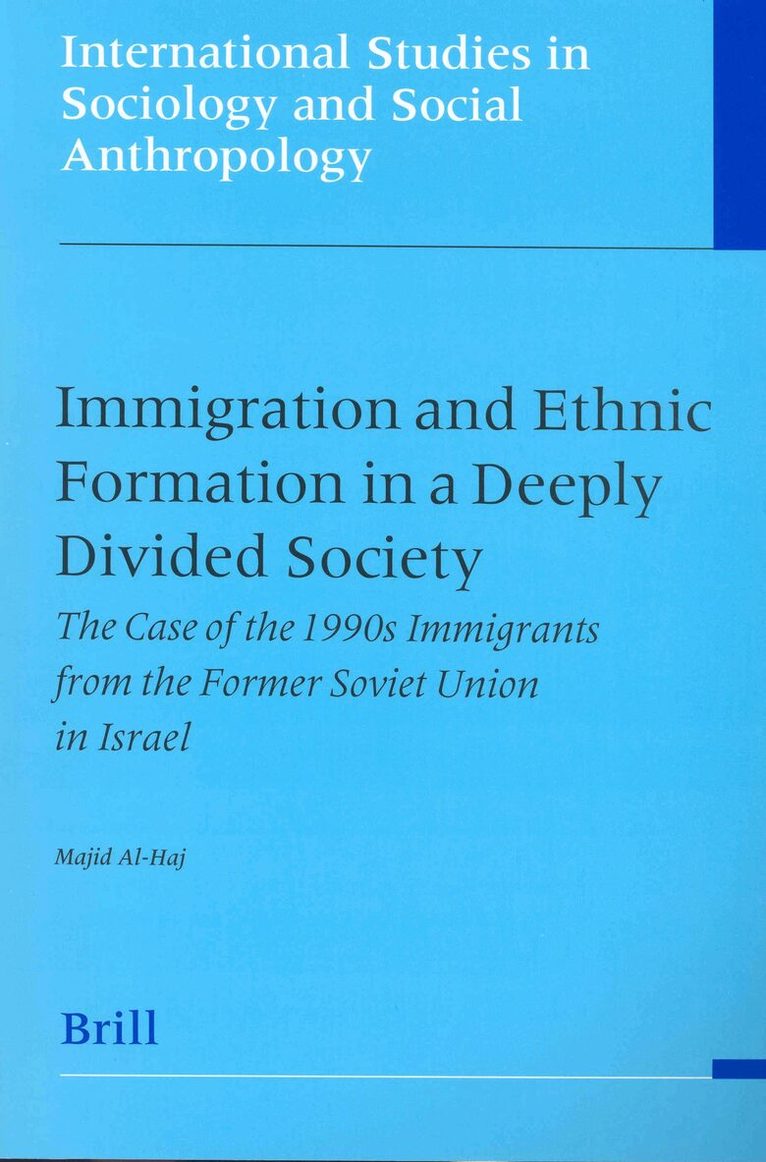
    Immigration and Ethnic Formation in a Deeply Divided Society

    The Case of the 1990s Immigrants from the Former Soviet Union in Israel

    AvMajid Al-Haj

    Häftad, Engelska, 2003

    Del 91 i serien International Studies in Sociology and Social Anthropology

    1 126 kr

    Beställningsvara. Skickas inom 5-8 vardagar. Fri frakt över 249 kr.

    Beskrivning

    This book deals with the ethnic formation among the 1990s immigrants from the former Soviet Union in Israel, in light of both domestic changes, and developments in the Israel- Arab conflict. Based on a broad variety of quantitative and qualitative methods, the book presents a detailed analysis of identity patterns among these immigrants, their orientation in matters of religion, society, culture and politics, and their relationships with all the constituent groups in Israeli society – including the Palestinian minority. The book provides a new critical perspective on questions of immigration, ethnicity and society in Israel. The analysis is placed in a global theoretical context that challenges the dominant approach in the sociology of immigration in Israel, which is based on the Zionist paradigm.

    Produktinformation

    • Utgivningsdatum:2003-11-20
    • Mått:160 x 240 x 15 mm
    • Vikt:453 g
    • Format:Häftad
    • Språk:Engelska
    • Serie:International Studies in Sociology and Social Anthropology
    • Antal sidor:246
    • Förlag:Brill
    • ISBN:9789004136250

    Utforska kategorier

    • Migration inom Samhälle och politik
    • Antropologi inom Samhälle och politik

    Mer om författaren

    Majid Al-Haj, Ph.D. (1984) in Sociology, The Hebrew University of Jerusalem, is Professor of Sociology and the Head of the Center for Multiculturalism at the University of Haifa. He has published extensively on demography, ethnicity and education including Education, Empowerment and Control: The Case of the Arabs in Israel (SUNY, 1995).

    Innehållsförteckning

    • Introduction. Immigrants from the Former Soviet Union in IsraelMethodologyImmigrants’ SurveySurvey of the General PopulationStudents’ SurveyFocus GroupsChapter 1. Theoretical FrameworkDefinitions of “Ethnic Group”Immigration and Ethnic FormationEthnic MobilizationThe Reactive PerspectiveThe Competitive Model of Ethnic MobilizationCriticism of the Reactive and Competitive ApproachesRational Choice Theory The Role of the StateChapter 2. Israeli Society: A BackgroundImmigration and the Construction of Social BoundariesUnique vs. Typical ImmigrationAn Ideological Value or a Means to Achieve Political GoalsImmigration and Ethnic Formation in IsraelBackground of Jewish EthnicityEthnic Composition over TimeEthnicity as a Socio-Cultural RiftThe Modernization-Establishment ApproachThe Melting Pot IdeologyCounter-approaches to Ethnic RelationsEthnic mobilizationEthnicity and the Religious-Nonreligious DivideThe Jewish-Arab DivideBackgroundPolicy toward the Palestinians in IsraelSocial ChangeEconomic DeterritorializationPolitical TerritorializationMulticulturalism vs. Tribalism in Israeli SocietyChapter 3. The Jews of Russia and the Former Soviet Union: Background andWaves of ImmigrationEmigration by Russian/Soviet/FSU JewsThe First Waves to PalestineImmigrants from the Soviet Union in the 1970sEthiopia: A New Reservoir of ImmigrantsAspirations for Aliya from the WestThe 1990s WaveMain TrendsDifferences between the 1970s and the 1990s WavesChapter 4. Identity Patterns and Ethnic FormationCommunal Ethnic OrganizationsSources of Information, Russian-Language MediaMotivation for Migration and Connection with the Home CountrySelf-IdentificationNon-Jewish immigrantsThe Other – Definition: How Veteran Israelis Perceive the ImmigrantsChapter 5. Attitudes toward Civil Society and Freedom of ExpressionCharacter of IsraelAttitudes toward PeaceFreedom of ExpressionCommunication EnvironmentsPermissivenessThe Ranking of RightsChapter 6. Political OrganizationVoting Patterns in the Knesset ElectionsCollective vs. Individual Factors behind the Voting PatternsFactors behind the Voting for Prime MinisterThe Elections of 2003Local ElectionsChapter 7. Immigrants versus Israeli SocietyAdjustment PatternsResidential AdjustmentEconomic AdjustmentSocial AdjustmentMutual InfluenceImmigrants’ Social Distance from Other Groups in IsraelSocial Distance from ArabsSocial Distance from other Jewish GroupsChapter 8. Attitudes of Veteran Groups toward ImmigrantsAttitudes in the Early 1990sJewish LeadershipJewish PublicThe Arab LeadershipArab PublicTrends over Time: A Decade laterInternal Divisions within Jewish PopulationsTolerance of Separate Immigrant OrganizationsSocial Distance The Attitudes of the Younger GenerationSocial Distance as Felt by the Younger Generation Concluding RemarksReferencesList of tablesList of Figures