• Fri frakt över 249 kr
  • •
  • Snabba leveranser
  • •
  • Billiga böcker
Kundservice

Du är på sajten för privatpersoner.

Företag, bibliotek eller offentlig verksamhet?

Du handlar på classic.bokus.com, där alla dina funktioner finns intakta.
Till classic.bokus.com
Bokus logotyp. Gå till startsidan.
  • Erbjudanden
  • Nyheter
  • Student
  • Topplistor
  • Barn & ungdom
  • Bokus Play
  • E-böcker
  • Pocketböcker
  • Spel & pussel

10% studentrabatt med kod TERM26

Sidfot

Mina sidor

    Hjälp

    • Kundservice
    • Vanliga frågor och svar
    • Frakt och leverans
    • Retur vid ångerrätt
    • Reklamera vara
    • Betalning
    • Köpvillkor
    • Allmänna villkor
    • Information om webbplatsens tillgänglighet

    Om Bokus

    • Om oss
    • Pressrum
    • För studenter
    • För företag
    • För bibliotek och offentlig verksamhet
    • För leverantörer
    • Hållbarhet

    Populärt

    • Aktuella erbjudanden
    • Presentkort
    • Studentlitteratur
    • Nya böcker
    • Topplistor
    • Signerade böcker
    • Engelska böcker

    Inspiration

    • Boktips
    • BookTok
    • Populära bokserier
    • Barnbokskaraktärer
    • Populära författare
    Logotyp för Bokus
    Följ oss på Facebook (extern länk)Följ oss på Instagram (extern länk)Följ oss på YouTube (extern länk)Följ oss på TikTok (extern länk)
    bokus @ CookiesAnpassa cookiesIntegritetspolicyKöpvillkor
    Till Citymail hemsida (extern länk)Till Budbee hemsida (extern länk)Till Postnord hemsida (extern länk)Till Schenker hemsida (extern länk)Till Early Bird hemsida (extern länk)Till Walleys hemsida (extern länk)
    1. Filosofi och religion
    2. Filosofi
    3. Filosofiska discipliner

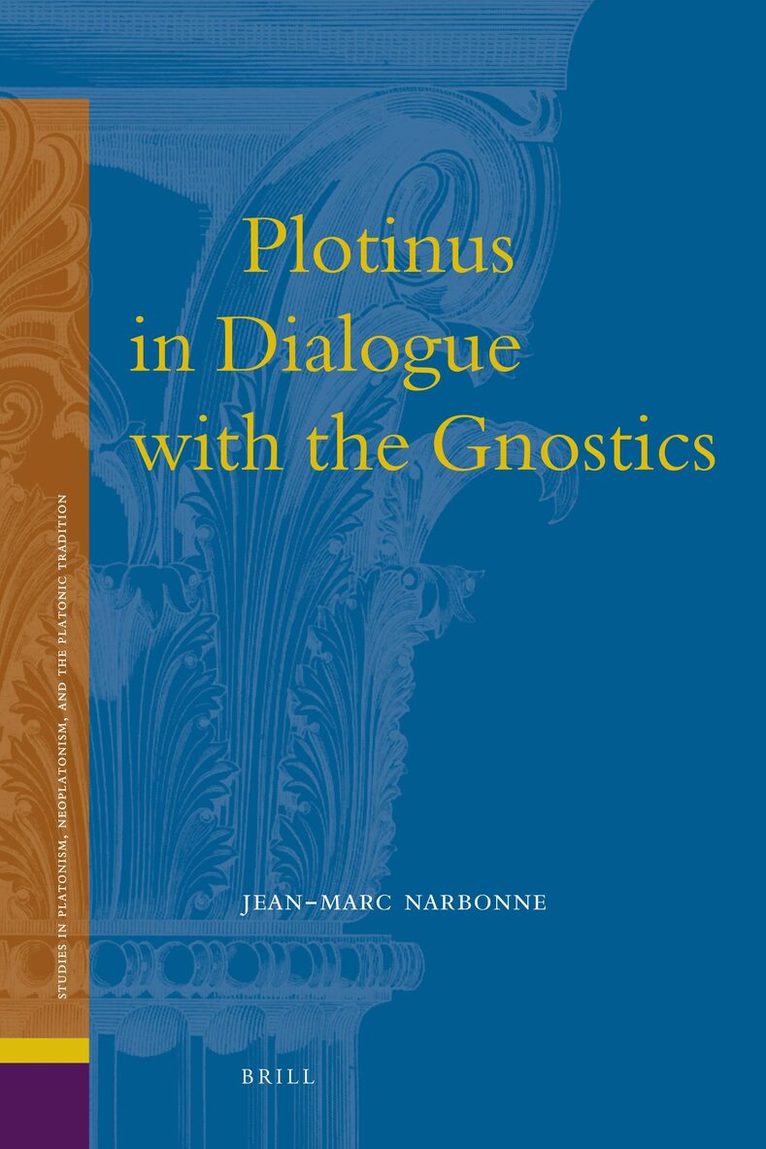
    Plotinus in Dialogue with the Gnostics

    AvJean-Marc Narbonne

    Inbunden, Engelska, 2011

    Del 11 i serien Studies in Platonism, Neoplatonism, and the Platonic Tradition

    1 989 kr

    Beställningsvara. Skickas inom 5-8 vardagar. Fri frakt över 249 kr.

    Beskrivning

    The point of view put forth in the following pages differs greatly from the common perspective according to which the treatises 30 to 33 constitute a single work, a Großschrift, and this single work, Plotinus’ essential response to the Gnostics. Our perspective is that of an ongoing discussions with his “Gnostic”—yet Platonizing—friends, which started early in his writings (at least treatise 6), developed into what we could call a Großzyklus (treatises 27 to 39), and went on in later treatises as well (e. g. 47-48, 51). The prospect of an ongoing discussion with the Gnostics bears an additional virtue, that of allowing for a truly dynamic understanding of the Plotinian corpus.

    Produktinformation

    • Utgivningsdatum:2011-03-18
    • Mått:155 x 235 x 14 mm
    • Vikt:399 g
    • Format:Inbunden
    • Språk:Engelska, Klassisk grekiska
    • Serie:Studies in Platonism, Neoplatonism, and the Platonic Tradition
    • Antal sidor:152
    • Förlag:Brill
    • ISBN:9789004203266

    Utforska kategorier

    • Filosofiska discipliner inom Filosofi och religion
    • Religion: allmänt inom Filosofi och religion

    Mer om författaren

    Jean-Marc Narbonne, Ph.D. (1988) in Philosophy at the Sorbonne, is Professor of Philosophy at Laval University (Quebec). He has published extensively on the Neoplatonic tradition, including Levinas and the Greek Heritage (2006); Hénologie, ontologie et Ereignis: Plotin – Proclus – Heidegger (2001); and La métaphysique de Plotin (2001).

    Innehållsförteckning

    • INTRODUCTION STUDY 1 THE CONTROVERSY OVER THE GENERATION OF MATTER IN PLOTINUS: THE RIDDLE RESOLVED? Part I: Plotinus and the Gnostics on the Generation of Matter (33 [II 9], 12 and 51 [I 8], 14) Part II: The Generation of Matter in Plotinus’ System 1. Sources 2. The exegetic context 2.1 The historical dimension 2.2 The doctrinal dimension 3. The double originality of Plotinus STUDY 2 THE RIDDLE OF THE PARTLY UNDESCENDEND SOUL IN PLOTINUS: THE GNOSTIC/HERMETIC LEAD OF THE OΜΟΟUΣΙΟΣ I. The Term ὁμοούςιοσ II. “And, if one ought to dare to express one’s own view more clearly, contradicting the opinion of others *...+” (Καὶ εἰ χρὴ παρὰ δόξαν τῶν ἄλλῶν τολμῆςαι τὸ φαινόμενον λέγειν ςαφέςτερον *...+)” III. The unification with the divine: the Gnostic variant and its Plotinian counterpart IV. Treatise 6 (IV 8): Plotinus’ first anti-Gnostic manifest? STUDY 3A DOCTRINAL EVOLUTION IN PLOTINUS? THE WEAKNESS OF THE SOUL IN ITS RELATION TO EVIL Sensible matter, by-product of the emanative process The proper task and accomplishment of treatise 51 STUDY 4 A NEW SIGN OF THE IMPACT OF THE QUARREL AGAINST THE GNOSTICS ON PLOTINUS’ THOUGHT: TWO MODES OF REASCENT IN 9 (VI 9) AND 37 (VI 8) I. Μόνου πρὸσ μόνον, or the solitary ascension of the soul in 9 (VI 9) II. The accompanied ascent of the soul, buoyed by the stream of Intellect in 38 (VI 7), 36 III. The Plotinian critique of the soul’s ascent according to the Gnosics III.1 The Gnostic’s privileged status in the face of other men III.2 The Gnostic’s privileged status in the face of other divinities III.3 The privileged status of the Gnostic before the Intellect IV. The ascent of the soul with the Intellect in 38 (VI 7), 36: a radical or a relative novelty? STUDY 5 A NEW TYPE OF CAUSALITY: PLOTINIAN CONTEMPLATIVE DEMIURGY An invention of contemplation? STUDY 6 NEW REFLECTIONS ON GOD AS CAUSA SUI IN PLOTINUS AND ITS POSSIBLE GNOSTIC SOURCES