• Fri frakt över 249 kr
  • •
  • Snabba leveranser
  • •
  • Billiga böcker
Kundservice

Du är på sajten för privatpersoner.

Företag, bibliotek eller offentlig verksamhet?

Du handlar på classic.bokus.com, där alla dina funktioner finns intakta.
Till classic.bokus.com
Bokus logotyp. Gå till startsidan.
  • Erbjudanden
  • Nyheter
  • Student
  • Topplistor
  • Barn & ungdom
  • Bokus Play
  • E-böcker
  • Pocketböcker
  • Spel & pussel

10% rabatt på allt med kod: NYSTART10 →

Sidfot

Mina sidor

    Hjälp

    • Kundservice
    • Vanliga frågor och svar
    • Frakt och leverans
    • Retur vid ångerrätt
    • Reklamera vara
    • Betalning
    • Köpvillkor
    • Allmänna villkor
    • Information om webbplatsens tillgänglighet

    Om Bokus

    • Om oss
    • Pressrum
    • För studenter
    • För företag
    • För bibliotek och offentlig verksamhet
    • För leverantörer
    • Hållbarhet

    Populärt

    • Aktuella erbjudanden
    • Presentkort
    • Studentlitteratur
    • Nya böcker
    • Topplistor
    • Signerade böcker
    • Engelska böcker

    Inspiration

    • Boktips
    • BookTok
    • Populära bokserier
    • Barnbokskaraktärer
    • Populära författare
    Logotyp för Bokus
    Följ oss på Facebook (extern länk)Följ oss på Instagram (extern länk)Följ oss på YouTube (extern länk)Följ oss på TikTok (extern länk)
    bokus @ CookiesAnpassa cookiesIntegritetspolicyKöpvillkor
    Till Citymail hemsida (extern länk)Till Budbee hemsida (extern länk)Till Postnord hemsida (extern länk)Till Schenker hemsida (extern länk)Till Early Bird hemsida (extern länk)Till Walleys hemsida (extern länk)
    1. Juridik
    2. Internationell rätt
    3. Folkrätt

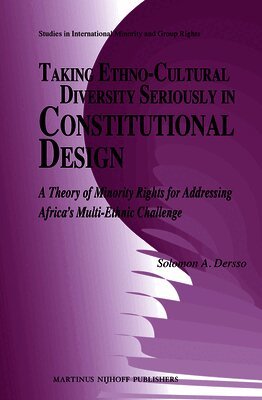
    Taking Ethno-Cultural Diversity Seriously in Constitutional Design

    A Theory of Minority Rights for Addressing Africa's Multi-ethnic Challenge

    AvSolomon A. Dersso

    Inbunden, Engelska, 2012

    Del 4 i serien Studies in International Minority and Group Rights

    2 406 kr

    Beställningsvara. Skickas inom 5-8 vardagar. Fri frakt över 249 kr.

    Beskrivning

    Despite decades of nation-building exercise, ethnic-based claims for substantive equality, justice and equitable political inclusion and socio-economic order continue to result in communal rivalries. These are claims that define and represent the issue of minorities in Africa, of which these conflicts are manifestations. Although ethnic conflicts in Africa have been a subject of a large number of studies, the potential and role of norms on minority rights to address claims that ethno-cultural groups raise has not received the attention it deserves. Based on materials from normative political theory and international human rights law and using an empirical and prescriptive analysis, this book defends a robust system of minority rights built around culture, equality and self-determination. This is employed to elaborate an adequate constitutional design providing policy frameworks (multilingual language policy, recognition and affirmation of cultural diversity,), structures (that ensure just representation and participation of members of all groups) and norms (that guarantee substantive equality and the rights to language, religion and culture). The study then proffers two cases studies (South Africa and Ethiopia) to ascertain how such constitutional design might be translated into actual policy frameworks, institutions and norms.

    Produktinformation

    • Utgivningsdatum:2012-11-08
    • Mått:155 x 235 x 18 mm
    • Vikt:1 260 g
    • Format:Inbunden
    • Språk:Engelska
    • Serie:Studies in International Minority and Group Rights
    • Antal sidor:268
    • Förlag:Brill
    • ISBN:9789004205352

    Utforska kategorier

    • Folkrätt inom Juridik
    • Författningsrätt och förvaltningsrätt inom Juridik

    Mer om författaren

    Solomon A. Dersso, Ph.D. (2009) in Constitutional and International Human Rights Law, is a senior researcher at the Institute for Security Studies and non-faculty Assistant Professor of Human Rights at the Institute of Human Rights, Addis Ababa University.

    Recensioner i media

    "This work relies on a multitude of sources, both in law and in social sciences, but remains critical in respect of them, contrasting them against each other and developing his own line of argument… It makes a significant contribution in respect of legal analysis of minority rights and minority issues in Africa."Martin Scheinin, Professor of Public International Law, European University Institute "The author very competently was able to formulate, discuss, sustain and counter arguments dealing with issues of the marginalized in state formation and political governance. He canvassed the predominant principles of the law of minority rights and was able to critique them relative to his research theme. He demonstrated comprehensive comparative ability in dealing with the various normative arrangements across Africa on minority protection and inclusion in state governance. His case studies of South Africa and Ethiopia, bears this out, as he adequately demonstrated the comparative characteristics of the minority question in each of the states."Vincent O. Nmehielle, Professor of Law, University of the Witwatersrand "The issue of the lack of scholarly analysis of problems of nation-building and state formation through the analytical grid of minority rights is an important one bearing implications for peace, security, human rights and constitutional governance… The Ethiopian case study was particularly interesting to read and would be material usefully disseminated to minority and constitutional law scholars in general." Li-aan Thio, Professor of Law, National University of Singapore

    Innehållsförteckning

    • Acknowledgement; Chapter I – Introduction1.1. Background and Objectives of the Study; 1.2. The Concept of Minorities; 1.3. The Framework of Minority Rights Defended in this Study ; 1.4. The Implications of a Minority Rights Framework for Democratisation in Africa; 1.5. Methodology of the Study; 1.6. Outline of Chapters ; Chapter II – The Issue of Minorities in Africa: Describing its Context and Understanding its Nature2.1. Introduction; 2.2. The Nature and Genesis of Ethno-Cultural Diversity in Africa; 2.3. Various Categories of Minorities and the Nature of their Claims; 2.4. Conclusion; Chapter III – The Issue of Minorities in the Political and Constitutional Discourse and Practice of Post-colonial Africa3.1. Introduction; 3.2. The Imperative of Nation-Building; 3.3. The Influence of the Dominant Constitutional Paradigm of the Nation-State; 3.4. The ‘Second African Independence’ and the Neglect of the Issue of Minorities; 3.5. Conclusion; Chapter IV – The Normative Bases for Constitutional Accommodation of Ethno-Cultural Diversity in Africa: The Three Components of the Minority Rights Framework4.1. Introduction; 4.2. Cultural Identity; 4.3. Equality; 4.4. Self-Determination; 4.5. Conclusion Chapter V – Towards a Multicultural Constitutional Framework: The Institutional Dimensions of the Minority Rights Framework5.1. Introduction; 5.2. Self-Government and/or Territorial Autonomy; 5.3. Institutionalising Effective Representation and Participation of Minorities; 5.4. Language and Cultural Policies, and Guarantees for Cultural, Religious and Linguistic Rights; 5.5. Socio-economic Guarantees, Including Positive Measures; 5.6. The Nature and Limits of Minority Rights and the Principles Regulating Them; 5.7. Conclusion Chapter VI – South Africa’s Constitutional Design for the Accommodation of Diversity6.1. Introduction; 6.2. The Context: The Nature of Minority Issues in South Africa; 6.3. Indirect Accommodation in the Political Processes and the Structures of the State; 6.4. Language Policy and the Accommodation of Linguistic Diversity; 6.5. Rights of Religious and Cultural Communities; 6.6. The CRCRLC; 6.7. Equality beyond Recognition of Difference: Socio-Economic Guarantees, including Positive Measures; 6.8. Conclusion Chapter VII – The Case of Ethiopia’s Ethnic Federalism; 7.1. Introduction; 7.2. Federalism as the Only Viable Option; 7.3. Representation and Participation; 7.4. Language and Culture; 7.5. Equality Beyond Recognition of Difference: Socio-economic Guarantees, Including Positive Measures; 7.6. Assessment of the Constitutional Design; 7.7. Conclusion ; Chapter VIII – Conclusion, Findings and Final Observations8.1. Introduction; 8.2. The Core Arguments and Findings of the Study; 8.3. Overall Conclusions and Final Observations; Bibliography; Index.