• Fri frakt över 249 kr
  • •
  • Snabba leveranser
  • •
  • Billiga böcker
Kundservice

Du är på sajten för privatpersoner.

Företag, bibliotek eller offentlig verksamhet?

Du handlar på classic.bokus.com, där alla dina funktioner finns intakta.
Till classic.bokus.com
Bokus logotyp. Gå till startsidan.
  • Erbjudanden
  • Nyheter
  • Student
  • Topplistor
  • Barn & ungdom
  • Bokus Play
  • E-böcker
  • Pocketböcker
  • Spel & pussel

10% studentrabatt med kod TERM26

Sidfot

Mina sidor

    Hjälp

    • Kundservice
    • Vanliga frågor och svar
    • Frakt och leverans
    • Retur vid ångerrätt
    • Reklamera vara
    • Betalning
    • Köpvillkor
    • Allmänna villkor
    • Information om webbplatsens tillgänglighet

    Om Bokus

    • Om oss
    • Pressrum
    • För studenter
    • För företag
    • För bibliotek och offentlig verksamhet
    • För leverantörer
    • Hållbarhet

    Populärt

    • Aktuella erbjudanden
    • Presentkort
    • Studentlitteratur
    • Nya böcker
    • Topplistor
    • Signerade böcker
    • Engelska böcker

    Inspiration

    • Boktips
    • BookTok
    • Populära bokserier
    • Barnbokskaraktärer
    • Populära författare
    Logotyp för Bokus
    Följ oss på Facebook (extern länk)Följ oss på Instagram (extern länk)Följ oss på YouTube (extern länk)Följ oss på TikTok (extern länk)
    bokus @ CookiesAnpassa cookiesIntegritetspolicyKöpvillkor
    Till Citymail hemsida (extern länk)Till Budbee hemsida (extern länk)Till Postnord hemsida (extern länk)Till Schenker hemsida (extern länk)Till Early Bird hemsida (extern länk)Till Walleys hemsida (extern länk)
    1. Juridik
    2. Internationell rätt

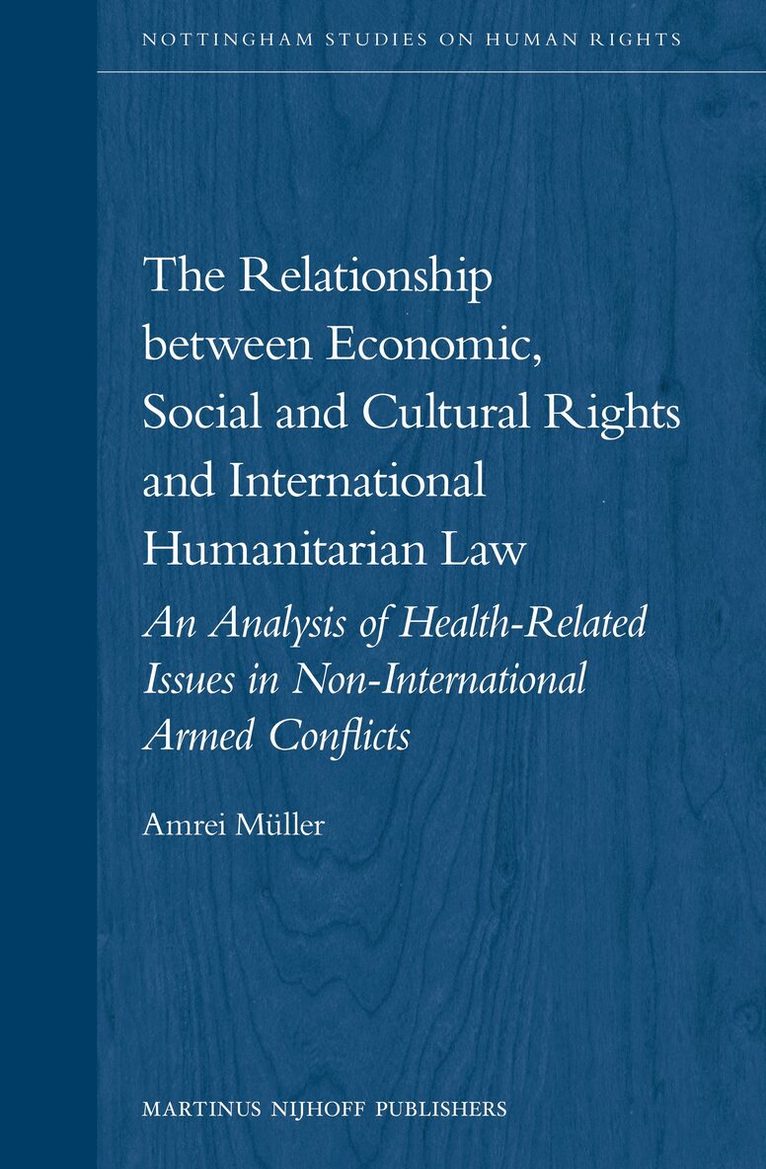
    Relationship between Economic, Social and Cultural Rights and International Humanitarian Law

    An Analysis of Health Related Issues in Non-international Armed Conflicts

    AvAmrei Müller

    Inbunden, Engelska, 2013

    Del 2 i serien Nottingham Studies on Human Rights

    2 626 kr

    Beställningsvara. Skickas inom 5-8 vardagar. Fri frakt över 249 kr.

    Beskrivning

    In The Relationship between Economic, Social and Cultural Rights and International Humanitarian Law, Amrei Müller offers a detailed analysis of the legal consequences of the parallel application of economic, social and cultural (ESC) rights and international humanitarian law (IHL) to non-international armed conflicts. With a focus on health related issues, the book covers important topics like the scope of limitations to and derogations from ESC rights, questions related to the integration of the right to health in military-target decisions, states’ obligations to mitigate the adverse public health impact of armed conflicts and obligations relating to the provision of humanitarian assistance. It moves the discussion about the parallel application of IHL and human rights to a new level, highlighting its potential to enhance the protection of people affected by armed conflicts but also the difficulties involved.

    Produktinformation

    • Utgivningsdatum:2013-04-17
    • Mått:155 x 235 x 26 mm
    • Vikt:665 g
    • Format:Inbunden
    • Språk:Engelska
    • Serie:Nottingham Studies on Human Rights
    • Antal sidor:336
    • Förlag:Brill
    • ISBN:9789004245273

    Utforska kategorier

    • Internationell rätt inom Juridik
    • Folkrätt inom Juridik

    Mer om författaren

    Amrei Müller, PhD (2011), University of Nottingham, is currently a post-doctoral fellow at the University of Oslo, department of public and International law. She has published on economic, social and cultural rights and the law of the European Convention on Human Rights

    Innehållsförteckning

    • Abstract; Acknowledgements;Table of Contents; Table of Abbreviations; Table of International Instruments; Table of Judgments and Decisions; CHAPTER I: Introduction1.Context and scope of the study;2.Methodology;3.Structure;CHAPTER II: The Development of the Relationship between IHL and IHRL and the Lex Specialis Maxim 1.Introduction;2.A brief overview of the development of the relationship between IHL and IHRL; 3.The function of the lex specialis maxim regulating the relationship between IHL and IHRL; 4.Concluding Remarks; CHAPTER III: International Humanitarian Law Applicable to Non-international Armed Conflicts1.Introduction; 2.A brief Introduction to the Development of IHL Applicable to Non-international Armed Conflict; 3.The scope of application of IHL of non-international armed conflicts; 4.Purpose, limits and principles of IHL applicable to non-international armed conflicts; 5.Concluding remarks; CHAPTER IV: Economic, Social and Cultural Rights and the Notion of Progressive Realisation1.Introduction; 2.Art.2(1) ICESCR: State obligations to progressively realise ESC rights; 3.States’ three-fold obligations to respect, protect and fulfil economic, social and cultural rights; 4.The minimum core approach: minimum core obligations and non-core obligations; 5.The TripleAQ-framework: Availability, accessibility, acceptability and quality; 6.Concluding remarks; CHAPTER V: Limitations to and Derogations from Economic, Social and Cultural Rights1.Introduction; 2.Limitations to economic, social and cultural rights; 3.Derogations from the ICESCR; 4.Concluding remarks; CHAPTER VI: Situations of Active Combat: Integrating the Right to Health in Military-Target Decisions1.Introduction; 2.‘Dual-use’ objects qualifying as military objectives in IHL and the right to health; 3.The function of the lex specialis maxim in situations of active combat;4.Integrating the right to health in IHL military-target decisions: the definition of a ‘military objective’5.Integrating the right to health in IHL military-target decisions: the principle of proportionality1196.Concluding remarks;CHAPTER VII: IHL and the Right to Health: Mitigating the Adverse Public Health Impact of Armed Conflicts1.Introduction;2.The lex specialis maxim – supporting complementarity; 3.The right to health, IHL and the diversion of resources from health care to military spending;4.The protection of the wounded and sick and the possible scope of health services to be provided in NIACs;5.Medical personnel, medical facilities and medical transports;6.Concluding remarks;CHAPTER VIII: Humanitarian Assistance 1.Introduction;2.Obligations to request and accept humanitarian assistance;3.Obligations to facilitate the work of humanitarian organisations and the right to control;4.Concluding remarks;CHAPTER IX: Concluding Remarks1.The function of the lex specialis maxim and recent developments in IHL of NIACs and in the doctrinal debate about ESC rights;2.The relationship of IHL and ESC rights: structured by a context-sensitive lex specialis maxim;3.Non-state armed groups and the parallel application of IHL and the ICESCR;4.Towards the operationalisation of this study’s findings;Literature; UN Documents; Other Documents/Reports; index.