• Fri frakt över 249 kr
  • •
  • Snabba leveranser
  • •
  • Billiga böcker
Kundservice

Du är på sajten för privatpersoner.

Företag, bibliotek eller offentlig verksamhet?

Du handlar på classic.bokus.com, där alla dina funktioner finns intakta.
Till classic.bokus.com
Bokus logotyp. Gå till startsidan.
  • Erbjudanden
  • Student
  • Topplistor
  • Barn & ungdom
  • Bokus Play
  • E-böcker
  • Ljudböcker
  • Pocketböcker
  • Spel och pussel

Pocketfynda! Hundratals böcker för 49 kr/st →

Sidfot

Mina sidor

    Hjälp

    • Kundservice
    • Vanliga frågor och svar
    • Frakt och leverans
    • Retur vid ångerrätt
    • Reklamera vara
    • Betalning
    • Köpvillkor
    • Allmänna villkor
    • Information om webbplatsens tillgänglighet

    Om Bokus

    • Om oss
    • Pressrum
    • För studenter
    • För företag
    • För bibliotek och offentlig verksamhet
    • För leverantörer
    • Hållbarhet

    Populärt

    • Aktuella erbjudanden
    • Presentkort
    • Studentlitteratur
    • Nya böcker
    • Topplistor
    • Signerade böcker
    • Engelska böcker

    Inspiration

    • Boktips
    • BookTok
    • Barnbokskaraktärer
    • Populära författare
    Logotyp för Bokus
    Följ oss på Facebook (extern länk)Följ oss på Instagram (extern länk)Följ oss på YouTube (extern länk)Följ oss på TikTok (extern länk)
    bokus @ CookiesAnpassa cookiesIntegritetspolicyKöpvillkor
    Till Citymail hemsida (extern länk)Till Budbee hemsida (extern länk)Till Postnord hemsida (extern länk)Till Schenker hemsida (extern länk)Till Early Bird hemsida (extern länk)Till Walleys hemsida (extern länk)
    1. Historia och arkeologi
    2. Historia

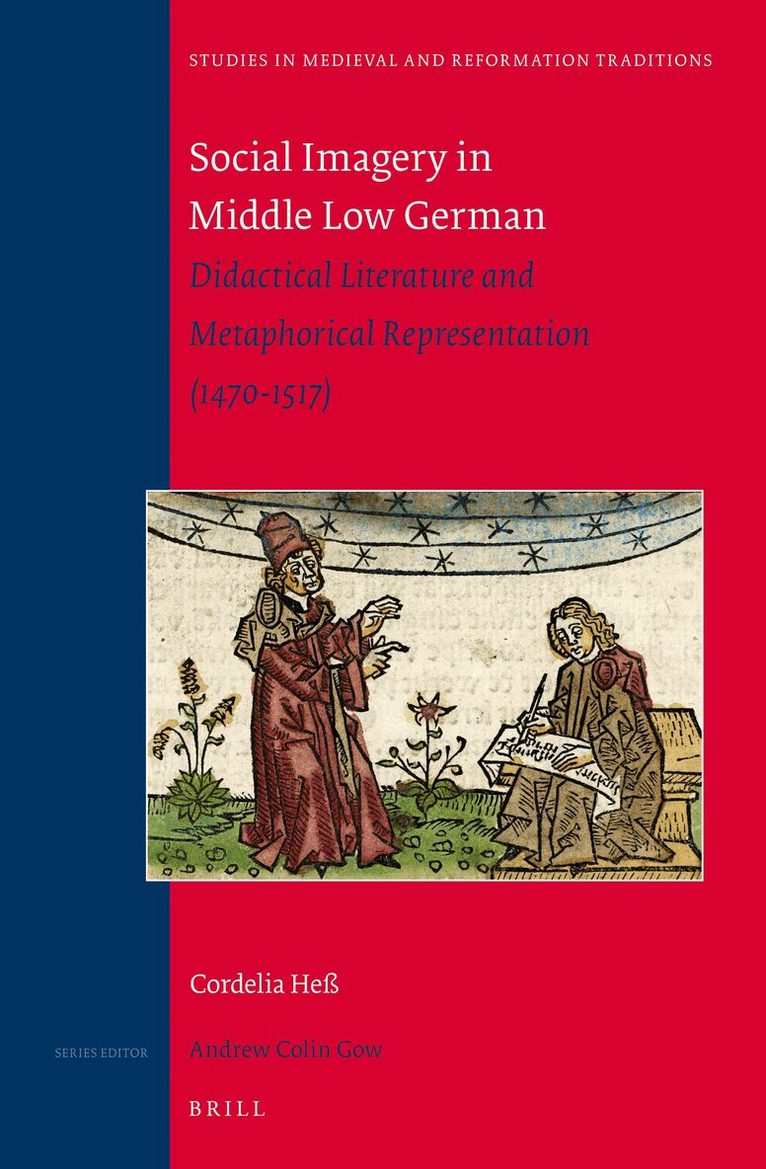
    Social Imagery in Middle Low German

    Didactical Literature and Metaphorical Representation (1470-1517)

    AvCordelia Hess,Cordelia Heß

    Inbunden, Engelska, 2013

    Del 167 i serien Studies in Medieval and Reformation Traditions

    3 233 kr

    Beställningsvara. Skickas inom 5-8 vardagar. Fri frakt över 249 kr.

    Beskrivning

    Social imagery during the Late Middle Ages was typically considered to be dominated by the three orders oratores, bellatores, laboratores as the most common way of describing social order, along with body metaphors and comprehensive lists of professions as known from the Danse macabre tradition. None of these actually dominates within the vast genre of lay didactical literature. This book comprises the first systematic investigation of social imagery from a specific late medieval linguistic context. It methodically catalogues images of the social that were used in a particular cultural/literary sphere, and it separates late medieval efforts at catechization in print from the social and religious ruptures that are conventionally thought to have occurred after 1517. The investigation thus compliments recent scholarship on late medieval vernacular literature in Germany, most of which has concentrated on southern urban centres of production. The author fills a major lacuna in this field by concentrating for the first time on the entire extant corpus of vernacular print production in the northern region dominated by the Hanseatic cities and the Middle Low German dialect.

    Produktinformation

    • Utgivningsdatum:2013-06-20
    • Mått:155 x 235 x 29 mm
    • Vikt:742 g
    • Format:Inbunden
    • Språk:Engelska
    • Serie:Studies in Medieval and Reformation Traditions
    • Antal sidor:404
    • Förlag:Brill
    • ISBN:9789004247758

    Utforska kategorier

    • Historia inom Historia och arkeologi
    • Biblar inom Filosofi och religion

    Mer om författaren

    Cordelia Heß, Dr. phil. (2007) in History, Hamburg University, is a research fellow at the Royal Swedish Academy of Letters, History and Antiquity and affiliated with the Centre for Medieval Studies at Stockholm University. Her research has a focus on the religious and cultural history of the Late Medieval Baltic Sea region.

    Innehållsförteckning

    • AcknowledgementsIntroductionI. A space of its own: Urban literature from Cologne to LübeckI.1 Language and cultural spaceI.2 Print production in Middle Low German 1470–1517I.3 Different discourses: modes of distinctionI.4 Names and metaphors: Establishing authority in different discoursesII. The “real world”: Social groups in normative and legal sourcesIII. Tripartitions and their dissolutionIII.1 The master narrative: Functional and moral tripartitionsIII.2 The terminology of moral tripartitionIV. The Nine Choirs of AngelsV. The Good, the Bad and the Mighty: the division of society into oppositionsV.1 Binomials as social imageryV.2 The Good and the EvilV.3 Man and womanV.4 Husband and wifeV.5 Lords and servantsV.6 Clergy and laityV.7 Christians and JewsV.8 “Ioden unde heyden”V.9 Rich and poor, man and woman, Jew and pagan: the combination of binomialsVI. Revues des étatsVII. The Mystical Body of ChristVIII. Exotics: AllegoriesVIII.1 Technological imagery and personification: the Boek van veleme radeVIII.2 The Chess gameConclusion: A science of (unaccomplished) possibilitiesAbbreviationsBibliographyPrinted sourcesSecondary literatureAppendix: Middle Low German incunabula and early imprints