• Fri frakt över 249 kr
  • •
  • Snabba leveranser
  • •
  • Billiga böcker
Kundservice

Du är på sajten för privatpersoner.

Företag, bibliotek eller offentlig verksamhet?

Du handlar på classic.bokus.com, där alla dina funktioner finns intakta.
Till classic.bokus.com
Bokus logotyp. Gå till startsidan.
  • Erbjudanden
  • Nyheter
  • Student
  • Topplistor
  • Barn & ungdom
  • Bokus Play
  • E-böcker
  • Pocketböcker
  • Spel & pussel

10% rabatt på allt med kod NYSTART10 →

Sidfot

Mina sidor

    Hjälp

    • Kundservice
    • Vanliga frågor och svar
    • Frakt och leverans
    • Retur vid ångerrätt
    • Reklamera vara
    • Betalning
    • Köpvillkor
    • Allmänna villkor
    • Information om webbplatsens tillgänglighet

    Om Bokus

    • Om oss
    • Pressrum
    • För studenter
    • För företag
    • För bibliotek och offentlig verksamhet
    • För leverantörer
    • Hållbarhet

    Populärt

    • Aktuella erbjudanden
    • Presentkort
    • Studentlitteratur
    • Nya böcker
    • Topplistor
    • Signerade böcker
    • Engelska böcker

    Inspiration

    • Boktips
    • BookTok
    • Populära bokserier
    • Barnbokskaraktärer
    • Populära författare
    Logotyp för Bokus
    Följ oss på Facebook (extern länk)Följ oss på Instagram (extern länk)Följ oss på YouTube (extern länk)Följ oss på TikTok (extern länk)
    bokus @ CookiesAnpassa cookiesIntegritetspolicyKöpvillkor
    Till Citymail hemsida (extern länk)Till Budbee hemsida (extern länk)Till Postnord hemsida (extern länk)Till Schenker hemsida (extern länk)Till Early Bird hemsida (extern länk)Till Walleys hemsida (extern länk)
    1. Samhälle och politik
    2. Samhälle och kultur
    3. Kultur och medier
    4. Kulturvetenskap

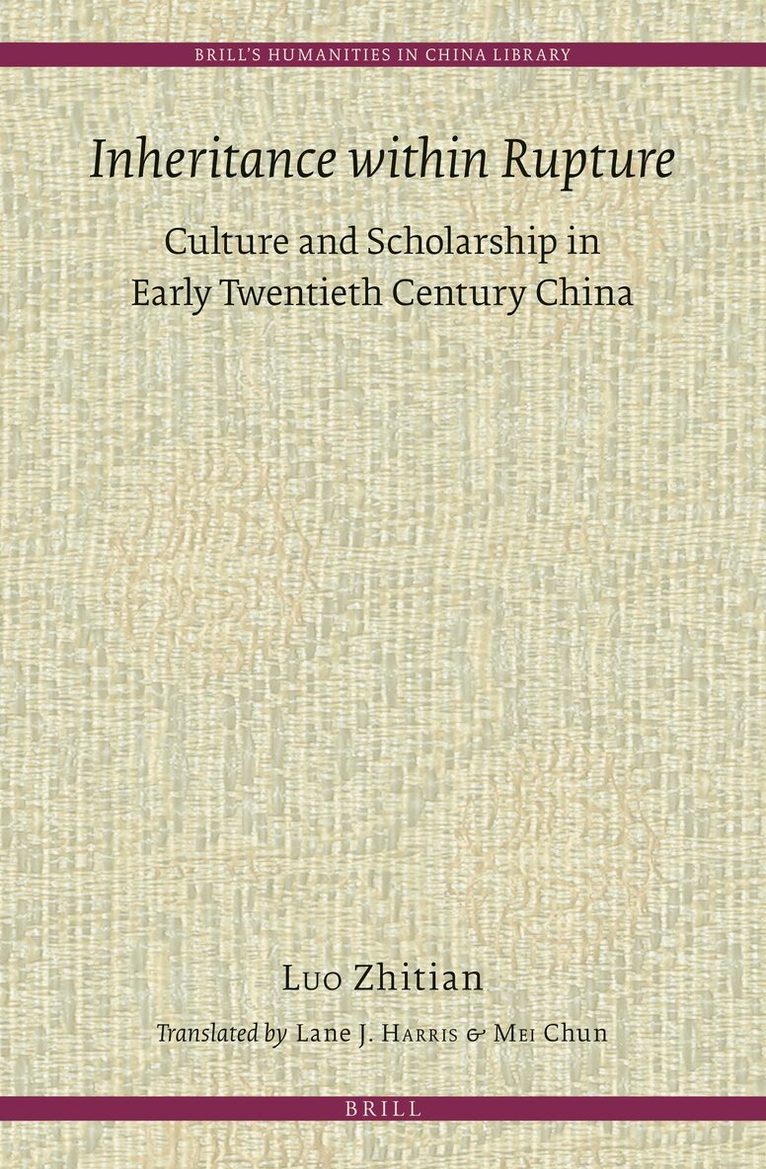
    Inheritance within Rupture

    Culture and Scholarship in Early Twentieth Century China

    AvZhitian Luo

    Inbunden, Engelska, 2015

    Del 7 i serien Brill's Humanities in China Library

    3 559 kr

    Beställningsvara. Skickas inom 5-8 vardagar. Fri frakt över 249 kr.

    Beskrivning

    In Inheritance within Rupture, Luo Zhitian brings together ten essays to explore the themes of change and continuity, rupture and inheritance from the late Qing through the early Republic (1890s-1940s). Rejecting binaries such as tradition/modernity, conservative/liberal, Luo blurs the divisions between intellectual opponents and clarifies the divergences between scholarly friends. Centering these discussions around some of the most famous intellectual debates in the modern period, Luo challenges our understanding of ideological positions, political affiliation, and scholarly identity in early twentieth-century China. By focusing on the influence of cultural inheritance within the rupture of modernity, we come to understand those concerns shared by all Chinese in their own times and in the present.

    Produktinformation

    • Utgivningsdatum:2015-01-30
    • Mått:155 x 235 x 33 mm
    • Vikt:867 g
    • Format:Inbunden
    • Språk:Engelska
    • Serie:Brill's Humanities in China Library
    • Antal sidor:452
    • Förlag:Brill
    • ISBN:9789004247796
    • Översättare:Lane Harris

    Utforska kategorier

    • Kulturvetenskap inom Samhälle och politik

    Mer om författaren

    Luo Zhitian, Ph.D. (1994), Princeton University, is the Distinguished Professor of History at Sichuan University and Professor of History at Peking University. He has published numerous monographs, edited volumes, and scholarly articles on Chinese history, including The Dream of Rebuilding Civilization: A Biography of Hu Shi (People's Publishing House, 1995). Lane J. Harris, Ph.D. (2012), University of Illinois, Urbana-Champaign, is Assistant Professor of History and Asian Studies at Furman University in Greenville, South Carolina. His articles have appeared in the Journal of Asian Studies, Journal of Early Modern History, Frontiers of History in China, and Twentieth-Century China.Mei Chun, Ph.D. (2005), in Chinese and Comparative Literature, Washington University in Saint Louis, is an independent scholar. Her publications include "'Garlic and Vinegar': The Narrative Significance of Verse in 'The Pearl Shirt Reencountered'" in Chinese Literature: Essays, Articles, Reviews and The Novel and Theatrical Imagination in Early Modern China (Brill, 2011).

    Recensioner i media

    "Professor Luo Zhitian's collected volume on the multi-layered bases of modem Chinese intellectual transformations from the post-Boxer Rebellion years to the May Fourth New Culture era, Inheritance within Rupture: Culture and Scholarship in Early Twentieth Century, makes an important contribution to English academia. [...] the translators have made this book readable and intellectually accesible in English."– Nagatomi Hirayama, University of Nottingham Ningbo China, in Frontiers of History in China 12.2 (August 2017)."A masterful as well as a very engaging piece of an important episode in contemporary China. On the one hand, it demonstrates the ways in which Chinese scholars tried to improve China’s cultural status in the world. On the other hand, it is a clear narrative, which makes it a valuable addition to the literature on China’s culture from the late Qing Dynasty through the early Republic era. This book will rightfully be of interest to scholars engaged in scholarly community and ideology in China (1890s-1940s), and it is a worthy addition to the shelf of any individual interested in the evolution of China’s culture and scholarship in China (1890s-1940s)." – Kai Chen, Xiamen University, in African and Asian Studies 17 (2018), p. 189-204.

    Innehållsförteckning

    • Series Editors' ForewordPrefaceHistorical ContinuitiesInheritance in the Anti-Traditional TurnThe Complete Negativization of TraditionAbout this WorkChapter 1. Turning Heterodoxy into Orthodoxy: The Historical Transitions Manifested by the Boxer Incident of 1900Intellectual Competitors and Allies in Social Categorization‘What Confucius Doesn’t Talk About’: The Post-Boxer Shift from Heterodoxy to OrthodoxyChapter 2. Confucianism, Non-Canonical Classical Philosophers, and the Yellow Emperor in National Learning: Late Qing Scholars and the Search for Symbols of National IdentityThe Rise of the Study of Non-Canonical Classical Philosophers and the Struggle with ConfucianismConfucius and the Yellow Emperor: Contending Symbols of National IdentityAn All-Encompassing National LearningChapter 3. The Dream of a Chinese Renaissance: From the Late Qing ‘Revival of Ancient Studies’ to the Republican ‘New Tide’The Revival of Ancient Studies in the Late Qing The Renaissance and Interpreting Qing ScholarshipAdditional ThoughtsChapter 4. Into the Museum: The Removal of ‘the Ancient’ from ‘the Modern’ by Scholars Pursuing ‘the New’ in the Late Qing and Early RepublicIts Origin in the Late QingIts Development in the Early RepublicThe Antiqued ‘Heritage’ and the Real ‘Nation’Chapter 5. Reading and Tradition: The Evolution of an On-Going Concern among Late Qing and Early Republican ScholarsReducing to the Minimum: Preserving Tradition through SimplificationStretching the Concept of ‘Using the New to Preserve the Old’ in the Late QingThe Early Republican Discussion of What Study-Abroad Students Should Read Study Abroad and TraditionChapter 6. Rejuvenating the Old to Better Understand the New: ‘Historical Perspective’ in the Late Qing and Early RepublicPerfecting the Old through Daily RenovationWeeding Through the Old to Bring Forth the New and Rejuvenating the Old to Better Understand the NewChapter 7. Exploring the Historical Relationship between Scholarship and Thought: Late Qing and Early Republican Intellectual Debates on ‘National Learning’Intellectual History and the History of Scholarship Intellectual Debates about National Essence, National Heritage, and National Learning in the Late Qing and Early RepublicChapter 8. ‘Mr. Science’s Turn Towards National Learning and History: An Example of “Science” as Seen by the Chinese Public During the May Fourth Period.‘Science,’ Learning, and Techniques in Modern ChinaHow Did Science Turn towards Reorganizing National Heritage?The Rise of Historical Materialism after the Turn from National Learning to HistoryChapter 9. The Voicelessness of Literature: Reorganizing National Heritage and Evidence-Based Research on LiteratureWas the Vernacular the Mainstream of Chinese Literary History?Europeanization, Classicization, and Popularization: Trends in the Vernacular The Breakthroughs and Inheritances of The New Redology in the Context of the Literary RevolutionWhen Ritual is Lost in the Capital, Seek it in the Country: Modern Expressions of TraditionConcluding RemarksChapter 10. The Rise of Materialism: A Trend in Twentieth-Century Chinese Culture‘Material Essence’ and ‘Cultural Essence’ in Late Qing Intellectual Discourse Visible and Invisible: From the ‘Spiritual’ to the ‘Technological’ in Science Culture is also National Power: The Spread of Utilitarianism in Society and Oppositional EffortsAppendix: List of NamesBibiliography