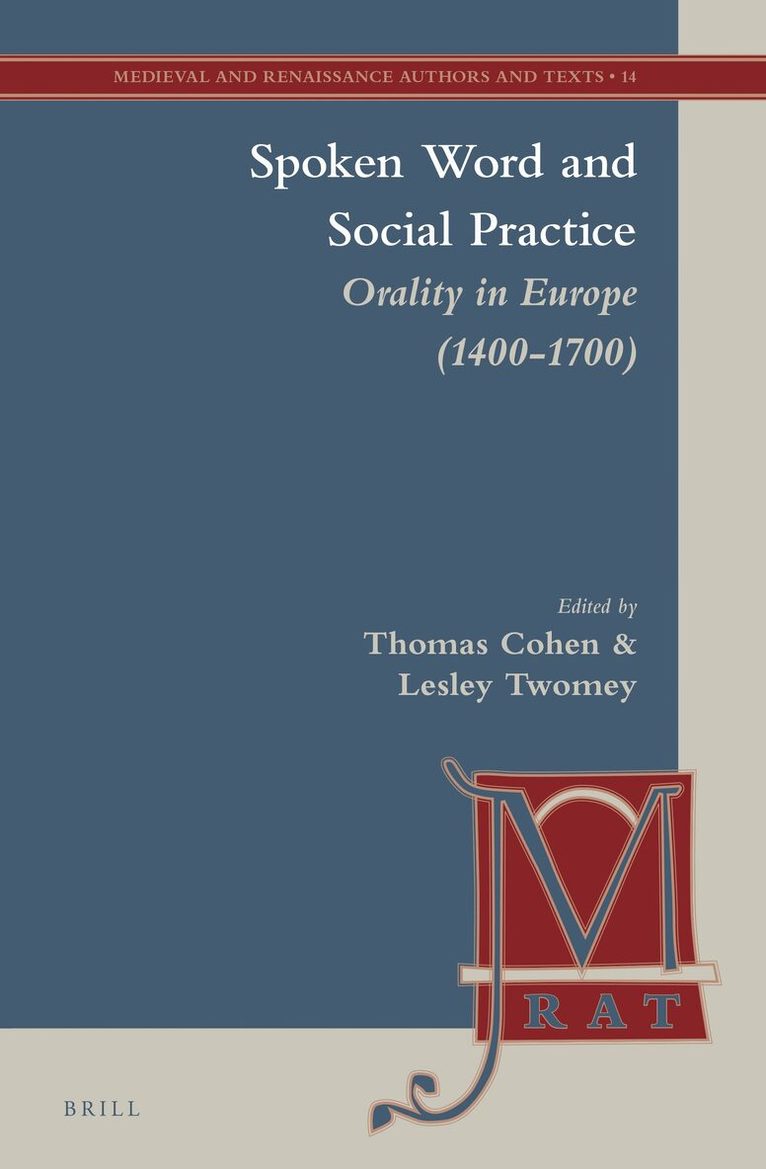
Inbunden, Engelska, 2015
Spoken Word and Social Practice
Orality in Europe (1400-1700)
Del 14 i serien Medieval and Renaissance Authors and Texts
3653 kr
Beställningsvara. Skickas inom 5-8 vardagar. Fri frakt över 249 kr.
Beskrivning
Produktinformation
- Utgivningsdatum: 2015-07-17
- Mått: 155 x 235 x 35 mm
- Vikt: 923 g
- Format: Inbunden
- Språk: Engelska
- Serie: Medieval and Renaissance Authors and Texts
- Antal sidor: 500
- Förlag: Brill
- ISBN: 9789004288683
Utforska kategorier
Mer om författaren
Thomas V. Cohen (Ph.D., 1974, Harvard University), is Professor of History and Humanities at York University in Toronto. He writes microhistories about the cultural and political anthropology of early modern Rome, championing close cultural reading of social documents and the narrative light touch.Lesley Karen Twomey (Ph.D., 1995, Hull University) is Reader in the Department of Arts at Northumbria University. She has published monographs on material culture in religious writing and a study of doctrine in Hispanic poetry and many articles on Isabel de Villena, a fifteenth-century Franciscan woman writer.
Recensioner i media
"This collection of essays successfully recovers and reconstructs a variety of late medieval and early modern oral practices. [...] The essays in this volume provide remarkable insight into late medieval and early modern orality, demonstrating how recovering speech habits also affect larger historical, literary, and cultural discussions. [...] For many who could not read or write, orality provided a form of power as well as a sense of community and belonging. This theme courses throughout many of the essays in this volume, and indeed, is what makes it such a strong and intriguing read for historians and literary scholars alike." Chelsea McKelvey, Southern Methodist University in: Sixteenth Century Journal 48/2 (2017), pp. 505-506."From the first cry at birth to the last words on the deathbed, oral communication is essential to humankind. Spoken words transmit ideas, shape identities, manage power, give pleasure. Obvious, yes, and yet all too easy to forget when interpreting the past through silent writings, images, and objects. Orality, nevertheless, was even more pervading in medieval and early modern times than today, and its interactions with writingmore complex and mutual. Scholars are increasingly aware that recovering this dimension, albeit difficult and uncertain, is potentially revealing—as this book confirms.[...] thanks to the wide scope of its case studies, together with the methodological relevance of some, this collection has undoubtedly something valuable to offer to anyone interested in the study of oral culture and communication as an opportunity to sharpen and even transform our understanding of the Renaissance world." Luca Degl’Innocenti, Università degli Studi di Firenze, in: Renaissance Quarterly, 71/1 (2018), pp. 278-279
Betyg & recensioner
0 recensioner
Inga recensioner tillgängliga.