• Fri frakt över 249 kr
  • •
  • Snabba leveranser
  • •
  • Billiga böcker
Kundservice

Du är på sajten för privatpersoner.

Företag, bibliotek eller offentlig verksamhet?

Du handlar på classic.bokus.com, där alla dina funktioner finns intakta.
Till classic.bokus.com
Bokus logotyp. Gå till startsidan.
  • Erbjudanden
  • Nyheter
  • Student
  • Topplistor
  • Barn & ungdom
  • Bokus Play
  • E-böcker
  • Pocketböcker
  • Spel & pussel

10% rabatt på allt med kod: NYSTART10 →

Sidfot

Mina sidor

    Hjälp

    • Kundservice
    • Vanliga frågor och svar
    • Frakt och leverans
    • Retur vid ångerrätt
    • Reklamera vara
    • Betalning
    • Köpvillkor
    • Allmänna villkor
    • Information om webbplatsens tillgänglighet

    Om Bokus

    • Om oss
    • Pressrum
    • För studenter
    • För företag
    • För bibliotek och offentlig verksamhet
    • För leverantörer
    • Hållbarhet

    Populärt

    • Aktuella erbjudanden
    • Presentkort
    • Studentlitteratur
    • Nya böcker
    • Topplistor
    • Signerade böcker
    • Engelska böcker

    Inspiration

    • Boktips
    • BookTok
    • Populära bokserier
    • Barnbokskaraktärer
    • Populära författare
    Logotyp för Bokus
    Följ oss på Facebook (extern länk)Följ oss på Instagram (extern länk)Följ oss på YouTube (extern länk)Följ oss på TikTok (extern länk)
    bokus @ CookiesAnpassa cookiesIntegritetspolicyKöpvillkor
    Till Citymail hemsida (extern länk)Till Budbee hemsida (extern länk)Till Postnord hemsida (extern länk)Till Schenker hemsida (extern länk)Till Early Bird hemsida (extern länk)Till Walleys hemsida (extern länk)
    1. Juridik
    2. Rättsvetenskap
    3. Rättshistoria

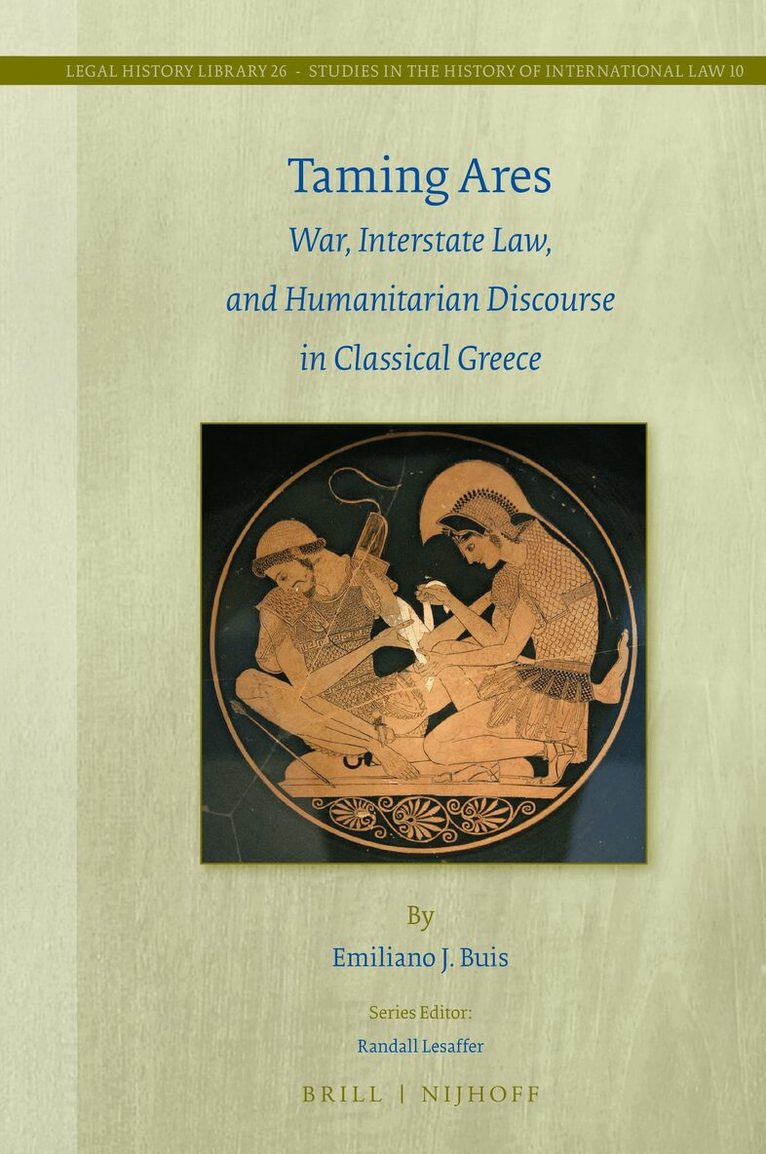
    Taming Ares: War, Interstate Law, and Humanitarian Discourse in Classical Greece

    AvEmiliano J. Buis

    Inbunden, Engelska, 2018

    Del i serien Studies in the History of International Law

    2 615 kr

    Beställningsvara. Skickas inom 5-8 vardagar. Fri frakt över 249 kr.

    Beskrivning

    In Taming Ares Emiliano J. Buis examines the sources of classical Greece to challenge both the state-centeredness of mainstream international legal history and the omnipresence of war and excessive violence in ancient times. Making ample use of epigraphic as well as literary, rhetorical, and historiographical sources, the book offers the first widespread account of the narrative foundations of the (il)legality of warfare in the classical Hellenic world. In a clear yet sophisticated manner, Buis convincingly proves that the traditionally neglected study of the performance of ancient Greek poleis can contribute to a better historical understanding of those principles of international law underlying the practices and applicable rules on the use of force and the conduct of hostilities.

    Produktinformation

    • Utgivningsdatum:2018-05-09
    • Mått:155 x 235 x 25 mm
    • Vikt:654 g
    • Format:Inbunden
    • Språk:Engelska
    • Serie:Studies in the History of International Law
    • Antal sidor:312
    • Förlag:Brill
    • ISBN:9789004359734

    Utforska kategorier

    • Rättshistoria inom Juridik
    • Forntidens historia inom Historia och arkeologi
    • Folkrätt inom Juridik

    Mer om författaren

    Emiliano Jerónimo Buis, PhD in Classics and Postdoctoral Degree in Law (Universidad de Buenos Aires) is Professor of International Law and Ancient Greek at that university and at UNICEN, as well as researcher at the CONICET in Argentina. He has widely published on the theory and history of international law, ancient Greek literature (especially drama) and Athenian law.

    Recensioner i media

    'Emiliano Buis’s book, Taming Ares: War, Interstate Law, and Humanitarian Discourse in Classical Greece, is one of the rare books to look at Classical Greece texts and norms from various religious, political, social, literary and artistic sources, through the prism of international humanitarian law (IHL), and offers a fascinating perspective on the historical roots of IHL.This book allows readers to get an in-depth view into how norms, interpolity relations and laws common to the classical Greeks were conceived during the Peloponnesian War period (431–404 BCE), and provides an enlightening analysis of some of the precursory roots of what we know today as ius ad bellum and ius in bello. Not only is the book based on meticulous research, but each of its sections is also supported by numerous examples and quotations of the original texts used as reference sources, with their English translation, allowing readers to fully appreciate how the norms and ideas preceding modern-day IHL were expressed.'Marie-Louise Tougas, in: International Review of the Red Cross, p. 1-7. Published online 18 July 2019. "The book’s greatest strength is Buis’ engagement both with the ancient evidence and with recent thinking in the field of International Law, a combination often allows for unexpected and stimulating insights. This monograph will be valuable both for students of international law seeking an introduction to Greek thinking and practices, and for classical Greek historians interested in the perspectives of the discipline of International Law". Peter Hunt, in H-Soz-Kult. Kommunikation und Fachinformation für die Geschichtswissenschaften (2019).

    Innehållsförteckning

    • ForewordRandall LesafferPreliminary ConsiderationsAcknowledgmentsList of Figures and MapsIntroduction1 Between Ares and Athena2 In-between Custom and Convenience: Analyzing the Restrictive Discourse of War3 Towards International Law in the Ancient World: Practices and Contexts4 Inhumane Acts, Human Words: Analyzing the Restrictive Discourse of WarPart 1: The Concepts1 Normativity, Hegemony, and Democratic Performance: The Case of Classical Athens1 International Normativity, Subordination, and Political Imposition in the Ancient World2 Justice, Law, Laws and Decrees: The Issue of Terminology3 Nomothesia: The Act of Legislating4 Dramatic Competitions and Athenian Festivals5 Justice as Spectacle in Athens: Judicial praxis6 The Assembly, the Theater, and the Courts: Performative Activities of DemocracySummation: Democracy as Performative Ritual2 Greek poleis and Their International Subjectivity1 Towards an Archaeology of the Subject: Did Legal Entities Have a Legal Personality in the Greek World?2 The Role of the polis in the Signing of Treaties during the Peloponnesian WarSummation: International Subjectivity in RuinsPart 2: The Rules3 Ius ad bellum and Its Limits on Inter-polis Law1 The Rhetoric of the Use of Armed Force in the Greek World2 The Vocabulary of the Grounds: The Spoken and the Unspoken in Thucydides3 Considerations on Guilt, Responsibility, Motivation and Encouraging: Helen’s Case4 Exoneration from the Attack: The Adversary’s Responsibility5 A ‘Legal’ Rhetoric of Self-Defense?Summation: Restraining the Use of Armed Force4 Ius in bello and Its Limits in Inter-polis Law1 Greek Warfare between Military Necessity and Limitation2 The Legal Matrix: The Foundations of “Common,” “Universal,” Inter-polis, and Intra-Hellenic Law3 Geneva in Greece: The nomos of the Greeks with Respect to the Protection of Victims and Practices in Wartime: Humanitarian Limits?4 The Hague in Greece: The nomos of the Greeks with Respect to the Restriction of Means and Methods of Warfare: Humanitarian Limits?5 Responding to Atrocity: Prosecution of War Crimes?Summation: Towards a Framework of RestraintConclusions: About Apples, Branches, and Humanitarian StrategiesAppendix A: Chart of Treaties Signed by Greek poleis during the Peloponnesian War (431–404)Appendix B: Digital Images of Treaties and DecreesBibliography1 Ancient Sources (Critical Apparatus of Greek Texts, Translations and Comments)2 Critical Bibliography3 Instrumenta studiorumIndex