• Fri frakt över 249 kr
  • •
  • Snabba leveranser
  • •
  • Billiga böcker
Kundservice

Du är på sajten för privatpersoner.

Företag, bibliotek eller offentlig verksamhet?

Du handlar på classic.bokus.com, där alla dina funktioner finns intakta.
Till classic.bokus.com
Bokus logotyp. Gå till startsidan.
  • Erbjudanden
  • Nyheter
  • Student
  • Topplistor
  • Barn & ungdom
  • Bokus Play
  • E-böcker
  • Pocketböcker
  • Spel & pussel

10% rabatt på allt med kod: NYSTART10 →

Sidfot

Mina sidor

    Hjälp

    • Kundservice
    • Vanliga frågor och svar
    • Frakt och leverans
    • Retur vid ångerrätt
    • Reklamera vara
    • Betalning
    • Köpvillkor
    • Allmänna villkor
    • Information om webbplatsens tillgänglighet

    Om Bokus

    • Om oss
    • Pressrum
    • För studenter
    • För företag
    • För bibliotek och offentlig verksamhet
    • För leverantörer
    • Hållbarhet

    Populärt

    • Aktuella erbjudanden
    • Presentkort
    • Studentlitteratur
    • Nya böcker
    • Topplistor
    • Signerade böcker
    • Engelska böcker

    Inspiration

    • Boktips
    • BookTok
    • Populära bokserier
    • Barnbokskaraktärer
    • Populära författare
    Logotyp för Bokus
    Följ oss på Facebook (extern länk)Följ oss på Instagram (extern länk)Följ oss på YouTube (extern länk)Följ oss på TikTok (extern länk)
    bokus @ CookiesAnpassa cookiesIntegritetspolicyKöpvillkor
    Till Citymail hemsida (extern länk)Till Budbee hemsida (extern länk)Till Postnord hemsida (extern länk)Till Schenker hemsida (extern länk)Till Early Bird hemsida (extern länk)Till Walleys hemsida (extern länk)
    1. Språk och ordböcker
    2. Språkvetenskap och lingvistik

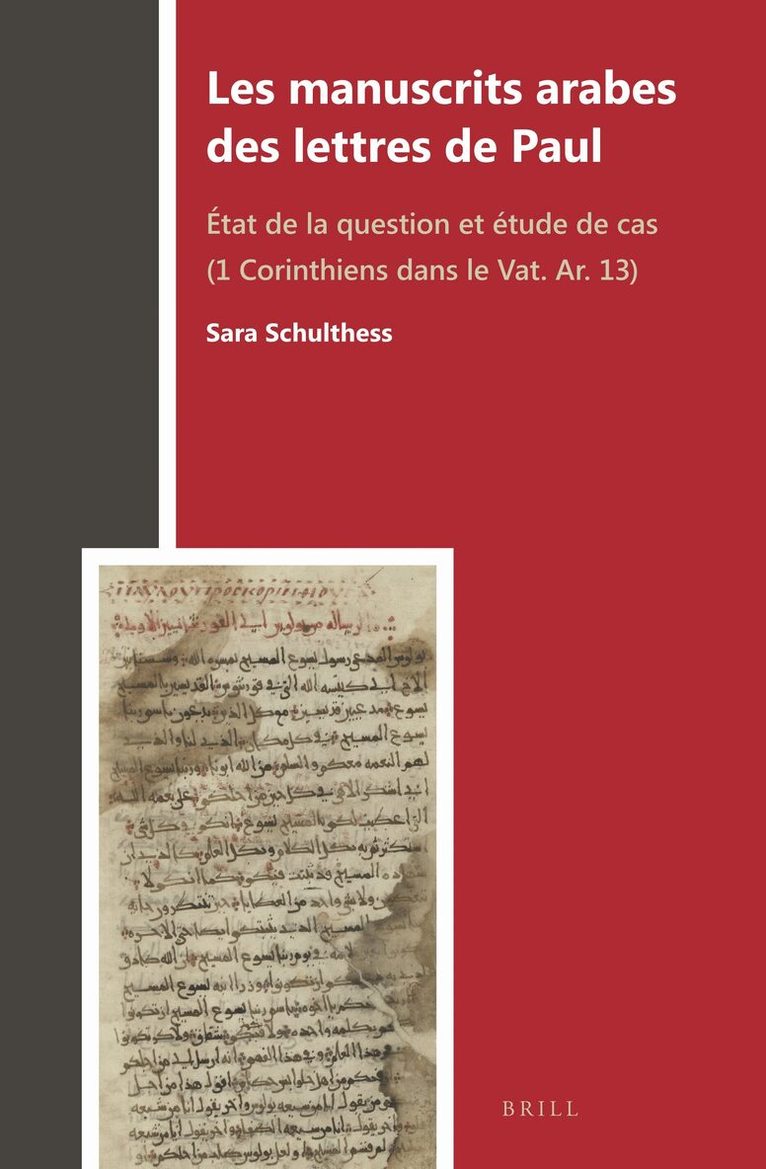
    Les manuscrits arabes des lettres de Paul

    État de la question et étude de cas (1 Corinthiens dans le Vat. Ar. 13)

    AvSara Schulthess

    Inbunden, Arabiska, 2018

    Del 6 i serien Biblia Arabica

    2 496 kr

    Beställningsvara. Skickas inom 5-8 vardagar. Fri frakt över 249 kr.

    Beskrivning

    Cet ouvrage ouvre une fenêtre sur la transmission des lettres de Paul en arabe. Il s’interroge sur le manque d’intérêt depuis le début du 20ème siècle pour les manuscrits arabes du Nouveau Testament et apporte une contribution à la récente reprise scientifique de ce champ, en étudiant le corpus largement inexploré des manuscrits arabes des lettres de Paul. Après un état des lieux établi à l’aide d’un répertoire de manuscrits, l’étude se concentre sur un manuscrit, le Vaticanus Arabicus 13. L’édition de la Première lettre aux Corinthiens de ce document du 9ème siècle est suivie d’une analyse linguistique et philologique pointue ; elle permet de dégager des éléments exégétiques qui mettent en lumière l’intérêt théologique du texte. This work provides an insight into the transmission of the Letters of Paul into Arabic. It aims to understand the lack of interest since the beginning of the 20th century for the Arabic manuscripts of the New Testament and to contribute to the current scholarly rediscovery for this field by studying the largely unexplored corpus of the Arabic manuscripts of the Letters of Paul. After a broad overview with the help of a list of witnesses, the study focuses on a specific manuscript: Vaticanus Arabicus 13. The edition of First Corinthians of this 9th century document is followed by a close analysis of linguistic and philological aspects, while the underlining of interesting exegetical points reveals the theological interest of the text.

    Produktinformation

    • Utgivningsdatum:2018-11-01
    • Mått:155 x 235 x 38 mm
    • Vikt:1 016 g
    • Format:Inbunden
    • Språk:Arabiska, Franska, Klassisk grekiska
    • Serie:Biblia Arabica
    • Antal sidor:550
    • Förlag:Brill
    • ISBN:9789004377677

    Utforska kategorier

    • Språkvetenskap och lingvistik inom Språk och ordböcker
    • Religion: allmänt inom Filosofi och religion
    • Biblar inom Filosofi och religion

    Mer om författaren

    Sara Schulthess (Ph.D. 2016, Nimègue/Lausanne) est chercheuse postdoc dans l’équipe interdisciplinaire Vital-DH@Vital-IT (SIB, Lausanne). Elle a publié plusieurs articles sur les manuscrits arabes du Nouveau Testament et les humanités digitales et publie actuellement sa recherche sur la plateforme digitale https://humarec.org.Sara Schulthess, Ph.D. 2016, Nijmegen/Lausanne, is a postdoc researcher in the interdisciplinary team Vital-DH@Vital-IT (SIB, Lausanne). She has published several articles on the Arabic manuscripts of the New Testament and Digital Humanities and is currently publishing her research on the digital platform https://humarec.org.

    Innehållsförteckning

    • RemerciementsList of Figures1 Introduction1 Problématique et objectifs2 Remarques épistémologiquesPARTIE 1: Les manuscrits arabes du Nouveau Testament dans la recherche contemporaine2 État de la recherche1 Les premières éditions2 Le 19e s. : d’une Vorlage latine à la complexité des nombreuses familles3 Le début du 20e s. : une traduction préislamique ?4 La contribution de Georg Graf (1944)5 De Vööbus (1954) à Griffith (1983) : remise en question de l’existence préislamique de traductions6 Les années 1990-2000 : séries d’articles7 Hikmat Kashouh (2012) : une monographie attendue8 Un nombre de publications croissant (2012-2017)9 Les lettres de Paul, parent pauvre de la recherche3 Du désintérêt à la redécouverte : analyse d’un phénomène scientifique1 La critique textuelle du Nouveau Testament se détourne des manuscrits arabes2 Un mépris aux racines « orientalistes » ?3 Évolution de la critique textuelle du Nouveau Testament et reprise du champ4 L’existence de traductions préislamiques, un point de vue minoritaire5 Enjeux interculturels et interreligieux : Internet6 Vers quelle recherche ? Hybridité/porosité entre les discoursPARTIE 2: Les manuscrits arabes des lettres de Paul4 Répertoire des manuscrits arabes des lettres de Paul1 Introduction2 Berlin, Staatsbibliothek3 Beyrouth, Bibliothèque orientale4 Bzommar, Bibliothèque du Couvent de Bzommar (Liban)5 Caire, Franciscan Center of Christian Oriental Studies6 Caire, Musée copte7 Caire, Patriarcat copte catholique8 Caire, Patriarcat copte orthodoxe9 Caire, Bibliothèque du Monastère Mar Menas10 Cambridge, University Library11 Charfeh, Bibliothèque patriarcale du monastère syro-catholique de Charfeh12 Copenhague, Det Kongelige Bibliothek13 Damas, Bibliothèque du Patriarcat syrien orthodoxe à Homs14 Deir al-Muḥarraq, Monastère copte15 Diyarbakir, Eglise syriaque orthodoxe Meryem Ana16 Dublin, Trinity College Library17 Duluth, University of Minnesota, Kathryn A. Martin Library, The Ramseyer-Northern Bible Society Collection18 Escorial, Real Biblioteca de San Lorenzo de El Escorial19 Florence, R. Biblioteca Medicea Laurenziana20 Göttingen, Staats – und Universitätsbibliothek21 Groningen, Universiteitsbibliotheek22 Halle, Archiv der Franckeschen Stiftungen23 Hambourg, Staats- und Universitätsbibliothek24 Jérusalem, Bibliothèque du Monastère grec au Saint-Sépulcre25 Jérusalem, Bibliothèque du Monastère Saint-Marc26 Leiden, Universiteitsbibliotheek27 Leipzig Universitätsbibliothek28 Londres, British Library29 Londres, Library of the School of Oriental and African Studies30 Madrid, Biblioteca Nacional31 Manchester, John Rylands Library32 Mardin, Bibliothèque de l’Archevêque chaldéen33 Milan, Biblioteca Ambrosiana34 Modène, Biblioteca Estense35 Mor Mattay, Bibliothèque du Monastère syriaque orthodoxe36 Mossul, Frères dominicains à Mossul37 Naples, Biblioteca nazionale Vittorio Emanuele III38 Oxford, Bodleian Library39 Oxford, Queen’s College Library40 Paris, Bibliothèque Nationale de France41 Princeton, University Library42 Saint-Pétersbourg, Bibliothèque nationale de Russie43 Saint-Pétersbourg, Institute of Oriental Manuscripts of the Russian Academy of Sciences44 Sinaï, Monastère Sainte-Catherine45 Vatican, Biblioteca Apostolica Vaticana46 Venise, Biblioteca Nazionale Marciana47 Wolfenbüttel, Herzog August Bibliothek48 Manuscrits mentionnés par Graf dont nous n’avons pas retrouvé la trace ou dont nous n’avons pu consulter le catalogue5 Observations1 Introduction2 Bibliothèques3 Dates4 Contenu des manuscrits5 Vorlagen selon Graf6 Manuscrits karshounis et manuscrits bilingues7 Matériel8 Copistes et scriptoria9 ConclusionPARTIE 3: La première lettre aux Corinthiens dans le Vat. Ar. 136 Introduction au Vat. Ar. 131 Introduction2 État de la recherche sur le Vat. Ar. 133 Description du manuscrit Vat. Ar. 137 Édition de 1 Corinthiens dans le Vat. Ar. 131 Remarques introductives concernant l’édition et ses standards2 Choix d’édition : texte diplomatique3 Édition digitale4 1 Corinthiens dans le Vat. Ar. 138 Commentaire et analyse de 1 Corinthiens dans le Vat. Ar. 131 Commentaire verset par verset2 Moyen arabe3 Affinités textuelles4 Lexique5 Conclusions9 Identité(s) dans 1 Corinthiens dans le Vat. Ar. 131 Lire une traduction : enjeux2 Qui sont les ḥunafāʾ dans 1 Corinthiens ?3 Pistes conclusivesConclusionBibliographie1 Références du Répertoire (Chapitre 4)2 Outils (Avec les Abréviations oour le Chapitre 8)3 Littérature SecondaireAnnexe