• Fri frakt över 249 kr
  • •
  • Snabba leveranser
  • •
  • Billiga böcker
Kundservice

Du är på sajten för privatpersoner.

Företag, bibliotek eller offentlig verksamhet?

Du handlar på classic.bokus.com, där alla dina funktioner finns intakta.
Till classic.bokus.com
Bokus logotyp. Gå till startsidan.
  • Erbjudanden
  • Nyheter
  • Student
  • Topplistor
  • Barn & ungdom
  • Bokus Play
  • E-böcker
  • Pocketböcker
  • Spel & pussel

10% rabatt på allt med kod: NYSTART10 →

Sidfot

Mina sidor

    Hjälp

    • Kundservice
    • Vanliga frågor och svar
    • Frakt och leverans
    • Retur vid ångerrätt
    • Reklamera vara
    • Betalning
    • Köpvillkor
    • Allmänna villkor
    • Information om webbplatsens tillgänglighet

    Om Bokus

    • Om oss
    • Pressrum
    • För studenter
    • För företag
    • För bibliotek och offentlig verksamhet
    • För leverantörer
    • Hållbarhet

    Populärt

    • Aktuella erbjudanden
    • Presentkort
    • Studentlitteratur
    • Nya böcker
    • Topplistor
    • Signerade böcker
    • Engelska böcker

    Inspiration

    • Boktips
    • BookTok
    • Populära bokserier
    • Barnbokskaraktärer
    • Populära författare
    Logotyp för Bokus
    Följ oss på Facebook (extern länk)Följ oss på Instagram (extern länk)Följ oss på YouTube (extern länk)Följ oss på TikTok (extern länk)
    bokus @ CookiesAnpassa cookiesIntegritetspolicyKöpvillkor
    Till Citymail hemsida (extern länk)Till Budbee hemsida (extern länk)Till Postnord hemsida (extern länk)Till Schenker hemsida (extern länk)Till Early Bird hemsida (extern länk)Till Walleys hemsida (extern länk)
    1. Kultur
    2. Konstböcker
    3. Konsthistoria

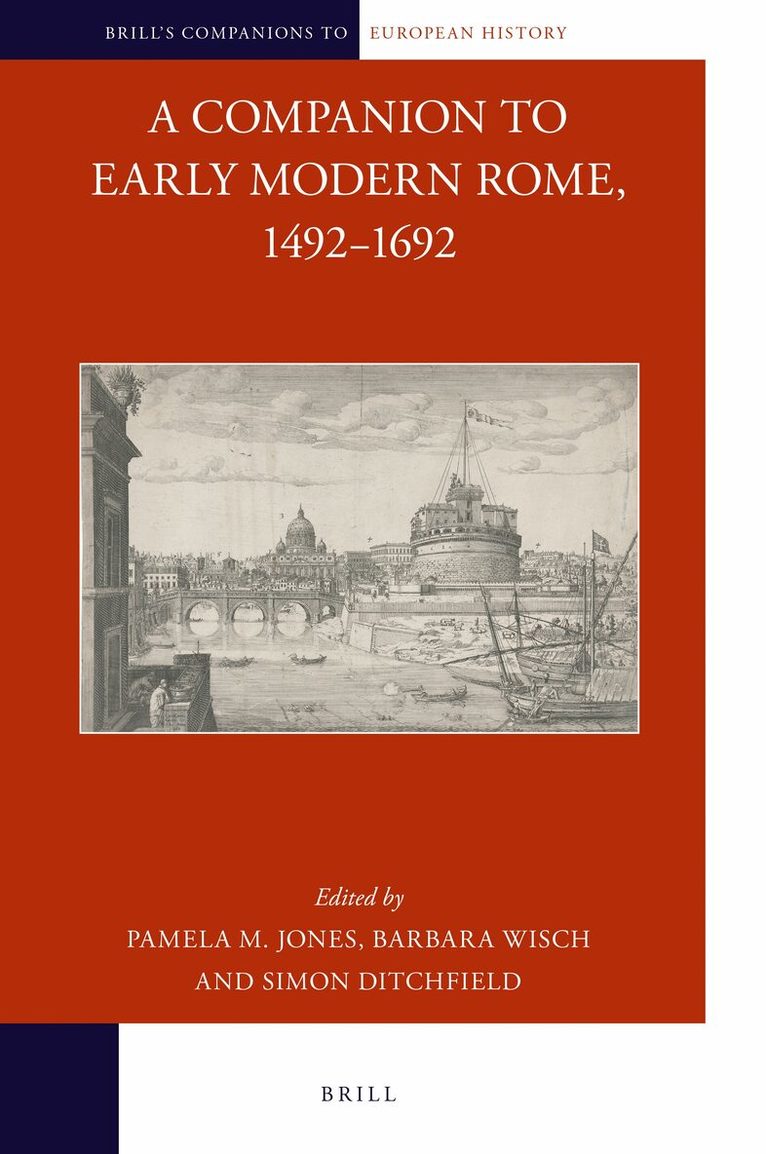
    Companion to Early Modern Rome, 1492–1692

    AvPamela M. Jones

    Inbunden, Engelska, 2019

    Del 17 i serien Brill's Companions to European History

    3 145 kr

    Beställningsvara. Skickas inom 5-8 vardagar. Fri frakt över 249 kr.

    Beskrivning

    Winner of the 2020 Bainton Prize for Reference WorksThis volume, edited by Pamela M. Jones, Barbara Wisch, and Simon Ditchfield, focuses on Rome from 1492-1692, an era of striking renewal: demographic, architectural, intellectual, and artistic. Rome’s most distinctive aspects--including its twin governments (civic and papal), unique role as the seat of global Catholicism, disproportionately male population, and status as artistic capital of Europe--are examined from numerous perspectives. This book of 30 chapters, intended for scholars and students across the academy, fills a noteworthy gap in the literature. It is the only multidisciplinary study of 16th- and 17th-century Rome that synthesizes and critiques past and recent scholarship while offering innovative analyses of a wide range of topics and identifying new avenues for research.Committee's statement "The volume includes a multidisciplinary study of early modern Rome by focusing on the 16th and 17th centuries by re-examining traditional topics anew. This volume will be of tremendous use to scholars and students because its focus is very well conceptualized and organized, while still covering a breadth of topics. The authors celebrate Rome’s diversity by exploring its role not only as the seat of the Catholic church, but also as home to large communities of diplomats, printers, and working artisans, all of whom contributed to the city’s visual, material, and musical cultures". Roland H.Bainton PrizesContributors are: Renata Ago, Elisa Andretta, Katherine Aron-Beller, Lisa Beaven, Eleonora Canepari, Christopher Carlsmith, Patrizia Cavazzini, Elizabeth S. Cohen, Thomas V. Cohen, Jeffrey Collins, Simon Ditchfield, Anna Esposito, Federica Favino, Daniele V. Filippi, Irene Fosi, Kenneth Gouwens, Giuseppe Antonio Guazzelli, John M. Hunt, Pamela M. Jones, Carla Keyvanian, Margaret A. Kuntz, Stephanie C. Leone, Evelyn Lincoln, Jessica Maier, Laurie Nussdorfer, Toby Osborne, Miles Pattenden, Denis Ribouillault, Katherine W. Rinne, Minou Schraven, John Beldon Scott, Barbara Wisch, Arnold A. Witte.

    Produktinformation

    • Utgivningsdatum:2019-02-14
    • Mått:155 x 235 x 43 mm
    • Vikt:1 335 g
    • Format:Inbunden
    • Språk:Engelska
    • Serie:Brill's Companions to European History
    • Antal sidor:632
    • Förlag:Brill
    • ISBN:9789004391956

    Utforska kategorier

    • Konsthistoria inom Kultur
    • Europas historia inom Historia och arkeologi
    • Kristendom inom Filosofi och religion

    Mer om författaren

    Pamela M. Jones, Ph.D. (1985), Brown University, is Professor Emerita of Art History at the University of Massachusetts Boston. Her books include Altarpieces and Their Viewers in the Churches of Rome from Caravaggio to Guido Reni (Ashgate, 2008).Barbara Wisch, Ph.D. (1985), University of California, Berkeley, is Professor Emerita of Art History at SUNY Cortland. Her publications include the co-authored Acting on Faith: The Confraternity of the Gonfalone in Renaissance Rome (Saint Joseph's University Press, 2013).Simon Ditchfield, Ph.D. (1991), Warburg Institute, is Professor of Early Modern History at the University of York (UK). Papacy and Peoples: The Making of Roman Catholicism as a World Religion, 1500-1700 is forthcoming from Oxford University Press.

    Recensioner i media

    "The volume is an outstanding summary of the state of research and a showcase for innovative work across a range of disciplines. Each essay presents a succinct and focused discussion, with an analysis of previous literature and a conclusion that outlines possibilities for future research. Contributions by several leading Italian scholars are presented in translation. Covering an admirably comprehensive range of topics, the chapters chart exciting prospects particularly for collaboration and interdisciplinary work [...] This is an important and enjoyable book, which does greater justice to the entirety of the Roman experience in the early modern period than any similar compilation. The editors must be thanked not only for the unusual degree to which the studies relate to one another but also for the remarkable unity of style- something that is all too rare in volumes of collected papers- that makes this book relevant both for scholars seeking the 'state of the question' and for non-academics and students."Kathleen Christian, in: College Art Association Reviews, November 2019 [Click here for full review.]"A Companion to Early Modern Rome, 1492-1692 brings together a wide array of scholars to present snapshots of Rome, provide the most up-to-date survey of recent scholarship, and give insights into future avenues to explore. While each chapter stands alone well, taken together a richer picture of early modern Rome emerges, one in which the various aspects of its history come fuller into dialogue with one another. [...] On the whole, this is a masterful collection."Robert John Cines, in: Journal of Jesuit Studies 6 (2019) "The volume includes a multidisciplinary study of early modern Rome by focusing on the 16th and 17th centuries by re-examining traditional topics anew. This volume will be of tremendous use to scholars and students because its focus is very well conceptualized and organized, while still covering a breadth of topics. The authors celebrate Rome’s diversity by exploring its role not only as the seat of the Catholic church, but also as home to large communities of diplomats, printers, and working artisans, all of whom contributed to the city’s visual, material, and musical cultures".Roland H.Bainton Prizes"This volume, part of Brill’s useful Companions series, aims to be invaluable to scholars of early modern Rome. To that end, the three editors, each a giant in the field, have compiled thirty brief articles across a wide range of disciplines and approaches. They explicitly seek to counter simplistic narratives that reduce every aspect of the city to a papally-directed Counter-Reformation narrative, or that fall back on narrow attempts to pinpoint moments of rise and fall. In this, they succeed admirably. The Rome that emerges from these articles is dynamic, complex, and polycentric. The editors’ introduction beautifully explicates the layers of symbolism and metaphor that enwrap the city, and the thirty-three authors are experts writing at the top of their game. This volume will become the certain starting point for future research on any of its given topics. [...] the Companion to Early Modern Rome represents a major accomplishment, immediately necessary both in the classroom and in research preparation. In its careful attention to producing a history that celebrates nuance and complexity, while remaining focussed, clear and readable, it should serve as a model for all aspects of early modern scholarship".Emily Michelson, in Archivum Historicum Societatis Iesu.

    Innehållsförteckning

    • AcknowledgmentsList of FiguresList of ContributorsIntroductionPamela M. Jones, Barbara Wisch and Simon Ditchfieldpart 1: Urbi et Orbi: Governing the City and International Politics1 A Civic IdentityEleonora Canepari and Laurie Nussdorfer2 The Roman CuriaMiles Pattenden3 Diplomatic Culture in Early Modern RomeToby Osborne4 Liturgical, Ritual, and Diplomatic Spaces at St. Peter’s and the Vatican Palace: the Innovations of Paul IV, Urban VIII, and Alexander VIIMargaret A. Kuntz5 Rome and the Vacant SeeJohn M. Hunt6 Justice and CrimeElizabeth S. Cohen and Thomas V. Cohen7 Romanus and Catholicus: Counter-Reformation Rome as Caput MundiSimon Ditchfield8 Celebrating New Saints in Rome and Across the GlobePamela M. Jonespart 2: When in Rome, Do as the Romans Do: Living in the City and Campagna9 The Plural City: Urban Spaces and Foreign CommunitiesIrene Fosi10 Rome’s Economic Life, 1492–1692Renata Ago11 “Charitable” Assistance between Lay Foundations and Pontifical InitiativesAnna Esposito12 Building Brotherhood: Confraternal Piety, Patronage, and PlaceBarbara Wisch13 Ghettoization: the Papal Enclosure and its JewsKatherine Aron-Beller14 Roma Theatrum Mundi: Festivals and Processions in the Ritual CityMinou Schraven15 Roma Sonora: an Atlas of Roman Sounds and MusicsDaniele V. Filippipart 3: Rome Wasn’t Built in a Day: Mapping, Planning, Building, and Display16 Mapping Rome’s RebirthJessica Maier17 Papal Urban Planning and Renewal: Real and Ideal, c.1471–1667Carla Keyvanian18 Renovatio Aquae: Aqueducts, Fountains, and the Tiber River in Early Modern RomeKatherine W. Rinne19 Palace Architecture and Decoration in Early Modern RomeStephanie C. Leone20 The Cultural Landscape of the Villa in Early Modern RomeDenis Ribouillault21 Elite Patronage and CollectingLisa Beaven22 Middle-Class Patronage, Collecting, and the Art MarketPatrizia Cavazzini23 Roman Church Architecture: the Early Modern FacadeJohn Beldon Scott24 Scale, Space, and Spectacle: Church Decoration in Rome, 1500–1700Arnold A. Wittepart 4: Ars longa, vita brevis: Intellectual Life in the Eternal City25 The Three Rs: Education in Early Modern RomeChristopher Carlsmith26 Institutions and Dynamics of Learned ExchangeKenneth Gouwens27 Scientific and Medical Knowledge in Early Modern RomeElisa Andretta and Federica Favino28 Roman Antiquities and Christian ArchaeologyGiuseppe Antonio Guazzelli29 Printers and Publishers in Early Modern RomeEvelyn Lincoln30 Sites and Sightseers: Rome through Foreign EyesJeffrey CollinsAppendix: List of Popes, 1492–1692BibliographyIndex