• Fri frakt över 249 kr
  • •
  • Snabba leveranser
  • •
  • Billiga böcker
Kundservice

Du är på sajten för privatpersoner.

Företag, bibliotek eller offentlig verksamhet?

Du handlar på classic.bokus.com, där alla dina funktioner finns intakta.
Till classic.bokus.com
Bokus logotyp. Gå till startsidan.
  • Erbjudanden
  • Nyheter
  • Student
  • Topplistor
  • Barn & ungdom
  • Bokus Play
  • E-böcker
  • Pocketböcker
  • Spel & pussel

10% rabatt på allt med kod: NYSTART10 →

Sidfot

Mina sidor

    Hjälp

    • Kundservice
    • Vanliga frågor och svar
    • Frakt och leverans
    • Retur vid ångerrätt
    • Reklamera vara
    • Betalning
    • Köpvillkor
    • Allmänna villkor
    • Information om webbplatsens tillgänglighet

    Om Bokus

    • Om oss
    • Pressrum
    • För studenter
    • För företag
    • För bibliotek och offentlig verksamhet
    • För leverantörer
    • Hållbarhet

    Populärt

    • Aktuella erbjudanden
    • Presentkort
    • Studentlitteratur
    • Nya böcker
    • Topplistor
    • Signerade böcker
    • Engelska böcker

    Inspiration

    • Boktips
    • BookTok
    • Populära bokserier
    • Barnbokskaraktärer
    • Populära författare
    Logotyp för Bokus
    Följ oss på Facebook (extern länk)Följ oss på Instagram (extern länk)Följ oss på YouTube (extern länk)Följ oss på TikTok (extern länk)
    bokus @ CookiesAnpassa cookiesIntegritetspolicyKöpvillkor
    Till Citymail hemsida (extern länk)Till Budbee hemsida (extern länk)Till Postnord hemsida (extern länk)Till Schenker hemsida (extern länk)Till Early Bird hemsida (extern länk)Till Walleys hemsida (extern länk)
    1. Skönlitteratur
    2. Litteraturvetenskap
    3. Litteraturvetenskap

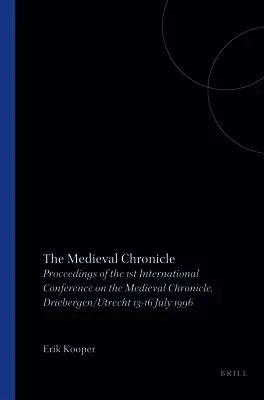
    Medieval Chronicle 13

    AvErik Kooper

    Häftad, Engelska, 2020

    Del 13 i serien Medieval Chronicle

    1 340 kr

    Beställningsvara. Skickas inom 5-8 vardagar. Fri frakt över 249 kr.

    Beskrivning

    Alongside annals, chronicles were the main genre of historical writing in the Middle Ages. Their significance as sources for the study of medieval history and culture is today widely recognised not only by historians, but also by students of medieval literature and linguistics and by art historians. The series The Medieval Chronicle aims to provide a representative survey of the on-going research in the field of chronicle studies, illustrated by examples from specific chronicles from a wide variety of countries, periods and cultural backgrounds.There are several reasons why the chronicle is particularly suited as the topic of a yearbook. In the first place there is its ubiquity: all over Europe and throughout the Middle Ages chronicles were written, both in Latin and in the vernacular, and not only in Europe but also in the countries neighbouring on it, like those of the Arabic world. Secondly, all chronicles raise such questions as by whom, for whom, or for what purpose were they written, how do they reconstruct the past, what determined the choice of verse or prose, or what kind of literary influences are discernable in them. Finally, many chronicles have been beautifully illuminated, and the relation between text and image leads to a wholly different set of questions.The Medieval Chronicle is published in cooperation with the Medieval Chronicle Society (medievalchronicle.org).

    Produktinformation

    • Utgivningsdatum:2020-05-01
    • Mått:155 x 235 x 18 mm
    • Vikt:498 g
    • Format:Häftad
    • Språk:Engelska
    • Serie:Medieval Chronicle
    • Antal sidor:314
    • Förlag:Brill
    • ISBN:9789004427617

    Utforska kategorier

    • Litteraturvetenskap inom Skönlitteratur
    • Medeltiden inom Historia och arkeologi

    Mer om författaren

    Erik Kooper received both his MA and Ph.D. degrees from Utrecht University, where he taught Old and Middle English until his retirement in 2007. Since then he has regularly taught courses and given guest lectures both at his own university, the Nijmegen Radboud University, and abroad. His recent publications include an edition of four Middle English romances for the American TEAMS series (2006), an edition of the Middle English poem Arthur (2011), and several articles, such as one identifying a previously unnoticed Latin Prose Brut manuscript (2016).Sjoerd Levelt is Senior Research Associate of the project The Literary Heritage of Anglo-Dutch Contacts, c.1050–1600 at the University of Bristol. He studied Dutch and English Medieval Studies in Amsterdam, Berkeley and Oxford, received his Ph.D. in Combined Historical Studies at the Warburg Institute, and previously taught at the Universities of Exeter and Sussex and Bilkent University (Ankara). He is a fellow of the Royal Historical Society and was awarded the Society for Renaissance Studies Book Prize 2012.

    Innehållsförteckning

    • PrefaceAbbreviationsNotes on ContributorsThe imperium in Alfonso X’s HistoriographyInés Fernández-OrdóñezAutorité spirituelle et pouvoir royal chez Wace: pour une relecture du Roman de RouCristian BratuRemarks on the Use of Numbers by Medieval Chroniclers in Battle NarrativesPierre Courroux‘Du commencement du monde depuis que Dieu ot fait ciel et terre’: Une chronique universelle en français composée à Valenciennes sous le règne de Philippe le BelIsabelle Guyot-BachyParoemiae to SS Boris and Gleb: Complementarity of Chronicles and Liturgical Canon in the Creation of the Image of the First Russian SaintsVictoria LegkikhTranslatio Imperii, translatio linguarum? On Medieval Universal Chronicles Produced around the Holy Roman EmpireMariana LeiteBetween Authorship and Anonymity: The Case of the Venetian ChroniclesȘerban V. MarinRethinking the Chronicle: Modern Genre Theory Applied to Medieval HistoriographyRamunė MarkevičiūtėRichard II’s Rejection of Counsel in the Westminster Chronicle and Thomas Walsingham’s Chronica MaioraHenry F.T. MarshConstructing Political Time: Temporal Structures of Meaning in the Old Swedish Chronicles Prosaiska krönikan and Lilla rimkrönikanMargaretha NordquistThe Textual Tradition of Bar ʿEbroyo’s Chronography and its Continuations: First SoundingsSimone I.M. Pratelli2000 Cows and 4000 Pigs at One Sitting: Was the Gesta Francorum Written to be Performed in Latin?Carol SweetenhamBloodless Turks and Sanguine Crusaders: William of Malmesbury’s Use of Vegetius in His Account of Urban II’s Sermon at ClermontJames TittertonReview: Bertrand Boysset, Chronique. Éd. et présentée par P. Gautier-Dalché, Marie-Rose Bonnet et Philippe RigaudIsabelle Guyot-BachyReview: Livia Visser-Fuchs, History as Pastime. Jean de Wavrin and His Collection of Chronicles of EnglandAntoine Brix