• Fri frakt över 249 kr
  • •
  • Snabba leveranser
  • •
  • Billiga böcker
Kundservice

Du är på sajten för privatpersoner.

Företag, bibliotek eller offentlig verksamhet?

Du handlar på classic.bokus.com, där alla dina funktioner finns intakta.
Till classic.bokus.com
Bokus logotyp. Gå till startsidan.
  • Erbjudanden
  • Nyheter
  • Student
  • Topplistor
  • Barn & ungdom
  • Bokus Play
  • E-böcker
  • Pocketböcker
  • Spel & pussel

10% rabatt på allt med kod: NYSTART10 →

Sidfot

Mina sidor

    Hjälp

    • Kundservice
    • Vanliga frågor och svar
    • Frakt och leverans
    • Retur vid ångerrätt
    • Reklamera vara
    • Betalning
    • Köpvillkor
    • Allmänna villkor
    • Information om webbplatsens tillgänglighet

    Om Bokus

    • Om oss
    • Pressrum
    • För studenter
    • För företag
    • För bibliotek och offentlig verksamhet
    • För leverantörer
    • Hållbarhet

    Populärt

    • Aktuella erbjudanden
    • Presentkort
    • Studentlitteratur
    • Nya böcker
    • Topplistor
    • Signerade böcker
    • Engelska böcker

    Inspiration

    • Boktips
    • BookTok
    • Populära bokserier
    • Barnbokskaraktärer
    • Populära författare
    Logotyp för Bokus
    Följ oss på Facebook (extern länk)Följ oss på Instagram (extern länk)Följ oss på YouTube (extern länk)Följ oss på TikTok (extern länk)
    bokus @ CookiesAnpassa cookiesIntegritetspolicyKöpvillkor
    Till Citymail hemsida (extern länk)Till Budbee hemsida (extern länk)Till Postnord hemsida (extern länk)Till Schenker hemsida (extern länk)Till Early Bird hemsida (extern länk)Till Walleys hemsida (extern länk)
    1. Skönlitteratur
    2. Litteraturvetenskap
    3. Litteraturvetenskap

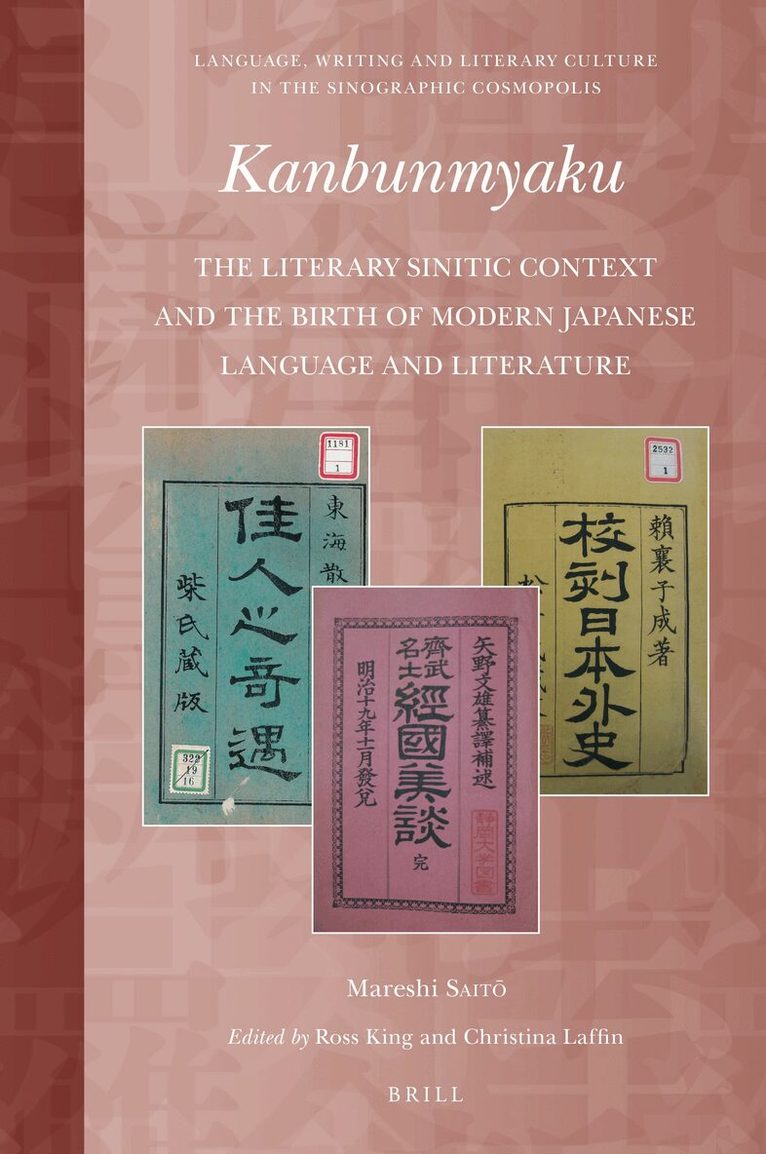
    Kanbunmyaku

    The Literary Sinitic Context and the Birth of Modern Japanese Language and Literature

    AvMareshi Saito,Ross King

    Inbunden, Engelska, 2020

    Del 2 i serien Language, Writing and Literary Culture in the Sinographic Cosmopolis

    970 kr

    Beställningsvara. Skickas inom 5-8 vardagar. Fri frakt över 249 kr.

    Beskrivning

    In Kanbunmyaku: The Literary Sinitic Context and the Birth of Modern Japanese Language and Literature, Saito Mareshi demonstrates the centrality of Literary Sinitic poetry and prose in the creation of modern literary Japanese. Saito’s new understanding of the role of “kanbunmyaku” in the formation of Japanese literary modernity challenges dominant narratives tied to translations from modern Western literatures and problematizes the antagonism between Literary Sinitic and Japanese in the modern academy. Saito shows how kundoku (vernacular reading) and its rhythms were central to the rise of new inscriptional styles, charts the changing relationship of modern poets and novelists to kanbunmyaku, and concludes that the chronotope of modern Japan was based in a language world supported by the Literary Sinitic Context.

    Produktinformation

    • Utgivningsdatum:2020-12-17
    • Mått:155 x 235 x 21 mm
    • Vikt:564 g
    • Format:Inbunden
    • Språk:Engelska
    • Serie:Language, Writing and Literary Culture in the Sinographic Cosmopolis
    • Antal sidor:232
    • Förlag:Brill
    • ISBN:9789004433465
    • Översättare:Ross King

    Utforska kategorier

    • Litteraturvetenskap inom Skönlitteratur

    Mer om författaren

    Saito Mareshi is Professor at the University of Tokyo. Trained at the University of Kyoto, he specializes in premodern Sinitic literature, the history of the sinographic tradition in Japan, and the role of sinographs and Literary Sinitic in modernizing East Asia.Ross King earned his PhD in Linguistics at Harvard University, and specializes in the history of language, reading, writing and literary cultures in the sinographic sphere, with a focus on Korea in the nineteenth and twentieth centuries.Christina Laffin received her PhD in premodern Japanese literature at Columbia University, and specializes in premodern Japanese literature with a focus on women’s writing, travel diaries, and the sociohistorical contexts for women’s education, socialization, and literacy.

    Recensioner i media

    it is immediately obvious that the editors and translators worked hard to enhance the accessibility and utility of the text for English-language readers by providing biographical and bibliographical footnotes, giving full citations for references, and sometimes adding in the margins the original Japanese terms used by the author. They have also compiled a bibliography and several indexes. These additions are helpful for those who already know Japanese and also make the translation accessible to those who don’t.(..) The editors and translators have rendered the field sterling service in making Saitō’s text accessible to an English-reading audience. The result is a meticulous and exact rendering that will, I hope, reach the kinds of readership the editors have in mind.' Peter Kornicki, Robinson College, Cambridge, Monumenta Nipponica 76:2 (2021)

    Innehållsförteckning

    • Editors’ Preface: Saitō Mareshi, the “Literary Sinitic Context,” and Literary Modernity in the Former Sinographic CosmopolisAuthor’s Preface to the English EditionList of IllustrationsIntroduction1 What Is the Literary Sinitic Context?: Two Poles of Style and Thought1 Japan’s Literary Sinitic Context2 Two Poles of Style and Thought3 Outline of the Literary Sinitic Context in Its Regional and Temporal Dimensions4 Literary Sinitic Cultivation5 The Kansei Reforms6 The Formation of Literati Consciousness7 Common Ground for Warriors and Literati8 How Literary Sinitic Was Studied9 The Style for Discussion of State Affairs10 The Patriotic Lamentations of Men of High Purpose in the Late Edo Period11 The Death Poem of Kondō Isami2 Why Did the Reading and Writing of Kanbun Spread?—The Unofficial History of Japan and the Voice of Kundoku1 Kanbun as a Written Language2 Rai San’yō and His Scholarly Lineage3 The System of Neo-Confucian Zhu Xi Studies4 The “Prohibition of Heterodoxy” and the Institutionalization of Learning5 Learning and the Orientation toward Governance6 The Grand Ambition of Historical Narrative7 The Completion of the Unofficial History of Japan8 Reasons for Bestsellerhood9 Reading-Conscious Kanbun10 Criticism of Washū11 Kundoku Rhythm as Different from Ordinary Speech12 Vernacular Reading (Kundoku) and Sinoxenic Vocalization (Ondoku)13 Famous, Captivating Melodies14 The Shigin Trend15 The Charm of Grandiose Kanshi16 The Literary Sinitic Context Popularized3 The Formation of a National Literary Style: The Civilization and Enlightenment Movement and Kundokubun1 The Separation of Literary Sinitic and Kundokubun2 Meiji-Period Evaluations of San’yō3 Differences in the Three Appraisals4 What Is “Futsūbun”?5 Two Points of Focus: A Text’s Functionality versus Its Moral Spirit6 Universal and Common7 Kundoku as Inscriptional Style8 The Gradual Dilution of Kanbun’s Mental World9 A Style Fit for Translation10 A Time for Utility and Practicality11 Contemporary Style as Modern Style12 The Rise of “a Compositional Style for the Populace”13 A Massive Lexicon of Sinographic Coinages14 The Writing Style of Enlightenment15 Rhetorical Kundoku Style: A True Account of America and Europe16 Sophisticated Contemporary Style4 When Did the “Modern” Begin in Japanese Literature?: Romantic Love as the Antithesis of Politics1 Calling into Question “Modern Literary History”2 Coteries of Kanshi Poets during Meiji3 Mori Shuntō, Leading Contributor to the Thriving of Kanshi4 The Public and the Private as Constituents of the Mental World5 Devotion to the Private World6 The Literati Mentality: Cherishing Literary Sinitic Poetry and Prose7 Ōnuma Chinzan in the World of the Literatus8 The Polarity of “Politics = Public” vs. “Literature = Private”9 The Separation of Literature from Learning10 Mori Ōgai’s Diary of a Westbound Voyage (Kōsei nikki)11 Mori Ōgai’s Self-Consciousness12 The Framework of Official Career vs. Reclusion13 Exaggerated Rhetoric14 The Motif of “The Dancing Girl” (Maihime)15 The Origins of Renown and Diligent Study16 Romantic Love as the Antithesis of Politics17 The Reorganization of “Literature”5 Japanese Novelists, Nostalgia, and the Exotic: China as the Land of Romantic Love and Revolution1 The Position of Novels in the Early Modern Period2 The Relative Status of Poetry and Fiction3 The Theme of “Emotion”4 Romantic Love and the Political Novel5 A Great Compendium of Romantic Fiction6 A New Focus for Fiction: The Replication of “Human Emotion”7 Nagai Kafū, Child of a Scholar-Official8 Diametrically Opposed Father and Son9 From Prodigal Son to Spitting Image of His Father10 Consciousness of Foreign Lands Nurtured by Interactions with Qing China11 Intoxication with Shanghai12 Reality Seeps into Kanshibun13 Kafū within the Literary Sinitic Context14 Tanizaki Jun’ichirō, Child of a Merchant Household15 Drowning Single-Mindedly in Beauty16 Shina as the Setting for Eros17 Akutagawa’s Realistic Conception of China18 Contrasting Tanizaki and Akutagawa19 What Was the Taishō Ideology of Education?6 The Horizon of Literary Sinitic: From the Literary Sinitic Context to a New Kind of Japanese Language1 Characteristics of the Genbun itchi (Congruence of Speech and Writing) Style2 Stepping Outside the Literary Sinitic Context3 The Focus of Écriture4 The Struggle of Natsume Sōseki with the New Literary Context5 The Literary Sinitic Context as Counterpoint to the West6 A Predilection for Zen7 The Aspect of Intellectual Play8 Literary Sinitic Poetry and Prose Today9 A Different Kind of Japanese10 Of Pastimes and Personal RefinementGlossary of Figures CitedGlossary of Texts CitedGlossary of TermsBibliographyIndex