• Fri frakt över 249 kr
  • •
  • Snabba leveranser
  • •
  • Billiga böcker
Kundservice

Du är på sajten för privatpersoner.

Företag, bibliotek eller offentlig verksamhet?

Du handlar på classic.bokus.com, där alla dina funktioner finns intakta.
Till classic.bokus.com
Bokus logotyp. Gå till startsidan.
  • Erbjudanden
  • Nyheter
  • Student
  • Topplistor
  • Barn & ungdom
  • Bokus Play
  • E-böcker
  • Pocketböcker
  • Spel & pussel

Må bättre, för mindre! Upp till 50% rabatt på hälsoböcker

Sidfot

Mina sidor

    Hjälp

    • Kundservice
    • Vanliga frågor och svar
    • Frakt och leverans
    • Retur vid ångerrätt
    • Reklamera vara
    • Betalning
    • Köpvillkor
    • Allmänna villkor
    • Information om webbplatsens tillgänglighet

    Om Bokus

    • Om oss
    • Pressrum
    • För studenter
    • För företag
    • För bibliotek och offentlig verksamhet
    • För leverantörer
    • Hållbarhet

    Populärt

    • Aktuella erbjudanden
    • Presentkort
    • Studentlitteratur
    • Nya böcker
    • Topplistor
    • Signerade böcker
    • Engelska böcker

    Inspiration

    • Boktips
    • BookTok
    • Populära bokserier
    • Barnbokskaraktärer
    • Populära författare
    Logotyp för Bokus
    Följ oss på Facebook (extern länk)Följ oss på Instagram (extern länk)Följ oss på YouTube (extern länk)Följ oss på TikTok (extern länk)
    bokus @ CookiesAnpassa cookiesIntegritetspolicyKöpvillkor
    Till Citymail hemsida (extern länk)Till Budbee hemsida (extern länk)Till Postnord hemsida (extern länk)Till Schenker hemsida (extern länk)Till Early Bird hemsida (extern länk)Till Walleys hemsida (extern länk)
    1. Samhälle och politik
    2. Samhälle och kultur
    3. Kultur och medier
    4. Referensverk och tvärvetenskap

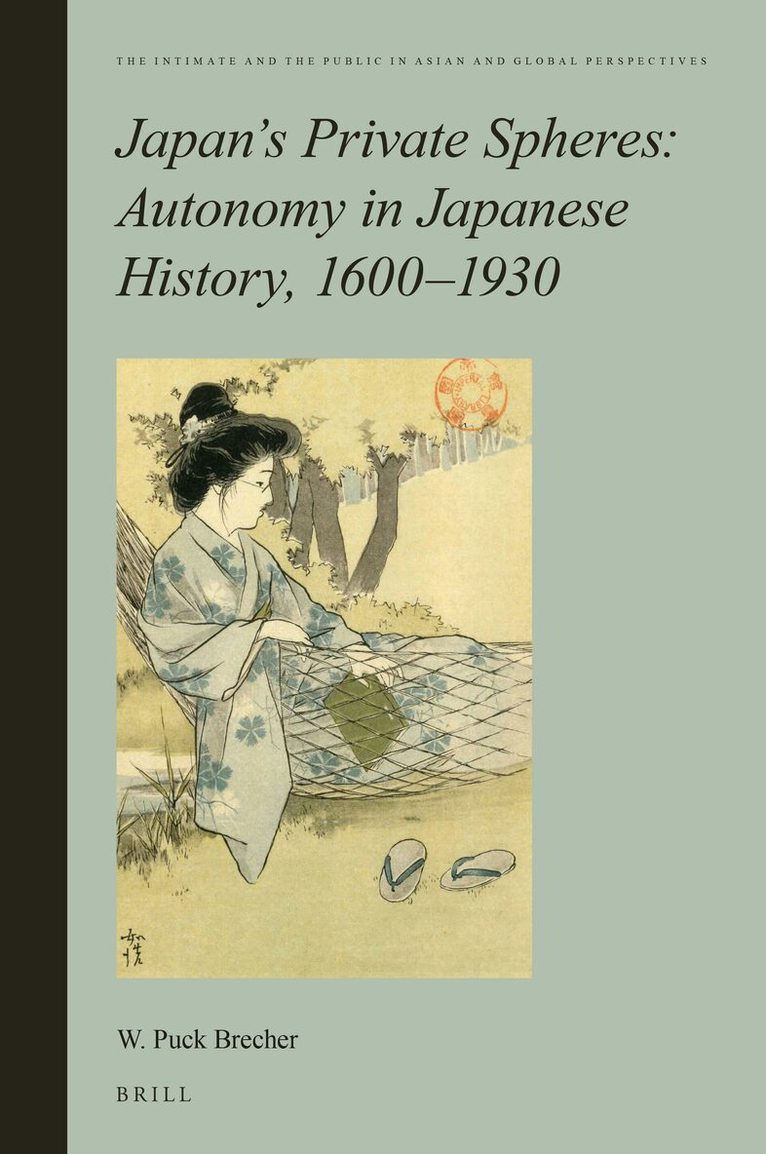
    Japan’s Private Spheres: Autonomy in Japanese History, 1600-1930

    AvWilliam Puck Brecher

    Inbunden, Engelska, 2021

    Del 13 i serien Intimate and the Public in Asian and Global Perspectives

    2 401 kr

    Beställningsvara. Skickas inom 5-8 vardagar. Fri frakt över 249 kr.

    Beskrivning

    Japan’s Private Spheres: Autonomy in Japanese History, 1600-1930 traces the shifting nature of autonomy in early modern and modern Japan. In this far-reaching, interdisciplinary study, W. Puck Brecher explores the historical development of the private and its evolving relationship with public authority, a dynamic that evokes stereotypes about an alleged dearth of individual agency in Japanese society. It does so through a montage of case studies. For the early modern era, case studies examine peripheral living spaces, boyhood, and self-interrogation in the arts. For the modern period, they explore strategic deviance, individuality in Meiji education, modern leisure, and body-maintenance. Analysis of these disparate private realms illuminates evolving conceptualizations of the private and its reciprocal yet often-contested relationship to the state.

    Produktinformation

    • Utgivningsdatum:2021-04-01
    • Mått:155 x 235 x 29 mm
    • Vikt:765 g
    • Format:Inbunden
    • Språk:Engelska
    • Serie:Intimate and the Public in Asian and Global Perspectives
    • Antal sidor:364
    • Förlag:Brill
    • ISBN:9789004447547

    Utforska kategorier

    • Referensverk och tvärvetenskap inom Samhälle och politik
    • Asiens historia inom Historia och arkeologi

    Mer om författaren

    W. Puck Brecher (Ph.D., University of Southern California, 2005) is Professor of Japanese History at Washington State University. He has authored three monographs and numerous articles on early modern and modern Japanese cultural history.

    Innehållsförteckning

    • AcknowledgmentsFigures and TablesKeywords (キーワード)ProloguePART 1Contextualizing the Private Sphere in Japanese History1 IntroductionThe Private “Problem”br/>1 Contexts of Privacy in Modernizing Japan2 Challenges and Methodologies2 Public and Private in Pre-Meiji Thought and Society1 Introduction2 Public and Private in the Japanese Context3 Public and Private in the Medieval Period4 Public and Private in the Edo Period3 The Private Self and the Meiji-Taisho State1 The Individual’s Relationship to the State2 Prescribed Private Spheres: Religion, the Home, and Leisure3 Historiography on Modern Japan’s Private SpheresPART 2The Autonomous Self in the Edo Period (1600–1868)4 Peripheries as Private Spheres1 Everything in Its Place: City, Suburb, Countryside2 Kōetsumura3 Itami3.1 Itami Saké3.2 The Itami Salon4 Negishi4.1 Negishi as a Homegrown Living Space4.2 Resignation and Reclusion5 Boyhood as an Autonomous Sphere1 Introduction2 Practical Childrearing3 Diaries4 Role Models and the Moral Authority of the Private6 “Publicizing” the PrivateSelf-Interrogation and Self-Indulgence in the Arts1 Human Difference in Early Modern Thought2 The Self-Interrogation of Hakuin (1685–1768) and Kinkoku (1761–1832)3 Self and Self-Portraiture4 Master Depravity and the Self as SpectaclePART 3Public and Private Selves in Meiji and Taisho (1868–1926)7 The Deviant in Meiji SocietyAutonomy, Individuality, and Public Power1 Meiji’s New Normal2 Loser Literature3 Anguished Art4 Ideology and Rupture: Eccentricity and Its Place in Meiji’s Cultural Field8 The Private Individual in Early Meiji Education (1872–1890s)1 The Individual in Early Meiji Education2 On the Practice of Keeping Individuality Charts3 Early Student Charts in the United States4 Individuality as Control9 Education and Public Individuality (1890s–1927)1 Kosei in Public Education2 Changes in Student Evaluations3 Kosei as “Public Individuality”PART 4The Nationalization of Private Leisure (1868–1930s)10 Vacationing and Moral Authority1 School Summer Vacations2 Moral Authority and Vacationing for Adults3 Ambivalence and Contestation11 Nationalizing the Body Physical Exercise as a Public Ethic1 “Civilizing” the Physical Body2 Western Athletics3 Public Fitness as Statecraft (1920s~)12 ConclusionCan Modern Japan’s Private Spheres Be Moral?1 Reconciliations of Self and StateEpilogueBibliographyIndex