• Fri frakt över 249 kr
  • •
  • Snabba leveranser
  • •
  • Billiga böcker
Kundservice

Du är på sajten för privatpersoner.

Företag, bibliotek eller offentlig verksamhet?

Du handlar på classic.bokus.com, där alla dina funktioner finns intakta.
Till classic.bokus.com
Bokus logotyp. Gå till startsidan.
  • Erbjudanden
  • Nyheter
  • Student
  • Topplistor
  • Barn & ungdom
  • Bokus Play
  • E-böcker
  • Pocketböcker
  • Spel & pussel

10% rabatt på allt med kod NYSTART10 →

Sidfot

Mina sidor

    Hjälp

    • Kundservice
    • Vanliga frågor och svar
    • Frakt och leverans
    • Retur vid ångerrätt
    • Reklamera vara
    • Betalning
    • Köpvillkor
    • Allmänna villkor
    • Information om webbplatsens tillgänglighet

    Om Bokus

    • Om oss
    • Pressrum
    • För studenter
    • För företag
    • För bibliotek och offentlig verksamhet
    • För leverantörer
    • Hållbarhet

    Populärt

    • Aktuella erbjudanden
    • Presentkort
    • Studentlitteratur
    • Nya böcker
    • Topplistor
    • Signerade böcker
    • Engelska böcker

    Inspiration

    • Boktips
    • BookTok
    • Populära bokserier
    • Barnbokskaraktärer
    • Populära författare
    Logotyp för Bokus
    Följ oss på Facebook (extern länk)Följ oss på Instagram (extern länk)Följ oss på YouTube (extern länk)Följ oss på TikTok (extern länk)
    bokus @ CookiesAnpassa cookiesIntegritetspolicyKöpvillkor
    Till Citymail hemsida (extern länk)Till Budbee hemsida (extern länk)Till Postnord hemsida (extern länk)Till Schenker hemsida (extern länk)Till Early Bird hemsida (extern länk)Till Walleys hemsida (extern länk)
    1. Samhälle och politik
    2. Sociologi och antropologi
    3. Sociologi

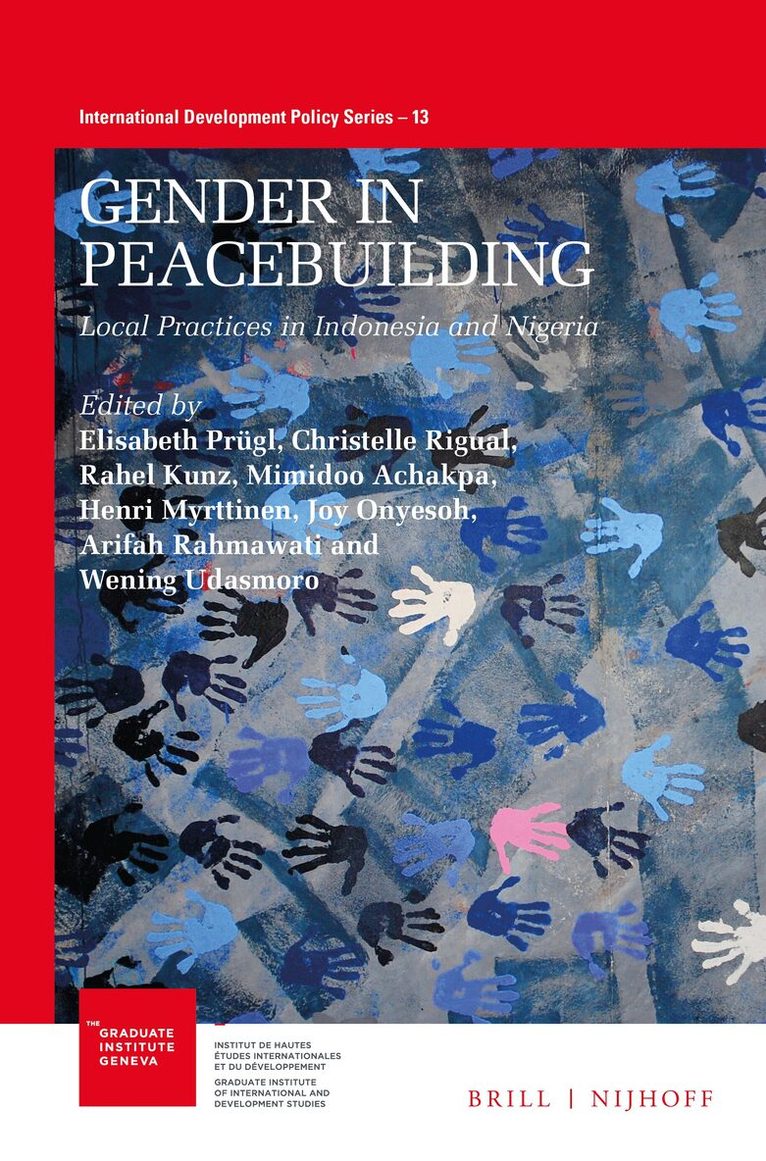
    Gender in Peacebuilding

    Local Practices in Indonesia and Nigeria

    AvElisabeth Prügl

    Häftad, Engelska, 2021

    Del 13 i serien International Development Policy

    1 365 kr

    Beställningsvara. Skickas inom 5-8 vardagar. Fri frakt över 249 kr.

    Beskrivning

    Gender, age, class, ethnicity, religion, and political ideologies all matter in peacebuilding. Adopting a feminist approach, the 13th volume of International Development Policy analyses such intersecting differences in local contexts to develop a better understanding of how intersectionally gendered dynamics shape and are shaped by peacebuilding. In this volume, findings are presented from a six-year collaborative research project that, involving scholars from Indonesia, Nigeria, and Switzerland, investigated peacebuilding initiatives in Indonesia and Nigeria. The authors identify a number of logics that highlight how gender is deployed strategically or asserts itself inadvertently through gender stereotypes, gendered divisions of labour, or identity constructions.Contributors include: Mimidoo Achakpa, Ceren Bulduk, Rahel Kunz, Henri Myrttinen, Joy Onyesoh, Elisabeth Prügl, Arifah Rahmawati, Christelle Rigual and Wening Udasmoro.

    Produktinformation

    • Utgivningsdatum:2021-11-04
    • Mått:155 x 235 x 12 mm
    • Vikt:354 g
    • Format:Häftad
    • Språk:Engelska
    • Serie:International Development Policy
    • Antal sidor:186
    • Förlag:Brill
    • ISBN:9789004498464

    Utforska kategorier

    • Sociologi inom Samhälle och politik

    Mer om författaren

    Mimidoo Achakpa is a doctoral candidate in Security and Strategic Studies at the Nasarawa State University, in Nigeria. Her PhD project examines ‘Post-conflict management in Plateau State and the gender question (2015-2020)’ focusing on the relative impact of conflict on gender, and the various models of post-conflict management and the role of gender. Achakpa is an unapologetic feminist and her areas of expertise include governance, gender, women, peace and security.Rahel Kunz is a senior lecturer at the Institute of Political Studies of the University of Lausanne, Switzerland. Her research draws on feminist post-structuralist and postcolonial theories to focus on gender issues in migration and development, and in conflict and security. Kunz has published in International Political Sociology, the Journal of European Integration, Migration Studies, Politics & Gender, the Review of International Political Economy and Third World Quarterly, and is the author of The Political Economy of Global Remittances: Gender, Governmentality and Neoliberalism (Routledge, 2011). Henri Myrttinen is a visiting Research Fellow with Katholieke Universiteit Leuven, in Belgium. He has worked on gender and peacebuilding issues with numerous non-governmental organisations and research institutions, focusing mostly on Southeast Asia, sub-Saharan Africa, and Central and Eastern Europe. Myrttinen earned a PhD in Conflict Resolution and Peace Studies from the University of KwaZulu-Natal, South Africa, with a thesis on masculinities and violence in Timor-Leste. Joy Onyesoh is International President of the Women’s International League for Peace and Freedom (WILPF) and President of WILPF Nigeria. She is the founder of the Joy Onyesoh Foundation, which is dedicated to building resilient communities in Nigeria. An experienced activist, facilitator, organiser, trainer and researcher, Onyesoh’s consultancy and research interests lie in the area of gender and development, with a focus on women, peace and security. She has written a doctoral dissertation on women’s transformative leadership in conflict and post-conflict societies.Elisabeth Prügl is Professor of International Relations and Co-director of the Gender Centre at the Graduate Institute of International and Development Studies (IHEID), Geneva, Switzerland. Her research and teaching focus on feminist international relations, in particular gender politics in international governance. She is the responsible applicant for the r4d Gender and Conflict research project and also directs the DEMETER project on land and agricultural commercialisation, both funded by the Swiss Programme for Research on Global Issues for Development (r4d).Arifah Rahmawati holds a PhD in Policy Studies from the Post Graduate School of Universitas Gadjah Mada (UGM), Yogyakarta, Indonesia, and a Master’s degree in Security Studies from the Naval Postgraduate School, Monterey, California, USA. She is currently a lecturer at the Universitas Muhammadiyah Madiun of East Java, Indonesia, and has been a researcher at the UGM’s Center for Security and Peace Studies (CSPS) since 1997. Christelle Rigual is a political scientist and a research affiliate with the Gender Centre at the Graduate Institute of International and Development Studies (IHEID), Geneva, Switzerland, where she coordinated the r4d project exploring ‘The Gender Dimensions of Social Conflict, Armed Violence, and Peacebuilding’. She holds a PhD in International Relations and Political Science from the Graduate Institute, Geneva.Wening Udasmoro is Professor of Literature and Gender at Universitas Gadjah Mada (UGM), Yogyakarta, Indonesia. She received her PhD in Gender Studies from the University of Geneva, Switzerland in 2006. Her main research interests are gender issues, literature, violence, identity politics, and critical discourse analysis. One of her latest works is ‘Gendered Dynamics of Labour Force Participation in Insurgency and Ethno-Religious Conflict: The Cases of Aceh and Ambon’, to be published in International Feminist Journal of Politics (forthcoming).

    Recensioner i media

    “This is such an important book! Applying a feminist methodology, as is done throughout this analysis, shows the need to go deeper, to understand the importance of intersectionality; how western neo liberal approaches fail and why real peacebuilding comes from within; from households to communities, which must be supported—not dictated to. Increasing our knowledge of how we succeed or fail in building peace is a vital contribution to our possibilities for success, and this book does just that.”– Madeleine Rees, Secretary General of the Women's International League for Peace and Freedom“This impressive collection of feminist research, rooted in detailed knowledge of peacebuilding practices in Nigeria and Indonesia, illuminates the multiple ways in which gender acts and is acted upon in the local dynamics that can either escalate or de-escalate conflicts. It is essential reading for peacebuilding practitioners, and offers academics valuable new material for understanding the diverse, rich and complex field of gender and peacebuilding.” – Claire Duncanson, School of Social and Political Science, University of Edinburgh

    Innehållsförteckning

    • ForewordPrefaceList of Figures and TablesAcronyms and AbbreviationsNotes on Contributors1 Introduction Local Peacebuilding through a Gender LensElisabeth Prügl, Rahel Kunz, Mimidoo Achakpa, Henri Myrttinen, Joy Onyesoh, Arifah Rahmawati, Christelle Rigual and Wening Udasmoro2 Questioning the Mantra ‘All for One and One for All’ The Reintegration of Aceh’s Female Ex-combatantsArifah Rahmawati3 Exploring Gendered Understandings of Peace in Delta StateCeren Bulduk, Joy Onyesoh and Mimidoo Achakpa4 Art-for-Peace in Ambon An Intersectional ReadingWening Udasmoro and Rahel KunzInterlude 1: Doing Research Differently? Putting Feminist Research Principles into PracticeHenri MyrttinenInterlude 2: The Silencing of Gender-Based ViolenceChristelle Rigual, Henri Myrttinen, Arifah Rahmawati and Mimidoo Achakpa5 ‘No Matter What—I’ve Got Rights’ Women’s Land Grab Protests in Banyuwangi, East JavaWening Udasmoro and Elisabeth Prügl6 Umuada A Sociopolitical Institution for Peacebuilding and Conflict Management in NigeriaJoy Onyesoh7 Three Dimensions of Gender Mainstreaming in Economic Peacebuilding Insights from Indonesia and NigeriaChristelle Rigual8 Conclusion. Seeing Patterns, Finding Diversity Researching and Engaging with Gender and Peacebuilding in Indonesia and NigeriaHenri MyrttinenIndex