• Fri frakt över 249 kr
  • •
  • Snabba leveranser
  • •
  • Billiga böcker
Kundservice

Du är på sajten för privatpersoner.

Företag, bibliotek eller offentlig verksamhet?

Du handlar på classic.bokus.com, där alla dina funktioner finns intakta.
Till classic.bokus.com
Bokus logotyp. Gå till startsidan.
  • Erbjudanden
  • Nyheter
  • Student
  • Topplistor
  • Barn & ungdom
  • Bokus Play
  • E-böcker
  • Pocketböcker
  • Spel & pussel

10% rabatt på allt med kod: NYSTART10 →

Sidfot

Mina sidor

    Hjälp

    • Kundservice
    • Vanliga frågor och svar
    • Frakt och leverans
    • Retur vid ångerrätt
    • Reklamera vara
    • Betalning
    • Köpvillkor
    • Allmänna villkor
    • Information om webbplatsens tillgänglighet

    Om Bokus

    • Om oss
    • Pressrum
    • För studenter
    • För företag
    • För bibliotek och offentlig verksamhet
    • För leverantörer
    • Hållbarhet

    Populärt

    • Aktuella erbjudanden
    • Presentkort
    • Studentlitteratur
    • Nya böcker
    • Topplistor
    • Signerade böcker
    • Engelska böcker

    Inspiration

    • Boktips
    • BookTok
    • Populära bokserier
    • Barnbokskaraktärer
    • Populära författare
    Logotyp för Bokus
    Följ oss på Facebook (extern länk)Följ oss på Instagram (extern länk)Följ oss på YouTube (extern länk)Följ oss på TikTok (extern länk)
    bokus @ CookiesAnpassa cookiesIntegritetspolicyKöpvillkor
    Till Citymail hemsida (extern länk)Till Budbee hemsida (extern länk)Till Postnord hemsida (extern länk)Till Schenker hemsida (extern länk)Till Early Bird hemsida (extern länk)Till Walleys hemsida (extern länk)
    1. Psykologi och pedagogik
    2. Pedagogik
    3. Pedagogik: historia

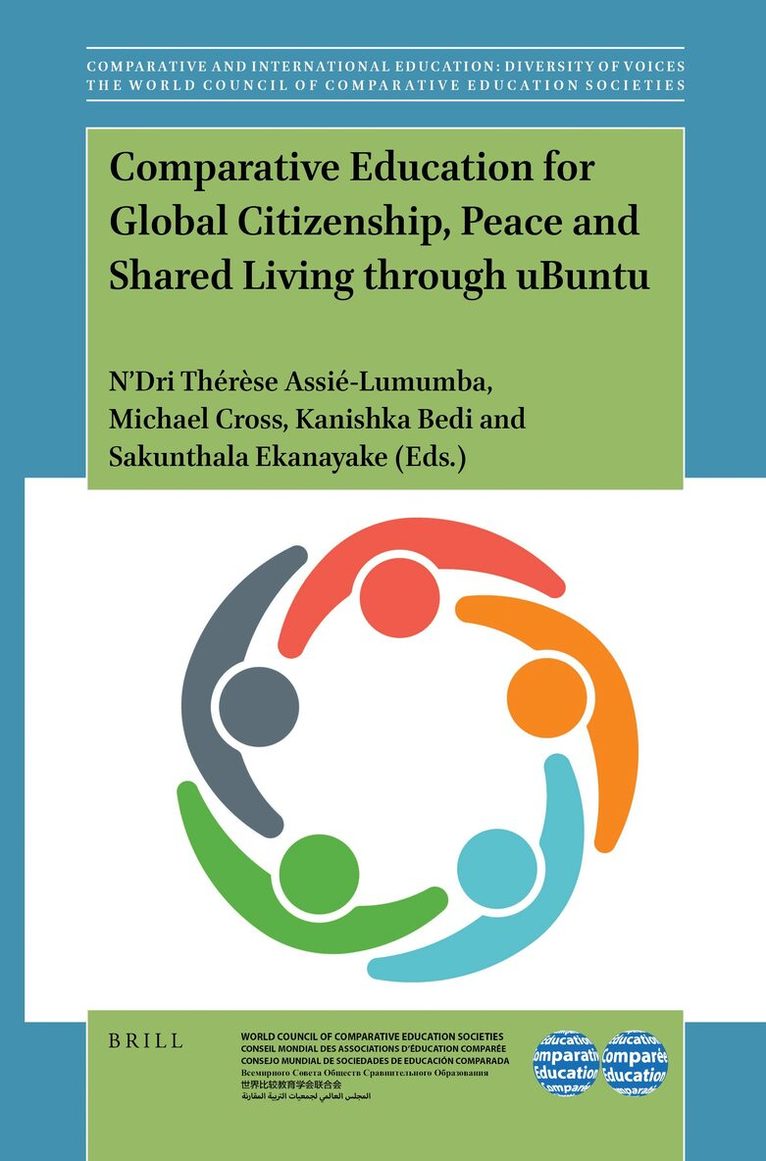
    Comparative Education for Global Citizenship, Peace and Shared Living through uBuntu

    AvN'Dri Thérèse Assié-Lumumba

    Häftad, Engelska, 2022

    Del i serien World Council of Comparative Education Societies

    826 kr

    Beställningsvara. Skickas inom 5-8 vardagar. Fri frakt över 249 kr.

    Beskrivning

    There is a dire need today to create spaces in which people can make meaning of their existence in the world, abiding by cultural frameworks and practices that acknowledge and validate a meaningful existence for all. People are not just isolated individuals but are connected in diverse ways with other persons within our natural and social environment which is part of the whole universe. The African philosophy of uBuntu or humaneness is re-emerging for its timely relevance and potential as indispensable in our quest for global citizenship, peace, and mutual understanding in securing sustainable human development in the broader ecosystem. Comparative educationists have the challenge to devise theoretical frameworks, epistemological and pedagogical constructs as well as pragmatic, useful and effective ways of promoting the virtues of compassion and recognition of our common humanity in eliminating the ills of domination and control that are guided by greed, hatred, jealousy, and intolerance. Comparative Education for Global Citizenship, Peace and Shared Living through Ubuntu paves the way for a better understanding of the critical importance of the collective search and endeavor towards achieving the virtues of nonviolence, peace, shared values of living together, global citizenship, improved quality of life for all and a better appreciation of the positive implications of interdependence.

    Produktinformation

    • Utgivningsdatum:2022-06-02
    • Mått:155 x 235 x 15 mm
    • Vikt:492 g
    • Format:Häftad
    • Språk:Engelska
    • Serie:World Council of Comparative Education Societies
    • Antal sidor:262
    • Förlag:Brill
    • ISBN:9789004518797

    Utforska kategorier

    • Pedagogik: historia inom Psykologi och pedagogik
    • Pedagogik inom Psykologi och pedagogik
    • Högskola och universitet inom Psykologi och pedagogik

    Mer om författaren

    N’Dri Thérèse Assié-Lumumba, Ph.D. (1982), University of Chicago, is a Professor at Cornell University in the Africana Studies and Research Center; Director of the Cornell Institute of African Development (IAD); Distinguished Visiting Professor in the Ali Mazrui Centre for Higher Education Studies at the University of Johannesburg; and President of the World Council of Comparative Education Societies (WCCES).Michael Cross, Ph.D. (1994), University of the Witwatersrand, was the Founding Director of the Ali Mazrui Centre for Higher Education Studies at the University of Johannesburg and served as an education specialist in several national education policy initiatives in South Africa.Kanishka Bedi, Ph.D. (2007), University of Lucknow, is President of Indian Ocean Comparative Education Society and Executive Director of World Council of Comparative Education Societies. Professor Bedi held leadership positions at several international institutions during 25 years of his career.Sakunthala Ekanayake, Ph.D. (2011), University of Bristol, is Professor in the Department of Education at the University of Peradeniya, Sri Lanka. She is Vice President of the Indian Ocean Comparative Education Society.

    Recensioner i media

    “This volume brings together many thoughtful essays on one of the most important issues of our time: how can the almost 8 billion inhabitants of our diverse world, which has been largely shaped historically by European notions of competition, individual freedom, and capitalist power relations, can come together in more constructive, cooperative ways to build a better world society. The authors focus on the African concept of uBuntu as a useful philosophical structure on which to develop this new approach. The book poses a multi-faceted challenge to traditional Western globalist thinking.” – Martin Carnoy, Stanford University, USA“Decolonization demands epistemic, political and philosophical shifts in how we frame and practice education. uBuntu principles capture the foundations of southern theories and decolonizing methodologies, and justifies their relevancy for a world confronted by global pandemic, environmental catastrophes and nationalistic geopolitics. Through uBuntu, this text delivers a cogent framework for moral and values-based education. This is a recommended read for educators, students and leaders who pursue a socially-just and sustainable world.” – Juliana McLaughlin, Queensland University of Technology, Australia“The world is getting increasingly globalized stressing that one nation cannot prosper while others suffer. Peace and prosperity should prevail collectively in the entire world. This principle articulated as vasudhaiva kutumbakam in Vedic philosophy and as uBuntu in African culture is of paramount importance today. Towards this goal, education systems have to prepare children to become not just good citizens, but to become global citizens imbibed with rich eternal universal human values, taking the concept ‘global citizenship’ to an altogether higher pedestal than what is being commonly interpreted. The volume edited by N’Dri Thérèse Assié-Lumumba et al., consisting of fifteen chapters, is a rich, timely contribution on this theme and I am sure, scholars around the world would immensely benefit from reading it.” – Jandhyala B. G. Tilak, Council for Social Development, India“Comparative Education for Global Citizenship, Peace and Shared Living through uBuntu is one of those gemlike books distilled from a lifetime’s research and study. It brings together twenty leading scholars (most of them from Africa) to present a provocative and timely reckoning with what remains one of the central challenges of the modern world: how to live together in a rapidly changing, often divisive world. UBuntu’s core philosophy, ‘I am because we are’, is central to every chapter in this book. Whether they are discussing the rights of women, inclusive education, indigenous systems of knowledge, or life skills development, the authors acknowledge one’s humanity through the recognition of ‘the others’ in their unique and different selves. Drawing on the inaugural WCCES symposium held at the Ali Mazrui Centre for Higher Education Studies, University of Johannesburg, in 2018, the book is dedicated to the memory of its Director, Professor Michael Cross. We miss and honor this scholar of remarkable intellectual power and social insight, who was a great friend of WCCES and UNESCO IBE. The WCCES remains a home for engaging many voices are still kept from fully entering the dialogue, and who lend the field a weight and force consistently informed by intellectual savvy and enlightening writing. I am happy to support the publication of this important book and to continue to grow our partnership.” – Yao Ydo, Director, UNESCO International Bureau of Education, Geneva, Switzerland

    Innehållsförteckning

    • ForewordTshilidzi MarwalaPreface and AcknowledgementsN’Dri Thérèse Assié-LumumbaDedicationList of Figures and TablesNotes on Contributors1 IntroductionN’Dri Thérèse Assié-Lumumba, Michael Cross, Kanishka Bedi and Sakunthala Ekanayake2 Educating for Global Citizenship, Peace and Harmony through uBuntuMoeketsi Letseka3 Global Citizenship Education and the (Post)Human ConditionLesley Le Grange4 ‘Jumping on the Band Wagon’: Is Global Citizenship an Illusion?Steve Azaiki and Gertrude Shotte5 African Philosophy of Higher Education and uBuntuYusef Waghid6 Beyond Classroom Pedagogies: Embracing Student-Driven Activities in Students’ Social and Intellectual Development in South African Higher EducationElizabeth Ndofirepi and Michael Cross7 “Creative Resistance”: Establishing a World-Minded Indian University in Colonial British IndiaMousumi Mukherjee8 The Education of the Girl Child in Algeria and the Condition of the Woman between Tradition and Change: Alienation or Emancipation?Aïcha Maherzi9 UBuntu Philosophy and the Gender Crisis within South Africa’s Higher Education SectorPhefumula Nyoni and Olaide Agbaje10 Teaching National Languages as an Instrument of Inclusion and Unity in AngolaTeresa Almeida Patatas and António Teodoro11 Imparting Academic Work Ethic in Undergraduate Students throughReligiosityDennis Zami Atibuni12 Inclusion of Students with Disabilities in the United Kingdom: Lessons for South AfricaSibonokuhle Ndlovu13 Educational Response to COVID-19 Pandemic with an uBuntu Lens: The Kenyan Experience (December 2019 to June 2020)Daniel Komo Gakunga14 Peace and Harmony through uBuntu in a Globalized WorldJoel Mukwedeya15 ConclusionN’Dri Thérèse Assié-Lumumba, Michael Cross, Kanishka Bedi and Sakunthala EkanayakeIndex