• Fri frakt över 249 kr
  • •
  • Snabba leveranser
  • •
  • Billiga böcker
Kundservice

Du är på sajten för privatpersoner.

Företag, bibliotek eller offentlig verksamhet?

Du handlar på classic.bokus.com, där alla dina funktioner finns intakta.
Till classic.bokus.com
Bokus logotyp. Gå till startsidan.
  • Erbjudanden
  • Nyheter
  • Student
  • Topplistor
  • Barn & ungdom
  • Bokus Play
  • E-böcker
  • Pocketböcker
  • Spel & pussel

Må bättre, för mindre! Upp till 50% rabatt på hälsoböcker

Sidfot

Mina sidor

    Hjälp

    • Kundservice
    • Vanliga frågor och svar
    • Frakt och leverans
    • Retur vid ångerrätt
    • Reklamera vara
    • Betalning
    • Köpvillkor
    • Allmänna villkor
    • Information om webbplatsens tillgänglighet

    Om Bokus

    • Om oss
    • Pressrum
    • För studenter
    • För företag
    • För bibliotek och offentlig verksamhet
    • För leverantörer
    • Hållbarhet

    Populärt

    • Aktuella erbjudanden
    • Presentkort
    • Studentlitteratur
    • Nya böcker
    • Topplistor
    • Signerade böcker
    • Engelska böcker

    Inspiration

    • Boktips
    • BookTok
    • Populära bokserier
    • Barnbokskaraktärer
    • Populära författare
    Logotyp för Bokus
    Följ oss på Facebook (extern länk)Följ oss på Instagram (extern länk)Följ oss på YouTube (extern länk)Följ oss på TikTok (extern länk)
    bokus @ CookiesAnpassa cookiesIntegritetspolicyKöpvillkor
    Till Citymail hemsida (extern länk)Till Budbee hemsida (extern länk)Till Postnord hemsida (extern länk)Till Schenker hemsida (extern länk)Till Early Bird hemsida (extern länk)Till Walleys hemsida (extern länk)
    1. Kultur
    2. Musikböcker
    3. Musik: stilar och genrer
    4. Klassisk musik, konstmusik och orkestermusik

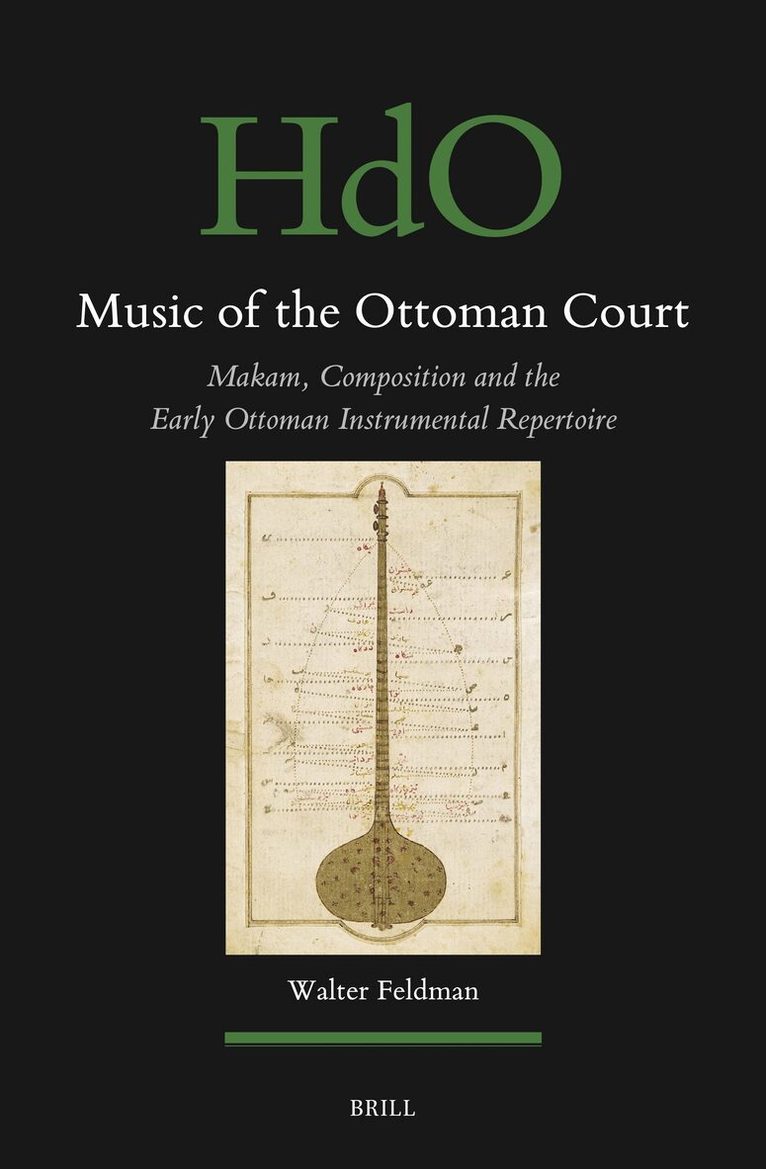
    Music of the Ottoman Court

    Makam, Composition and the Early Ottoman Instrumental Repertoire

    AvWalter Feldman

    Inbunden, Engelska, 2023

    Del 177 i serien Handbook of Oriental Studies. Section 1 The Near and Middle East

    3 707 kr

    Beställningsvara. Skickas inom 5-8 vardagar. Fri frakt över 249 kr.

    Beskrivning

    Between 1600 and 1750 Ottoman Turkish music differentiated itself from an older Persianate art music and developed the genres antecedent to modern Turkish art music. Based on a translation of Demetrius Cantemir’s seminal “Book of the Science of Music” from the early eighteenth century, this work is the first to bring together contemporaneous notations, musical treatises, literary sources, travellers’ accounts and iconography. These present a synthetic picture of the emergence of Ottoman composed and improvised instrumental music. A detailed comparison of items in the notated Collections of Cantemir and of Bobowski—from fifty years earlier—together with relevant treatises, reveal key aspects of modality, melodic progression and rhythmic structures.

    Produktinformation

    • Utgivningsdatum:2023-12-20
    • Mått:155 x 235 x 35 mm
    • Vikt:1 204 g
    • Format:Inbunden
    • Språk:Engelska
    • Serie:Handbook of Oriental Studies. Section 1 The Near and Middle East
    • Antal sidor:554
    • Förlag:Brill
    • ISBN:9789004531253
    • Originaltitel:Music of the Ottoman Court: Makam, Composition and the Early Ottoman Instrumental Repertoire (1996)

    Utforska kategorier

    • Klassisk musik, konstmusik och orkestermusik inom Kultur

    Mer om författaren

    Walter Feldman, PhD (1980, Columbia University), is a leading scholar of both Ottoman Turkish and Jewish music. His most recent publications are From Rumi to the Whirling Dervishes (Edinburgh U Press, 2022) and Klezmer: Music, History and Memory (Oxford U Press, 2016).

    Innehållsförteckning

    • Preface to the New Edition1 Chronologies and “Local Modernity”2 Instrumental Music: Mehterhane and Fasıl-i SazendeAcknowledgementsList of Figures, Tables and Music Examples xxviThe Structuring of the BookIntroduction1 Turkish Classical Music and Ottoman Music2 Ethnomusicology and History in Ottoman TurkeyThe Major Sources for Ottoman Music 1650–1750Part 1: Musicians and Performance1 Professionalism and the Music of the Ottoman Court1 The Ottomans and the Turco-Mongol Courtly Heritage2 The Emergence of Ottoman Court Music3 Vocalists and Instrumentalists4 The Geographical Origin of the Musicians and Location of Musical Centers5 Changes in the Ruling Class and in the Organization of Music in the Palace6 Unfree Musicians7 Free Musicians in the Palace Service and the Bureaucracy2 Professionalism and the Music of the Ottoman Court: Dervishes and Turkish Art Music1 The Mevleviye2 Music in the Other Sunni tarikats3 Conclusion3 Instruments and Instrumentalists1 Sources for the Instrumentation of Ottoman Music2 Organ and Genre3 The Ottoman Court Ensemble of the Sixteenth Century4 The Ottoman Ensemble from the Seventeenth to the Mid-Eighteenth Century5 Social Contexts of the Turkish Lutes6 Conclusion4 The Ottoman Cyclical Concert-Formats Fasil and Ayin1 The Structure of the Ottoman Fasıl2 The Fasl-i Sazende3 Structure of the Fasl-i Sazende4 The Mevlevi AyinPart 2: Makam5 The General Scale of Seventeenth-Century Ottoman Music1 Nomenclature of Scale Degree and Mode2 Cantemir’s General Scale3 The Problem of the Note Segah4 Saba, Uzzal, Beyati, Hisar5 Conclusion6 A Note on Symbols6 Makam and Terkib1 Other Modal Entities2 Terkib and Şube Structures3 The Terkib in the Eighteenth Century7 Melodic Progression1 Seyir in Compositions2 Cantemir’s Terminology for Melodic Progression3 Hızır Ağa and Harutin8 The Taksim and Modulation1 The Generic Nature and Origin of the Taksim2 Turkish and Persian “Taksim” in Cantemir’s Treatise3 Modulation and the Taksim4 Modulation and the Küll-i Külliyat Genre5 ConclusionPart 3: Peşrev and Semai9 The Peşrev/Pishrow1 The Peşrev as Genre2 Origin and Structure of the Peşrev/Pishrow3 Generic Variation within the Ottoman Peşrev10 The Ottoman Peşrev1 Periodization of the Turkish Peşrev2 Factors Leading to Change in the Formal Structure of the Peşrev3 Conclusion11 Peşrevs and Analyses1 Period I (1500–1550)2 Period 2 (1550–1600)3 Period 3 (1600–1650)4 Period 4 (1650–1690)5 Neyzen Ali Hoca6 The Peşrevs of Cantemir7 Muhayyer Muhammes8 Buselik-Aşirani Berefşan9 Conclusion12 The Seventeenth-Century Persian Peşrev1 Peşrevs and Analyses13 Transmission of the Ottoman Peşrev Repertoire1 Transmission of the Peşrev during the Seventeenth Century: Peşrevs and Analyses2 The Nazire (“Imitatio”)3 Conclusion4 Transmission of the Peşrev in the Eighteenth Century14 The Instrumental Semai1 Semai-i Sazende in the Later Seventeenth Century2 Periodization of the Semai-i Sazende/Saz Semaisi3 Analysis of the Seventeenth-Century Semai Documents4 Semai-i Lenk/Aksak Semai5 Transformation of the Old Semai6 Conclusion15 Conclusion1 The Departure of Turkey from the “Persianate” Musical Sphere2 The New Ottoman Style of the Eighteenth CenturyGlossaryFigure CreditsBibliographyIndex