• Fri frakt över 249 kr
  • •
  • Snabba leveranser
  • •
  • Billiga böcker
Kundservice

Du är på sajten för privatpersoner.

Företag, bibliotek eller offentlig verksamhet?

Du handlar på classic.bokus.com, där alla dina funktioner finns intakta.
Till classic.bokus.com
Bokus logotyp. Gå till startsidan.
  • Erbjudanden
  • Nyheter
  • Student
  • Topplistor
  • Barn & ungdom
  • Bokus Play
  • E-böcker
  • Pocketböcker
  • Spel & pussel

10% studentrabatt med kod TERM26

Sidfot

Mina sidor

    Hjälp

    • Kundservice
    • Vanliga frågor och svar
    • Frakt och leverans
    • Retur vid ångerrätt
    • Reklamera vara
    • Betalning
    • Köpvillkor
    • Allmänna villkor
    • Information om webbplatsens tillgänglighet

    Om Bokus

    • Om oss
    • Pressrum
    • För studenter
    • För företag
    • För bibliotek och offentlig verksamhet
    • För leverantörer
    • Hållbarhet

    Populärt

    • Aktuella erbjudanden
    • Presentkort
    • Studentlitteratur
    • Nya böcker
    • Topplistor
    • Signerade böcker
    • Engelska böcker

    Inspiration

    • Boktips
    • BookTok
    • Populära bokserier
    • Barnbokskaraktärer
    • Populära författare
    Logotyp för Bokus
    Följ oss på Facebook (extern länk)Följ oss på Instagram (extern länk)Följ oss på YouTube (extern länk)Följ oss på TikTok (extern länk)
    bokus @ CookiesAnpassa cookiesIntegritetspolicyKöpvillkor
    Till Citymail hemsida (extern länk)Till Budbee hemsida (extern länk)Till Postnord hemsida (extern länk)Till Schenker hemsida (extern länk)Till Early Bird hemsida (extern länk)Till Walleys hemsida (extern länk)
    1. Naturvetenskap och teknik
    2. Matematik och naturvetenskap
    3. Naturvetenskap:allmänt
    4. Naturvetenskapens historia

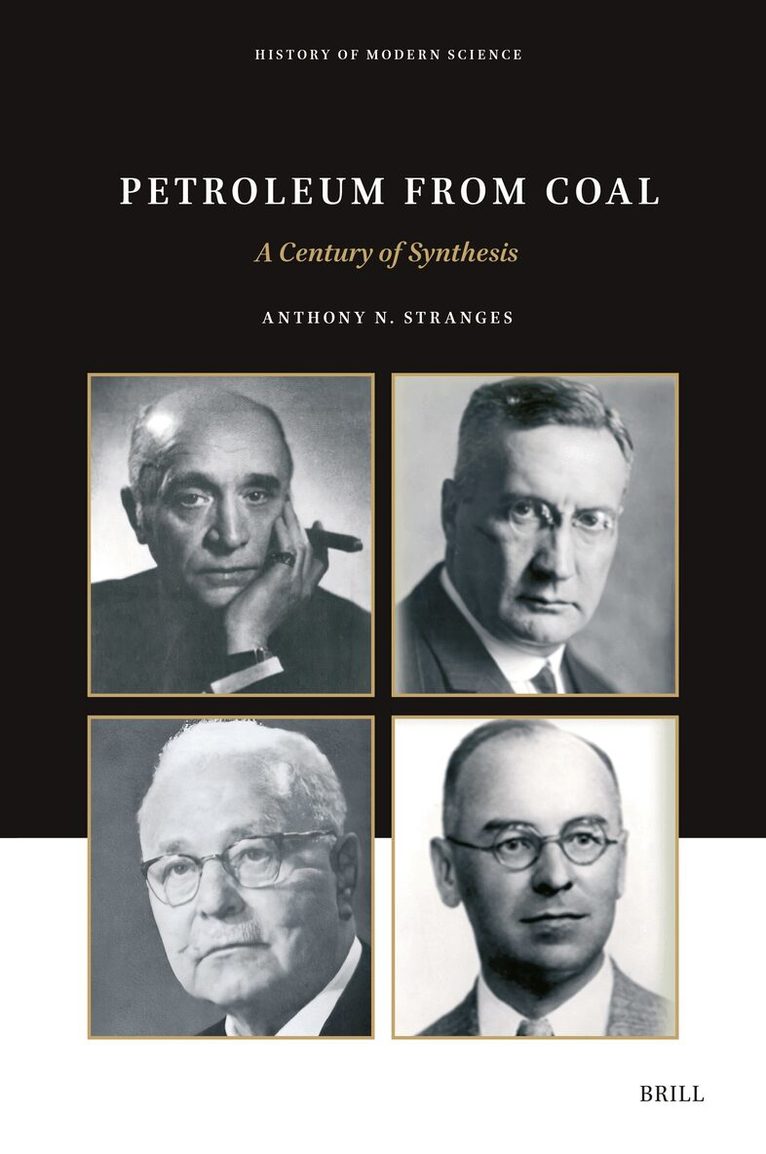
    Petroleum from Coal

    A Century of Synthesis

    AvAnthony N. Stranges

    Inbunden, Engelska, 2024

    Del 5 i serien History of Modern Science

    2 641 kr

    Beställningsvara. Skickas inom 5-8 vardagar. Fri frakt över 249 kr.

    Beskrivning

    Petroleum from Coal shows why and how Friedrich Bergius and Franz Fischer and Hans Tropsch in 1913-26 invented and developed synthetic fuel processes; explains why and how Matthias Pier at BASF- IG Farben and Otto Roelen at Ruhrchemie successfully industrialized the syntheses during the Nazi-World War II years; and analyzes the pre- and post-World War II vicissitudes of the synthetic fuel industry. The research of Germany’s scientists in the 1920s-40s made them world leaders in synthetic fuel studies. Information on the synthetic fuel processes has come from the Allied teams who went to Germany and Japan during World War II’s closing months and from British, American, and Canadian synthetic fuel investigations.

    Produktinformation

    • Utgivningsdatum:2024-05-09
    • Mått:234 x 30 x 159 mm
    • Vikt:790 g
    • Format:Inbunden
    • Språk:Engelska
    • Serie:History of Modern Science
    • Antal sidor:410
    • Förlag:Brill
    • ISBN:9789004544116

    Utforska kategorier

    • Naturvetenskapens historia inom Naturvetenskap och teknik
    • Industrialismen och industrihistoria inom Historia och arkeologi
    • Energiteknik inom Naturvetenskap och teknik

    Mer om författaren

    Anthony N. Stranges is Professor in the History Department at Texas A&M University. He teaches history of science, especially chemistry and chemical engineering. He has published several books and articles in various journals, including Isis, Technology and Culture, and Annals of Science.

    Recensioner i media

    "Petroleum from Coal: A Century of Synthesis is a foundational work on the history of synthetic fuels—thoroughly researched, rich in primary sources, and internationally comparative in scope. Of particular note is the outstanding archival work, which forms the backbone of the study and sets a methodological benchmark. [...] With this volume, Stranges has made a valuable contribution to the history of applied chemistry, industrial catalysis, and energy policy—one that is likely to serve as a reference point for future work in the history of chemistry and technology" – Christoph Kießling, in: Bulletin for the History of Chemistry (2025), p. 71"Detailed source material on synthetic processes from Germany and Japan, the countries defeated in World War II, were collected by Allied research teams. [...] In 1975, a project was initiated to gather as much material as possible in the archives of Texas A&M University. The author of this book, Anthony N. Stranges, was involved in establishing this collection at College Station, Texas. In 1984, he wrote his first article on the German development of synthetic fuels and thereafter continued to publish with some frequency in leading history of science journals. The book contains adaptations of six of his publications, the latest dating from the year 2000. The author and editor have paid special attention to thedesign of the book." – Ton van Helvoort, in: a target="_blank" href="https://www.tandfonline.com/doi/full/10.1080/00026980.2025.2516365"> Ambix (2025), pp. 1-2

    Innehållsförteckning

    • ContentsPrefacePermission AcknowledgementsList of Illustrations and TablesAbbreviations1 Overview of the Synthetic Fuel Industry1 Introductory2 Global Energy Situation 1910–90s: Energy Crises and Revivals3 Impact of Hydraulic Fracturing (Fracking) Revolution on Natural Petroleum and Synthetic Fuel Production4 Scientific and Engineering Advances in Synthetich Fuel Research and Development5 Economics and Politics of Synthetic Fuel Development6 Chapter Titles and Summaries7 A Note on Sources2 Friedrich Bergius, Franz Fischer and Hans Tropsch: The Rise of the German Synthetic Fuel Industry1 Introductory2 Hydrogenation Begins3 First Industrial Application of High-Pressure Hydrogenation4 Friedrich Bergius: Background to High-Pressure Coal Hydrogenation5 IG Farben Process and Its Industrialization in Germany6 Fischer-Tropsch Synthesis7 Conclusion3 Germany’s Synthetic Fuel Industry 1927–451 Introductory2 Germany’s Energy Plan3 BASF-IG Farben’s Coal Hydrogenation Program4 Industrial Development of the F-T Synthesis5 Summary of Synthetic Fuel Industrial Development in Germany 1927–456 Labor Force in the Synthetic Fuel Plants7 Conclusion4 From Birmingham to Billingham: High-Pressure Coal Hydrogenation in Great Britain1 Introductory2 Fischer-Tropsch Synthesis and the Beginning of Coal Hydrogenation in Britain: Birmingham3 Coal Hydrogenation at the Fuel Research Station4 Influence of Variables on the Conversion Process5 Development of a Small-Size Continuous Plant6 ICI and the Billingham Plant7 Politics and Economics8 Conclusion5 Synthetic Fuel Production in Prewar and World War II Japan: A Study in Technological Failure1 Introductory2 Overview of Japan’s Coal Conversion Processes, Seven Year Energy Plan3 Development of Japan’s Oil Shale, Derived and Synthetic Liquid Fuel Sources to 19304 Government Support of Japan’s Synthetic Fuel Industry5 Oil Shale and LTC Emerge as Major Sources of Liquid Fuel6 Research and Development of the Fischer-Tropsch Synthesis: A Promising Beginning7 Coal Hydrogenation: High Hopes but Little Success8 Japan’s IG Farben Connection9 Conclusion6 Canada’s Mines Branch and Its Synthetic Fuel Program for Energy Independence1 Introductory2 Early Concern for Fuel Supply3 Synthetic Fuel Research at the Mines Branch4 Wartime Developments on Synthetic Fuel5 Postwar Developments on Oil Sands Separation6 The Blair Report, Athabasca Conference, and the State of Canadian Fuel Research7 Canada’s Changing Energy Situation8 Conclusion7 The United States Bureau of Mines’ Synthetic Fuel Program 1920s–50s: German Connections and American Advances1 Introductory2 Early Bureau of Mines, European, and Japanese Research and Development of Derived and Synthetic Liquid Fuel3 Liquid Fuel Developments in the United States4 Development of the F-T Synthesis5 Early Research on Coal Hydrogenation6 Coal Hydrogenation and F-T Synthesis at the Bureau of Mines, the Synthetic Liquid Fuels Act of 19447 The Demonstration Synthetic Fuel Plants in Louisiana, Missouri8 Industrial Development of F-T and Coal Hydrogenation9 Concluding the Bureau’s Synthetic Fuel Program8 Epilogue: Post-World War II Synthetic Fuel Development and the Emergence of Environmental Concerns1 Introductory2 Pre-World War II Small-Scale Synthetic Fuel Developments: Italy and France 1920s–40s3 Post-World War II Synthetic Fuel Developments: Sasol 1950s–2000s4 Post-World War II Synthetic Fuel Developments: United States 1960s–80s5 Fossil Fuel, Synthetic Fuel, the Environment6 Oil Crises 1990s, Oil Shale Fracking Revolution and Its Consequences7 ConclusionBibliographyIndex