• Fri frakt över 249 kr
  • •
  • Snabba leveranser
  • •
  • Billiga böcker
Kundservice

Du är på sajten för privatpersoner.

Företag, bibliotek eller offentlig verksamhet?

Du handlar på classic.bokus.com, där alla dina funktioner finns intakta.
Till classic.bokus.com
Bokus logotyp. Gå till startsidan.
  • Erbjudanden
  • Nyheter
  • Student
  • Topplistor
  • Barn & ungdom
  • Bokus Play
  • E-böcker
  • Pocketböcker
  • Spel & pussel

10% studentrabatt med kod TERM26

Sidfot

Mina sidor

    Hjälp

    • Kundservice
    • Vanliga frågor och svar
    • Frakt och leverans
    • Retur vid ångerrätt
    • Reklamera vara
    • Betalning
    • Köpvillkor
    • Allmänna villkor
    • Information om webbplatsens tillgänglighet

    Om Bokus

    • Om oss
    • Pressrum
    • För studenter
    • För företag
    • För bibliotek och offentlig verksamhet
    • För leverantörer
    • Hållbarhet

    Populärt

    • Aktuella erbjudanden
    • Presentkort
    • Studentlitteratur
    • Nya böcker
    • Topplistor
    • Signerade böcker
    • Engelska böcker

    Inspiration

    • Boktips
    • BookTok
    • Populära bokserier
    • Barnbokskaraktärer
    • Populära författare
    Logotyp för Bokus
    Följ oss på Facebook (extern länk)Följ oss på Instagram (extern länk)Följ oss på YouTube (extern länk)Följ oss på TikTok (extern länk)
    bokus @ CookiesAnpassa cookiesIntegritetspolicyKöpvillkor
    Till Citymail hemsida (extern länk)Till Budbee hemsida (extern länk)Till Postnord hemsida (extern länk)Till Schenker hemsida (extern länk)Till Early Bird hemsida (extern länk)Till Walleys hemsida (extern länk)
    1. Historia och arkeologi
    2. Historia
    3. Historia: särskilda händelser och ämnen
    4. Socialhistoria och kulturhistoria

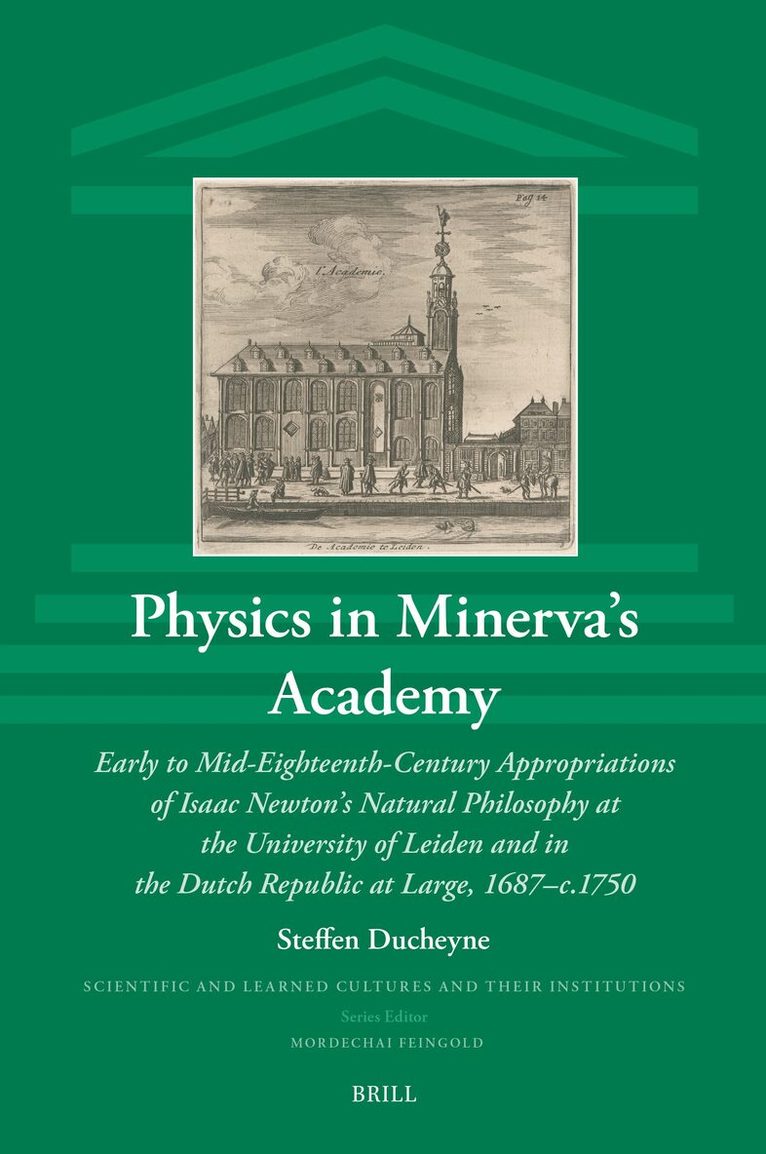
    Physics in Minerva’s Academy

    Early to Mid-Eighteenth-Century Appropriations of Isaac Newton’s Natural Philosophy at the University of Leiden and in the Dutch Republic at Large, 1687–c.1750

    AvSteffen Ducheyne

    Inbunden, Engelska, 2025

    Del 37 i serien Scientific and Learned Cultures and Their Institutions

    1 880 kr

    Beställningsvara. Skickas inom 3-6 vardagar. Fri frakt över 249 kr.

    Beskrivning

    This monograph explains how, in the aftermath of the battle over René Descartes’ philosophy, Newton’s natural philosophy found fertile ground at the University of Leiden. Newton’s natural philosophical views and methods, along with their underlying distinctions, seamlessly aligned with the University of Leiden’s institutional-religious policy, which urged professors and students to separate theology from philosophy. Additionally, these views supported the natural philosophical agendas of Herman Boerhaave, Willem Jacob's Gravesande, and Petrus van Musschenbroek. Newton’s natural philosophical program was especially useful in the three Leiden professors' project of reforming existing disciplines and providing them with epistemic legitimacy.

    Produktinformation

    • Utgivningsdatum:2025-01-30
    • Mått:155 x 235 x 36 mm
    • Vikt:917 g
    • Format:Inbunden
    • Språk:Engelska
    • Serie:Scientific and Learned Cultures and Their Institutions
    • Antal sidor:460
    • Förlag:Brill
    • ISBN:9789004716155

    Utforska kategorier

    • Socialhistoria och kulturhistoria inom Historia och arkeologi

    Mer om författaren

    Steffen Ducheyne, Ph.D. (2006), is Professor of Philosophy at the Vrije Universiteit Brussel. He is affiliated with the Centre for Logic and Philosophy of Science-The Centre Leo Apostel. He has published widely in the field of History and Philosophy of Science. He is the author of The main Business of Natural Philosophy: Isaac Newton’s Natural-Philosophical Methodology (Springer, 2017) and the editor of Reassessing the Radical Enlightenment (Routledge, 2017).

    Innehållsförteckning

    • Acknowledgements1 Isaac Newton and the University of Leiden1 ‘L’amour de la vérité m’avait conduit à Leyde’: the Academia Lugduno-Batava and Its Role in the Diffusion of Isaac Newton’s Natural Philosophy2 The Religious Uses of Newton’s Natural Philosophy3 Early to Mid-Eighteenth-Century Dutch Interest in Newton’s Natural Philosophy: a Fresh Look4 Overview and StructurePart 1: The Diffusion of Isaac Newton’s Natural Philosophy in and around Amsterdam, c.1687–17202 Adriaen Verwer and the First Edition of Isaac Newton’s Principia in the Dutch Republic1 Preamble: One of Newton’s ‘Most Valiant Soldiers’2 A doopsgezind Merchant in Amsterdam3 ‘Chaining the Hellhound’4 Entering the Republic of Letters5 Verwer as a Reader of the First Edition of the Principia6 The Foundations of Christian Faith and Natural Reason7 Conclusion3 Using One’s Talents to Honour God: Lambert ten Kate and Newton’s Natural Philosophy1 Lambert ten Kate: a Versatile Amsterdam Doopsgezinde2 Worldly Vanities and Christian Virtues3 The Impact of the Second Edition of the Principia4 Improving on Newton’s Musical Division of the Spectrum and Fortifying the Proof of God’s Being and Governing with ‘More Than a Hundred Pillars’5 Conclusion4 Countering the ‘Pernicious Pride to Know Everything:’ Bernard Nieuwentijt on Newton as a Mixed Mathematician1 Curing pansophia through ‘Learned Ignorance’2 Medicine, Mathematics and Experimental Philosophy, 1675–963 Het regt gebruik der werelt beschouwingen (1715): Nieuwentijt’s Physico-Theological and Biblical Attacks on Spinoza4 The Appropriation of Newton’s Principia in Het regt gebruik der werelt beschouwingen5 Gronden der zekerheid (1720): Nieuwentijt’s Epistemological-Methodological Attack on Spinoza6 Newton as a Mixed Mathematician7 ConclusionPart 2: The Blossoming of Newton’s Natural Philosophy at the University of Leiden, c.1710–17625 Herman Boerhaave, the Introduction of Newton’s Natural Philosophy at the University of Leiden, and the Unshackling ‘the Bondage of Sectarianism’1 Introduction2 Descartes’s Philosophy at the University of Leiden3 Burchard de Volder and the Theatrum physicum4 Wolferd Senguerd’s Anglophilia5 The Education of the ‘communis Europæ sub initia hujus seculi Præceptor’6 Medicine, Method, and Boerhaave’s ‘Mathematicorum via’, 1701–17087 The Introduction of Newton’s Work in Leiden: Boerhaave’s 1710–1711 ‘Praelectiones de methodo addiscendae medicinae’8 Boerhaave’s 1715 Rectoral Address9 Conclusion6 Willem Jacob ’s Gravesande, physica, and ‘NEWTONI vestigiis insistere’1 Introduction2 From ’s-Hertogenbosch to Leiden, 1688–17073 The Hague, Mathematics, the 1715–1716 Diplomatic Trip to England, and ‘loix particulières’4 ‘[V]ous faire voir l’estime que j’ai pour vous’: Defending Newton in the Journal litéraire de la Haye, 1713–c.17175 Newton, ‘veræ Philosophiæ Instaurator’, and Moral Certainty: 1717 and Beyond6 Epistemological and Methodological Considerations in the Preface to the First Edition of Physices elementa mathematica: 1719 and Beyond7 ’s Gravesande’s Magnum Opus: a Bird’s-Eye View8 Machinae and Experiments Galore9 Conclusion7 ‘Nullius partes sequor:’ Pieter van Musschenbroek and the Provisionalism and Fallibilism of Natural Philosophy1 Van Musschenbroek, ‘the Greatest Natural Scientists of Our Time’2 The Contours of Van Musschenbroek’s Life and Career3 Newton in Van Musschenbroek’s Orations and Writings for Students and Compatriots, 1723–1741: Nihil novi sub sole4 Beyond 1741: The Plot Thickens5 ‘The Doctrine of Firmness Will Always Escape the Sagacity of Mathematicians:’ Van Musschenbroek on Cohesion6 Conclusion8 ConclusionBibliographyGeneral Index