• Fri frakt över 249 kr
  • •
  • Snabba leveranser
  • •
  • Billiga böcker
Kundservice

Du är på sajten för privatpersoner.

Företag, bibliotek eller offentlig verksamhet?

Du handlar på classic.bokus.com, där alla dina funktioner finns intakta.
Till classic.bokus.com
Bokus logotyp. Gå till startsidan.
  • Erbjudanden
  • Nyheter
  • Student
  • Topplistor
  • Barn & ungdom
  • Bokus Play
  • E-böcker
  • Pocketböcker
  • Spel & pussel

10% rabatt på allt med kod: NYSTART10 →

Sidfot

Mina sidor

    Hjälp

    • Kundservice
    • Vanliga frågor och svar
    • Frakt och leverans
    • Retur vid ångerrätt
    • Reklamera vara
    • Betalning
    • Köpvillkor
    • Allmänna villkor
    • Information om webbplatsens tillgänglighet

    Om Bokus

    • Om oss
    • Pressrum
    • För studenter
    • För företag
    • För bibliotek och offentlig verksamhet
    • För leverantörer
    • Hållbarhet

    Populärt

    • Aktuella erbjudanden
    • Presentkort
    • Studentlitteratur
    • Nya böcker
    • Topplistor
    • Signerade böcker
    • Engelska böcker

    Inspiration

    • Boktips
    • BookTok
    • Populära bokserier
    • Barnbokskaraktärer
    • Populära författare
    Logotyp för Bokus
    Följ oss på Facebook (extern länk)Följ oss på Instagram (extern länk)Följ oss på YouTube (extern länk)Följ oss på TikTok (extern länk)
    bokus @ CookiesAnpassa cookiesIntegritetspolicyKöpvillkor
    Till Citymail hemsida (extern länk)Till Budbee hemsida (extern länk)Till Postnord hemsida (extern länk)Till Schenker hemsida (extern länk)Till Early Bird hemsida (extern länk)Till Walleys hemsida (extern länk)
    1. Filosofi och religion
    2. Filosofi
    3. Filosofiska discipliner

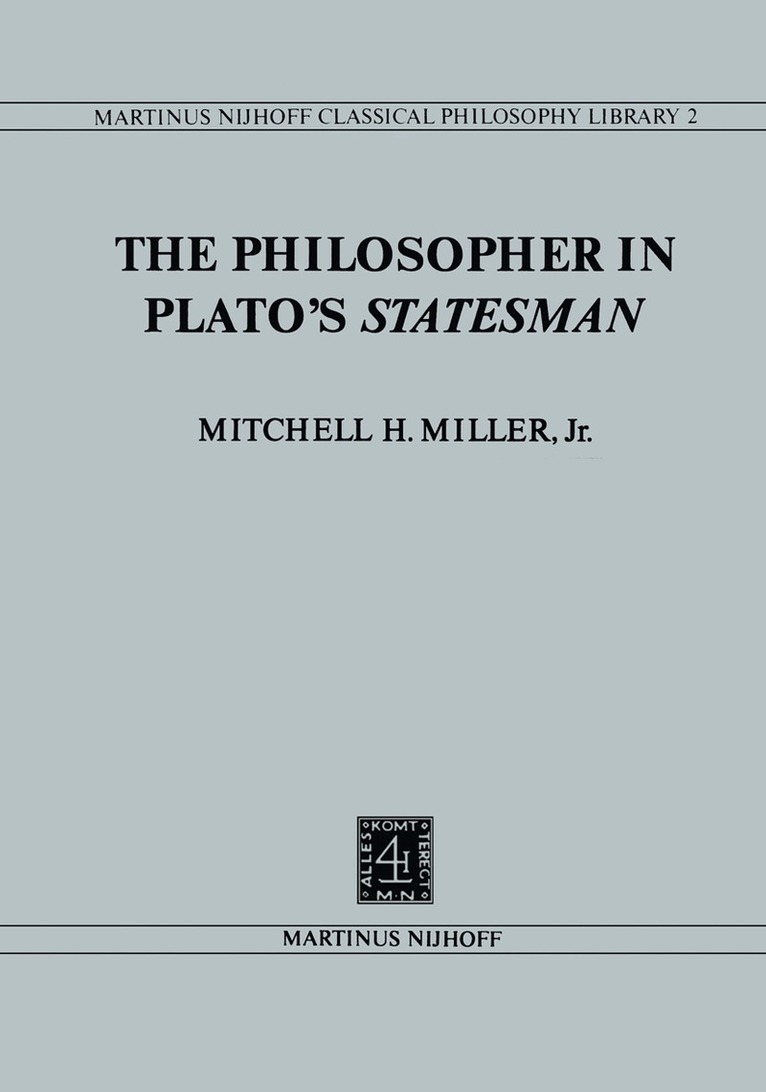
    Philosopher in Plato’s Statesman

    AvMitchell H. Miller

    Inbunden, Engelska, 1979

    Del 2 i serien Nijhoff Classical Philosophy Library

    1 086 kr

    Beställningsvara. Skickas inom 10-15 vardagar. Fri frakt över 249 kr.

    Fler format och utgåvor

    E-bok

    1 413 kr

    Häftad

    1 194 kr

    Beskrivning

    others in his discipline tend not to bring their studies to bear on the substance of the dialogues. Conversely, philosophical interpreters have generally felt free to approach the extensive logical and ontological, cosmological, and political doctrines of the later dialogues without concern for questions of literary style s and form. Given, moreover, the equally sharp distinction between the diSCiplines of philosophy and cultural history, it has been too easy to treat this bulk of doctrine without a pointed sense of the specific historical audience to which it is addressed. As a result, the pervasive tendency has been the reverse of that which has dominated the reading of the early dialogues: here we tend to neglect drama and pedagogy and to focus exclusively on philosophical substance. Both in general and particularly in regard to the later dialogues, the difficulty is that our predispositions have the force of self-fulfilling prophecy. Are we sure that the later Plato's apparent loss of interest in the dramatic is not, on the contrary, a reflection of our limited sense of the integrity of drama and sub­ stance, form and content? What we lack eyes for, of course, we will not see. The basic purpose of this essay is to develop eyes, as it were, for that integrity. The best way to do this, I think, is to take a later dialogue and to try to read it as a whole of form, content, and communicative function.

    Produktinformation

    • Utgivningsdatum:1979-12-31
    • Mått:155 x 235 x 14 mm
    • Vikt:424 g
    • Format:Inbunden
    • Språk:Engelska
    • Serie:Nijhoff Classical Philosophy Library
    • Antal sidor:144
    • Upplaga:1980
    • Förlag:Springer
    • ISBN:9789024722105

    Utforska kategorier

    • Filosofiska discipliner inom Filosofi och religion

    Innehållsförteckning

    • I. The Dramatic Context.- 1. Dramatic situation: the trial of Socrates.- 2. Dramatis personae: antipathy, eagerness, silence.- 3. The stranger from Elea.- 4. The agreement to begin.- II. The Initial Diairesis (258b–267c).- 1. Formal structure of the method; the apparent accord (258b–261e).- 2. Young Socrates’ error; the value of bifurcatory diairesis (261e–264b).- 3. The closing bifurcations; jokes and problems (264b–267c).- III. The Digressions on Substance and Method (267c–287b).- A. The first digression: the myth of the divine shepherd (267c–277a).- B. The second digression: paradigm and the mean (277a–287b).- IV. The Final Diairesis (287b–311c).- a. The change in the form of diairesis (287b ff.).- b. The first phase: the indirectly responsible arts, makers of instruments (287b–289c).- c. The second phase, part one: the directly responsible arts, subaltern servants (289c–290e).- d. The digression: philosophy and ordinary opinion; statesmanship and actual political order (291a–303d).- e. Resumption of the diairesis (second phase, part two): the true aides (303d–305e).- f. The third phase: the statesman as weaver; the virtues and the mean (305e–311c).- Notes.- Index of Historical Persons.- Index of References to Platonic Passages.