• Fri frakt över 249 kr
  • •
  • Snabba leveranser
  • •
  • Billiga böcker
Kundservice

Du är på sajten för privatpersoner.

Företag, bibliotek eller offentlig verksamhet?

Du handlar på classic.bokus.com, där alla dina funktioner finns intakta.
Till classic.bokus.com
Bokus logotyp. Gå till startsidan.
  • Erbjudanden
  • Student
  • Topplistor
  • Barn & ungdom
  • Bokus Play
  • E-böcker
  • Ljudböcker
  • Pocketböcker
  • Spel och pussel

Pocketfynda! Hundratals böcker för 49 kr/st →

Sidfot

Mina sidor

    Hjälp

    • Kundservice
    • Vanliga frågor och svar
    • Frakt och leverans
    • Retur vid ångerrätt
    • Reklamera vara
    • Betalning
    • Köpvillkor
    • Allmänna villkor
    • Information om webbplatsens tillgänglighet

    Om Bokus

    • Om oss
    • Pressrum
    • För studenter
    • För företag
    • För bibliotek och offentlig verksamhet
    • För leverantörer
    • Hållbarhet

    Populärt

    • Aktuella erbjudanden
    • Presentkort
    • Studentlitteratur
    • Nya böcker
    • Topplistor
    • Signerade böcker
    • Engelska böcker

    Inspiration

    • Boktips
    • BookTok
    • Barnbokskaraktärer
    • Populära författare
    Logotyp för Bokus
    Följ oss på Facebook (extern länk)Följ oss på Instagram (extern länk)Följ oss på YouTube (extern länk)Följ oss på TikTok (extern länk)
    bokus @ CookiesAnpassa cookiesIntegritetspolicyKöpvillkor
    Till Citymail hemsida (extern länk)Till Budbee hemsida (extern länk)Till Postnord hemsida (extern länk)Till Schenker hemsida (extern länk)Till Early Bird hemsida (extern länk)Till Walleys hemsida (extern länk)
    1. Skönlitteratur
    2. Litteraturvetenskap
    3. Litteraturvetenskap

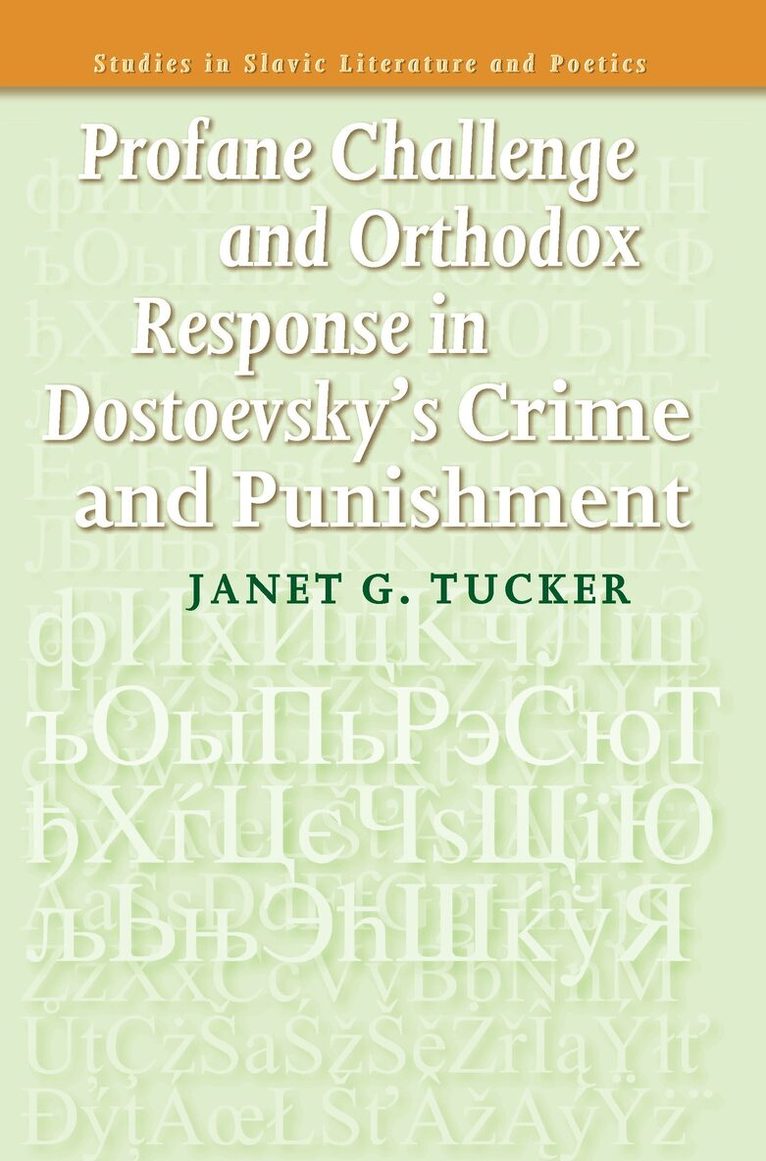
    Profane Challenge and Orthodox Response in Dostoevsky’s Crime and Punishment

    AvJanet G. Tucker

    Häftad, Engelska, 2008

    Del 52 i serien Studies in Slavic Literature and Poetics

    1 703 kr

    Beställningsvara. Skickas inom 5-8 vardagar. Fri frakt över 249 kr.

    Beskrivning

    Profane Challenge and Orthodox Response in Dostoevsky’s Crime and Punishment presents for the first time an examination of this great novel as a work aimed at winning back “target readers”, young contemporary radicals, from Utilitarianism, nihilism, and Utopian Socialism. Dostoevsky framed the battle in the context of the Orthodox Church and oral tradition versus the West. He relied on knowledge of the Gospels as text received orally, forcing readers to react emotionally, not rationally, and thus undermining the very basis of his opponents’ arguments. Dostoevsky saves Raskol’nikov, underscoring the inadequacy of rational thought and reminding his readers of a heritage discarded at their peril. This volume should be of special interest to secondary and university students, as well as to readers interested in literature, particularly, in Russian literature, and Dostoevsky.

    Produktinformation

    • Utgivningsdatum:2008-01-01
    • Mått:155 x 235 x 17 mm
    • Vikt:495 g
    • Format:Häftad
    • Språk:Engelska
    • Serie:Studies in Slavic Literature and Poetics
    • Antal sidor:285
    • Förlag:Brill
    • ISBN:9789042024946

    Utforska kategorier

    • Litteraturvetenskap inom Skönlitteratur
    • Kulturvetenskap inom Samhälle och politik

    Mer om författaren

    Janet Tucker is Professor of Russian Language and Literature at the University of Arkansas. She is the author of Innokentij Annenskij and the Acmeist Doctrine and Revolution Betrayed: Jurij Oleša’s Envy. She is also the editor of Against the Grain: Parody, Satire and Intertextuality in Russian Literature. In addition, she has contributed chapters in books, with pieces on Nikolai Gogol, Jurij Oleša and Isaak Babel. Her articles include a study of Aleksandr Pushkin’s Eugene Onegin, an essay on Varlam Shalamov, and a recent article plus a book chapter on Nikolai Gogol.

    Innehållsförteckning

    • PrefaceIntroductionChapter One: The Significance of Orality and the Oral Tradition: Dostoevsky Counter-Attacks Chapter Two: The Religious Symbolism of Cloth and Clothing in Crime and Punishment Chapter Three: Iconic Images in Crime and Punishment: Russia’s Western Capital Chapter Four: “The Parable of the Prodigal Son” in Crime and Punishment Chapter Five: The Significance of Alterity or “Otherness” in Crime and Punishment: Russian Culture and Western Change Chapter Six: The Epilogue ReconsideredConclusion BibliographyIndex