Häftad, Engelska, 2013
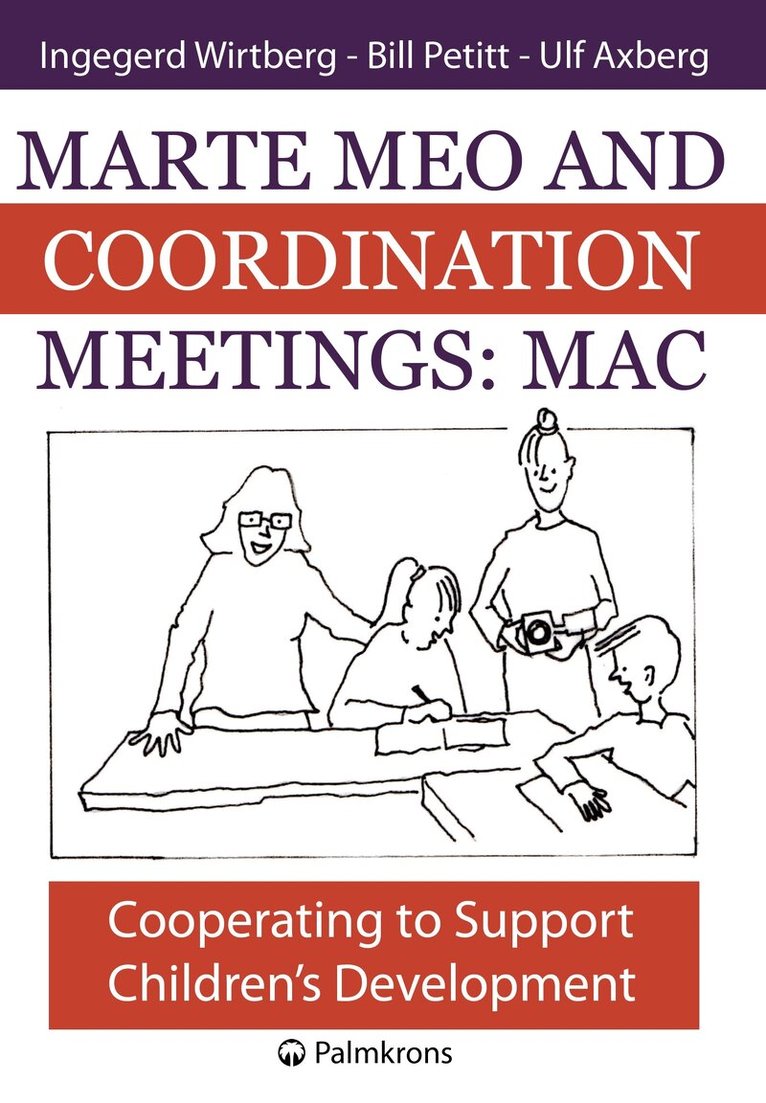
Marte meo and coordination meetings : MAC
Av Ingegerd Wirtberg, Bill Petitt, Ulf Axberg
189 kr
Skickas tisdag 13/10. Fri frakt över 249 kr.
Beskrivning
In the early 1990s two sets of experiences coincided and eventually resulted in the development of Marte Meo and Co-ordination Meetings (MAC). The first concerned my experience of inter-agency effectiveness in Sweden. In my work as an external supervisor and trainer in my hometown I often came across the same children, but in different professional contexts. They and their families had been referred to different agencies and the reason for the referral was often a teacher who expressed her concern about the child s development. The school often described these children as having interaction and learning problems. It was also common that the agencies to whom the children were referred the Social Services, Child Guidance Clinics, agencies for children with special needs etc. did not share the school s definition of the problem. This was sometimes true even for the child s parents. However, the general consensus from the professionals was that the family should receive some form of help, and that this work would then (hopefully) result in the child performing better in school. It could also be that the different agencies disagreed in their evaluation of the seriousness of the child s problem or whose responsibility it was to help. More than once I witnessed schools and other agencies criticise each other, each of them often questioning the way in which the other defined and carried out their professional responsibilities. This kind of experience strengthened the conviction that there must surely be a fairly simple and practical way for the agencies created by society in order to protect and ensure children s safety and development to co-operate more effectively, and use their resources and knowledge in a more co-ordinated fashion. Another clearly observed pattern was that when the parents of the child did not share the professional s view of the child s need for support, the resulting conflict often stopped the child from receiving any kind of support. A short history 0-titel-innehall-x.indd 7 2013-02-11 19.01 8 The second was coming into contact with and learning the videobased model named Marte Meo. I helped introduce Marte Meo into Sweden in the late eighties and although at that time nothing was known (more than anecdotal evidence) regarding the effectiveness of the model, it quickly became apparent that there was a great deal of interest to implement it in different professional settings. A colleague and friend Professor Kjell Hansson constantly reminded me about the lack of evidence, and in particular what he said was my lack of responsibility in introducing a model whose effectiveness was unknown. His friendly pressure was very helpful, and the decision was made to research the model and its effectiveness. These two sets of experiences were the starting point of what later became MAC. One of the core ideas that form the foundation of MAC is that the child can be offered help in that context where her problem is first observed and identified in this case, the school. In practice, this means that when the school seeks contact with parents, it is to ask for their consent so that the teacher can get extra help in the classroom to better support their child. Succeeding experience has shown that few parent turns down this offer. In the early stages of planning a pilot-project it became apparent that some kind of social construction a story or narrative that could be accepted by all parts was needed to keep the system of school and parents co-ordinated, and create a co-operative frame. Such a frame would help elicit the parents blessing in the school s attempt to support their children, and offer the school a rationale that would justify the extra expenditure of time and energy in the classroom. The idea of how this should happen in practice was initially rather foggy, and it proved to be a stroke of luck to invite psychologist Ulf Axberg, Ph. D. to help with the creation of this part of the project. He brought both theoretical and practical clarity with him, and researched the work, and eventually wrote his doctoral dissertation on the project. Kjell Hansson has continued to offer his invaluable collaboration during MAC s development over time, as well as to the ongoing research designed to determine its effectiveness. He has been a constant discussion partner and has given constructive feedback throughout the writing process. Ingegerd Wirtberg
Produktinformation
- Utgivningsdatum: 2013-04-26
- Mått: 149 x 210 x 12 mm
- Vikt: 280 g
- Format: Häftad
- Språk: Engelska
- Antal sidor: 185
- Förlag: Argos/Palmkrons Förlag
- ISBN: 9789189638259
Utforska kategorier
Betyg & recensioner
0 recensioner
Inga recensioner tillgängliga.