• Fri frakt över 249 kr
  • •
  • Snabba leveranser
  • •
  • Billiga böcker
Kundservice

Du är på sajten för privatpersoner.

Företag, bibliotek eller offentlig verksamhet?

Du handlar på classic.bokus.com, där alla dina funktioner finns intakta.
Till classic.bokus.com
Bokus logotyp. Gå till startsidan.
  • Erbjudanden
  • Nyheter
  • Student
  • Topplistor
  • Barn & ungdom
  • Bokus Play
  • E-böcker
  • Pocketböcker
  • Spel & pussel

10% rabatt på allt med kod NYSTART10 →

Sidfot

Mina sidor

    Hjälp

    • Kundservice
    • Vanliga frågor och svar
    • Frakt och leverans
    • Retur vid ångerrätt
    • Reklamera vara
    • Betalning
    • Köpvillkor
    • Allmänna villkor
    • Information om webbplatsens tillgänglighet

    Om Bokus

    • Om oss
    • Pressrum
    • För studenter
    • För företag
    • För bibliotek och offentlig verksamhet
    • För leverantörer
    • Hållbarhet

    Populärt

    • Aktuella erbjudanden
    • Presentkort
    • Studentlitteratur
    • Nya böcker
    • Topplistor
    • Signerade böcker
    • Engelska böcker

    Inspiration

    • Boktips
    • BookTok
    • Populära bokserier
    • Barnbokskaraktärer
    • Populära författare
    Logotyp för Bokus
    Följ oss på Facebook (extern länk)Följ oss på Instagram (extern länk)Följ oss på YouTube (extern länk)Följ oss på TikTok (extern länk)
    bokus @ CookiesAnpassa cookiesIntegritetspolicyKöpvillkor
    Till Citymail hemsida (extern länk)Till Budbee hemsida (extern länk)Till Postnord hemsida (extern länk)Till Schenker hemsida (extern länk)Till Early Bird hemsida (extern länk)Till Walleys hemsida (extern länk)
    1. Naturvetenskap och teknik
    2. Teknik och industri
    3. Elektronik och kommunikationer

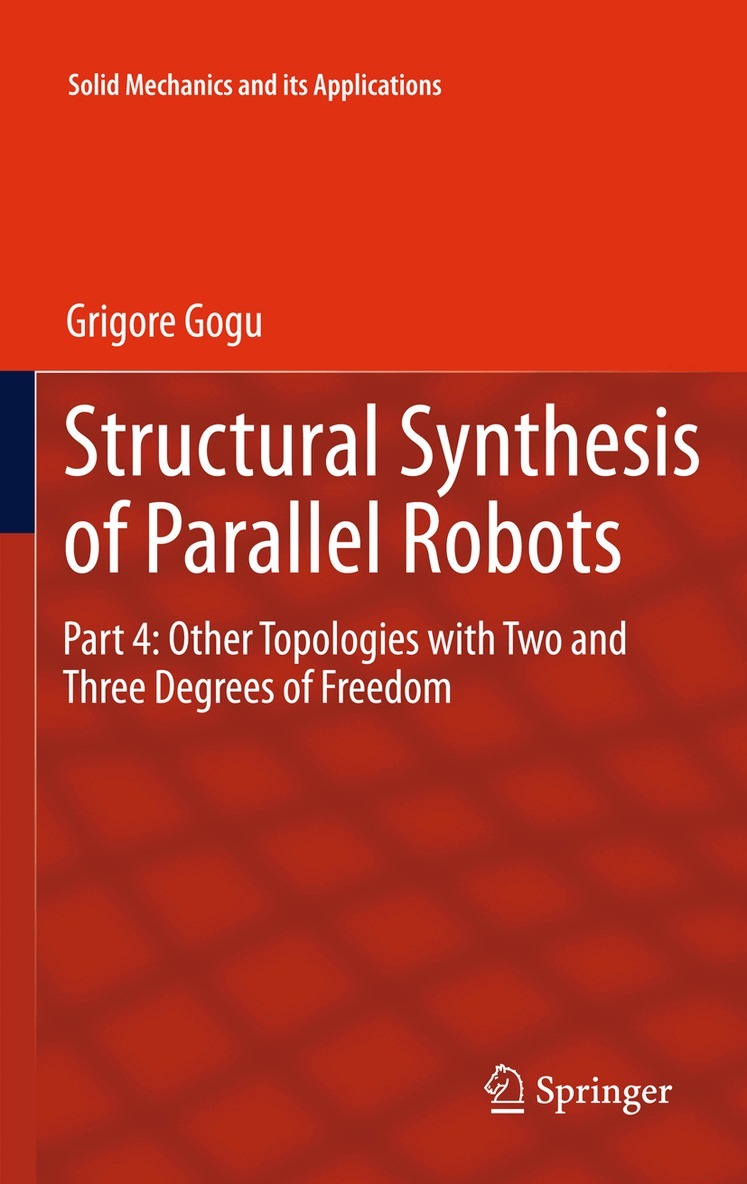
    Structural Synthesis of Parallel Robots

    Part 4: Other Topologies with Two and Three Degrees of Freedom

    AvGrigore Gogu

    Inbunden, Engelska, 2011

    Del i serien Solid Mechanics and Its Applications

    1 623 kr

    Beställningsvara. Skickas inom 10-15 vardagar. Fri frakt över 249 kr.

    Fler format och utgåvor

    Inbunden

    1 623 kr

    E-bok

    2 044 kr

    Inbunden

    1 623 kr

    E-bok

    2 051 kr

    Häftad

    1 623 kr

    Häftad

    1 623 kr

    Inbunden

    2 162 kr

    E-bok

    2 833 kr

    E-bok

    2 044 kr

    Häftad

    2 162 kr

    Beskrivning

    This book represents the fourth part of a larger work dedicated to the structural synthesis of parallel robots. Part 1 (Gogu 2008a) presented the methodology of structural synthesis and the systematisation of structural solutions of simple and complex limbs with two to six degrees of connectivity systematically generated by the structural synthesis approach. Part 2 (Gogu 2009a) presented structural solutions of translational parallel robotic manipulators with two and three degrees of mobility. Part 3 (Gogu 2010a) focussed on structural solutions of parallel robotic manipulators with planar motion of the moving platform. This book offers other topologies of parallel robotic manipulators with two and three degrees of freedom systematically generated by using the structural synthesis approach proposed in Part 1. The originality of this work resides in the fact that it combines the new formulae for mobility connectivity, redundancy and overconstraints, and the evolutionary morphology in a unified approach of structural synthesis giving interesting innovative solutions for parallel robotic manipulators. This is the first book of robotics presenting various solutions of coupled, decoupled, uncoupled, fully-isotropic and maximally regular parallel robotic manipulators with two and three degrees of freedom systematically generated by using the structural synthesis approach proposed in Part 1. Non-redundant/redundant, overconstrained/isostatic solutions with simple/complex limbs actuated by linear/rotary actuators with/without idle mobilities are proposed. Many solutions are presented here for the first time in the literature. The author had to make a difficult and challenging choice between protecting these solutions through patents, and releasing them directly into the public domain. The second option was adopted by publishing them in various recent scientific publications and mainly in this book. In this way, the author hopes tocontribute to a rapid and widespread implementation of these solutions in future industrial products.

    Produktinformation

    • Utgivningsdatum:2011-10-13
    • Mått:155 x 235 x 40 mm
    • Vikt:1 127 g
    • Format:Inbunden
    • Språk:Engelska
    • Serie:Solid Mechanics and Its Applications
    • Antal sidor:628
    • Upplaga:2012
    • Förlag:Springer
    • ISBN:9789400726741

    Utforska kategorier

    • Elektronik och kommunikationer inom Naturvetenskap och teknik
    • Klassisk mekanik inom Naturvetenskap och teknik
    • Maskinteknik och material inom Naturvetenskap och teknik

    Innehållsförteckning

    • Preface.-  Acknowledgements.-  List of abbreviations and notations.-  1 Introduction.-  1.1 Terminology.-  1.1 Links, joints and kinematic chains.-  1.2 Serial, parallel and hybrid robots.-  1.2 Methodology of structural synthesis.-  1.2.1 New formulae for mobility, connectivity, redundancy and overconstraint of parallel robots.-  1.2.2 Evolutionary morphology approach.-  1.2.3 Types of parallel robots with respect to motion coupling.-  2 Parallel mechanisms with cylindrical motion of the moving platform.-  2.1 T1R1-type parallel mechanisms with coupled cylindrical motion.-  2.1.1 Overconstrained solutions.-  2.1.2 Non overconstrained solutions.-  2.2 T1R1-type parallel mechanisms with decoupled cylindrical  motion.-  2.2.1 Overconstrained solutions.-  2.2.2 Non overconstrained solutions.-  2.3 T1R1-type parallel mechanisms with uncoupled cylindrical motion.-  2.3.1 Overconstrained solutions.-  2.3.2 Non overconstrained solutions.-  2.4 Maximally regular parallel mechanisms with cylindrical motion.-  2.4.1 Overconstrainedsolutions.-  2.4.2 Non overconstrained solutions.-  3 Other T1R1-type parallel mechanisms.-  3.1 T1R1-type parallel mechanisms with coupled motions.-  3.1.1 Overconstrained solutions.-   3.1.2 Non overconstrained solutions.-  3.2 T1R1-type parallel mechanisms with decoupled motions.-  3.2.1 Overconstrained solutions.-  3.2.2 Non overconstrained solutions.-  3.3 T1R1-type parallel mechanisms with uncoupled motions.-  3.3.1 Overconstrained solutions.-  3.3.2 Non overconstrained solutions.-  3.4 Maximally regular T1R1-type parallel mechanisms.-  3.4.1 Overconstrained solutions.-  3.4.2 Non overconstrained solutions.-  4 Parallel wrists with two degrees of freedom.-  4.1 R2-type parallel wrists with coupled motions.-  4.1.1 Overconstrained solutions.-  4.1.2 Non overconstrained solutions.-  4.2 R2-type parallel wrists with decoupled motions.-  4.2.1 Overconstrained solutions.-  4.2.2 Non overconstrained solutions.-  4.3 R2-type parallel wrists with uncoupled motions.-  4.3.1 Overconstrained solutions.-  4.3.2 Nonoverconstrained solutions.-  4.4 Maximally regular R2-type parallel wrists.-  4.4.1 Overconstrained solutions.-  4.4.2 Non overconstrained solutions.-  5 T2R1-type overconstrained spatial parallel manipulators.-  5.1 Overconstrained solutions with coupled motions.-  5.1.1 Fully-parallel solutions.-  5.1.2 Non fully-parallel solutions.-  5.2 Overconstrained solutions with decoupled motions.-  5.2.1 Fully-parallel solutions.-  5.2.2 Non fully-parallel solutions.-  5.3 Overconstrained solutions with uncoupled motions.-  5.3.1 Fully-parallel solutions.-  5.3.2 Non fully-parallel solutions.-  5.4 Overconstrained maximally regular solutions.-  5.4.1 Fully-parallel solutions.-  5.4.2 Non fully-parallel solutions.-  6 Non overconstrained T2R1-type spatial parallel manipulators.-  6.1 Non overconstrained solutions with coupled motions.-  6.1.1 Fully-parallel solutions.-  6.1.2 Non fully-parallel solutions.-  6.2 Non overconstrained solutions with decoupled motions.-  6.2.1 Fully-parallel solutions.-  6.2.2 Non fully-parallel solutions.- 6.3 Non overconstrained solutions with uncoupled motions.-  6.3.1 Fully-parallel solutions.-  6.3.2 Non fully-parallel solutions.-  6.4 Non overconstrained maximally regular solutions.-  6.4.1 Fully-parallel solutions.-  6.4.2 Non fully-parallel solutions.-  7 T1R2-type spatial parallel manipulators.-  7.1 T1R2-type spatial parallel manipulators with coupled motions.-  7.1.1 Overconstrained solutions.-  7.1.2 Non overconstrained solutions.-  7.2 T1R2-type spatial parallel manipulators with decoupled motions.-  7.2.1 Overconstrained solutions.-  7.2.2 Non overconstrained solutions.-  7.3 T1R2-type spatial parallel manipulators with uncoupled motions.-  7.3.1 Overconstrained solutions.-  7.3.2 Non overconstrained solutions.-  7.4 Maximally regular T1R2-type spatial parallel manipulators.-  7.4.1 Overconstrained solutions.-  7.4.2 Non overconstrained solutions.-  8 Parallel wrists with three degrees of freedom.-  8.1 Parallel wrists with coupled motions.-  8.1.1 Overconstrained solutions.-  8.1.2 Non overconstrained solutions.- 8.2 Parallel wrists with decoupled motions.-  8.2.1 Overconstrained solutions.-  8.2.2 Non overconstrained solutions.-  8.3 Parallel wrists with uncoupled motions.-  8.3.1 Overconstrained solutions.-  8.3.2 Non overconstrained solutions.-  8.4 Maximally regular parallel wrists.-  8.4.1 Overconstrained solutions.-  8.4.2 Non overconstrained solutions.-  9 Parallel mechanisms with dependent motions of the moving  platform.-  9.1 Solutions with two degrees of freedom.-  9.1.1 Overconstrained solutions.-  9.1.2 Non overconstrained solutions.-  9.2 Solutions with three degrees of freedom.-  9.1.1 Overconstrained solutions.-  9.1.2 Non overconstrained solutions.-  References.-  Index.