• Fri frakt över 249 kr
  • •
  • Snabba leveranser
  • •
  • Billiga böcker
Kundservice

Du är på sajten för privatpersoner.

Företag, bibliotek eller offentlig verksamhet?

Du handlar på classic.bokus.com, där alla dina funktioner finns intakta.
Till classic.bokus.com
Bokus logotyp. Gå till startsidan.
  • Erbjudanden
  • Nyheter
  • Student
  • Topplistor
  • Barn & ungdom
  • Bokus Play
  • E-böcker
  • Pocketböcker
  • Spel & pussel

10% rabatt på allt med kod: NYSTART10 →

Sidfot

Mina sidor

    Hjälp

    • Kundservice
    • Vanliga frågor och svar
    • Frakt och leverans
    • Retur vid ångerrätt
    • Reklamera vara
    • Betalning
    • Köpvillkor
    • Allmänna villkor
    • Information om webbplatsens tillgänglighet

    Om Bokus

    • Om oss
    • Pressrum
    • För studenter
    • För företag
    • För bibliotek och offentlig verksamhet
    • För leverantörer
    • Hållbarhet

    Populärt

    • Aktuella erbjudanden
    • Presentkort
    • Studentlitteratur
    • Nya böcker
    • Topplistor
    • Signerade böcker
    • Engelska böcker

    Inspiration

    • Boktips
    • BookTok
    • Populära bokserier
    • Barnbokskaraktärer
    • Populära författare
    Logotyp för Bokus
    Följ oss på Facebook (extern länk)Följ oss på Instagram (extern länk)Följ oss på YouTube (extern länk)Följ oss på TikTok (extern länk)
    bokus @ CookiesAnpassa cookiesIntegritetspolicyKöpvillkor
    Till Citymail hemsida (extern länk)Till Budbee hemsida (extern länk)Till Postnord hemsida (extern länk)Till Schenker hemsida (extern länk)Till Early Bird hemsida (extern länk)Till Walleys hemsida (extern länk)
    1. Djur och Natur
    2. Naturböcker
    3. Växtböcker

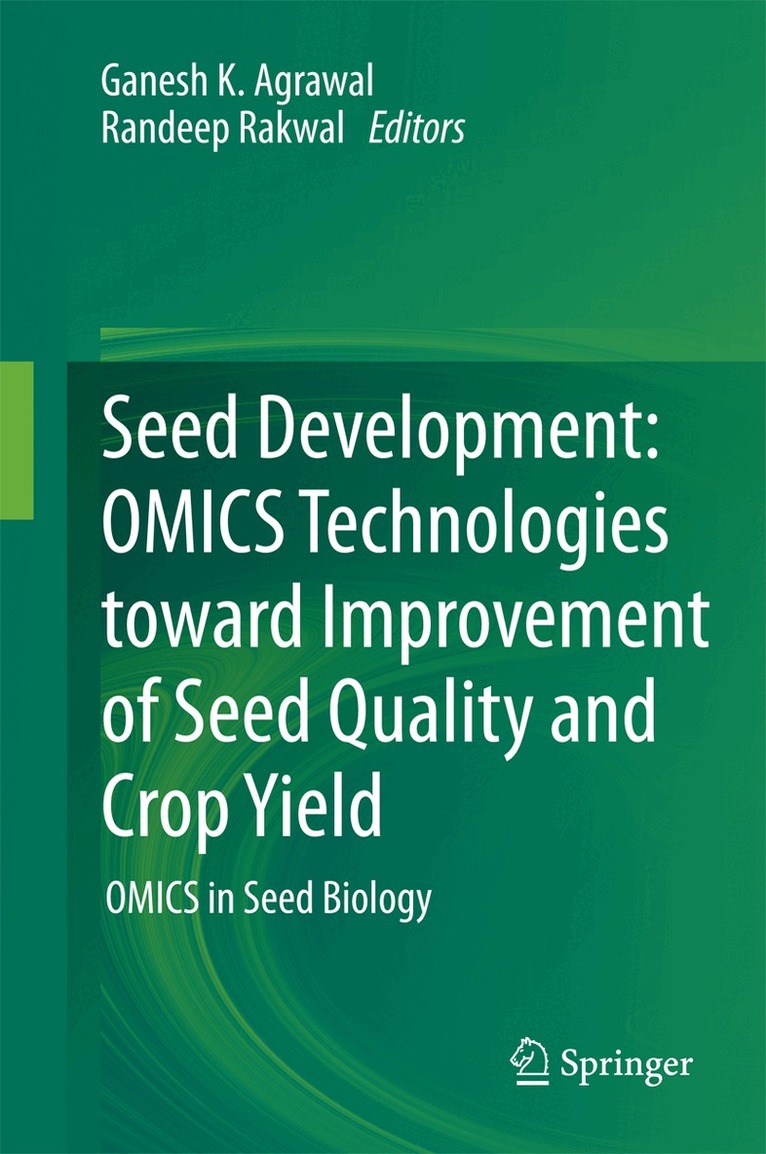
    Seed Development: OMICS Technologies toward Improvement of Seed Quality and Crop Yield

    OMICS in Seed Biology

    AvGanesh K. Agrawal,Randeep Rakwal

    Inbunden, Engelska, 2012

    2 165 kr

    Beställningsvara. Skickas inom 10-15 vardagar. Fri frakt över 249 kr.

    Beskrivning

    The book is about the seed development in the model and crop plants. Seed development is a key step of the plant life cycle that determines the nutrient value of seeds – the life for human civilization, growth, and development. The nutrient value of seeds is mainly due to storage reserve products such as carbohydrates, lipids (triacylglycerols), and proteins. The book primarily focuses on application of the 21st century high-throughput technologies transcriptomics, proteomics, metabolomics, and systems biology in near complete understanding of the various processes involved in seed development in different crop plants. The book reveals how such technologies have revolutionized our understanding of the multilayer processes and regulations involved therein by generating large-scale datasets. Accumulated datasets provide basic knowledge to develop integrated strategies to eventually improve the nutritional value of plant seed and crop yield, a critical goal in food security issues aroundthe globe.

    Produktinformation

    • Utgivningsdatum:2012-12-07
    • Mått:155 x 235 x 38 mm
    • Vikt:1 080 g
    • Format:Inbunden
    • Språk:Engelska
    • Antal sidor:576
    • Upplaga:2012
    • Förlag:Springer
    • ISBN:9789400747487

    Utforska kategorier

    • Växtböcker inom Djur och Natur
    • Botanik inom Naturvetenskap och teknik
    • Cellbiologi inom Naturvetenskap och teknik

    Innehållsförteckning

    • PREFACE.- DEDICATION.- PART I: INTRODUCTION.- 1. Seed development: A comparative overview on biology of morphology, physiology, and biochemistry between monocot and dicot plants.- 2. Proteomics reveals a potential role of the perisperm in starch remobilization during sugarbeet seed germination.- 3. Omics platforms: Importance of 21st century genome-enabled technologies in seed developmental research for improved seed quality and crop yield.- PART II: TRANSCRIPTOMICS.- 4. Rice seed development: A cornerstone for cereal crops.- 5. A transcriptional roadmap for seed development in maize.- 6. Using transcriptomics to reveal gene networks of seed development in Arabidopsis.- 7. The Medicago truncatula gene expression atlas (MtGEA): A tool for legume seed biology and biotechnology.- 8. Transcriptomics of legume seed: Soybean a model grain legume.- 9. Peanut seed development: Molecular mechanisms of storage reserve mobilization and effect of water deficit stress on seed metabolism.- 10. Probing the genes expressed in developing seed of oilseed plants: Brassica napus (L.) as a case example.- 11. Networks of seed storage protein regulation networks in cereals and legumes at the dawn of the omics era.- PART III: PROTEOMICS.- 12. Organelle proteomics of developing seeds: Comparison with other plant tissue organelles.- 13. Proteomics in identifying new regulatory mechanisms involved in seed development and ultimately seed quality.- 14. Digging deeper into the seed proteome: Pre-fractionation of total proteins.- 15. The central role of phosphoenolpyruvate metabolism in developing oilseeds.- PART IV: METABOLOMICS.- 16. Search for low-molecular-weight biomarkers in plant tissues and seeds using metabolomics: tools, strategies, and applications.- PART V: TOWARDS SYSTEMS BIOLOGY: ORGANIZATION, INTEGRATION AND MODELIZATION OF DATA.- 17. Plant metabolic pathways: Database and pipeline for stoichiometric analysis.- 18. Coupled transcript-metabolite profiling: Towards systems biology approaches to unravel regulation of seed secondary metabolism.- 19. Using systems approaches to analyze metabolic networks involved in storage reserves synthesis in developing seeds.- 20. Metabolic specialization of maternal and filial tissues.- PART VI: DISCOVERY-DRIVEN SEED AND YIELD IMPROVEMENT.- 21. Marker-aided breeding revolutionizes 21st century crop improvement.- 22. Metabolomics-assisted crop breeding towards improvement in seed quality and yield.- 23. A role for "omics" technologies in exploration of the seed nutritional quality.- 24. Using genome-enabled technologies to address allergens in seeds of crop plants: Legumes as a case study.- 25. Improving quality and content of oils in seeds: Strategies, approaches, and application towards engineering new oilseed crop plants.- 26. Integrating “omics” in food quality and safety assessment.- PART VII: APPENDIX.- References.- Abbreviations.- Editors’ acknowledgment to contributors.- Editors’ biographies.- Index.