• Fri frakt över 249 kr
  • •
  • Snabba leveranser
  • •
  • Billiga böcker
Kundservice

Du är på sajten för privatpersoner.

Företag, bibliotek eller offentlig verksamhet?

Du handlar på classic.bokus.com, där alla dina funktioner finns intakta.
Till classic.bokus.com
Bokus logotyp. Gå till startsidan.
  • Erbjudanden
  • Nyheter
  • Student
  • Topplistor
  • Barn & ungdom
  • Bokus Play
  • E-böcker
  • Pocketböcker
  • Spel & pussel

10% rabatt på allt med kod: NYSTART10 →

Sidfot

Mina sidor

    Hjälp

    • Kundservice
    • Vanliga frågor och svar
    • Frakt och leverans
    • Retur vid ångerrätt
    • Reklamera vara
    • Betalning
    • Köpvillkor
    • Allmänna villkor
    • Information om webbplatsens tillgänglighet

    Om Bokus

    • Om oss
    • Pressrum
    • För studenter
    • För företag
    • För bibliotek och offentlig verksamhet
    • För leverantörer
    • Hållbarhet

    Populärt

    • Aktuella erbjudanden
    • Presentkort
    • Studentlitteratur
    • Nya böcker
    • Topplistor
    • Signerade böcker
    • Engelska böcker

    Inspiration

    • Boktips
    • BookTok
    • Populära bokserier
    • Barnbokskaraktärer
    • Populära författare
    Logotyp för Bokus
    Följ oss på Facebook (extern länk)Följ oss på Instagram (extern länk)Följ oss på YouTube (extern länk)Följ oss på TikTok (extern länk)
    bokus @ CookiesAnpassa cookiesIntegritetspolicyKöpvillkor
    Till Citymail hemsida (extern länk)Till Budbee hemsida (extern länk)Till Postnord hemsida (extern länk)Till Schenker hemsida (extern länk)Till Early Bird hemsida (extern länk)Till Walleys hemsida (extern länk)
    1. Naturvetenskap och teknik
    2. Geovetenskap
    3. Geovetenskap

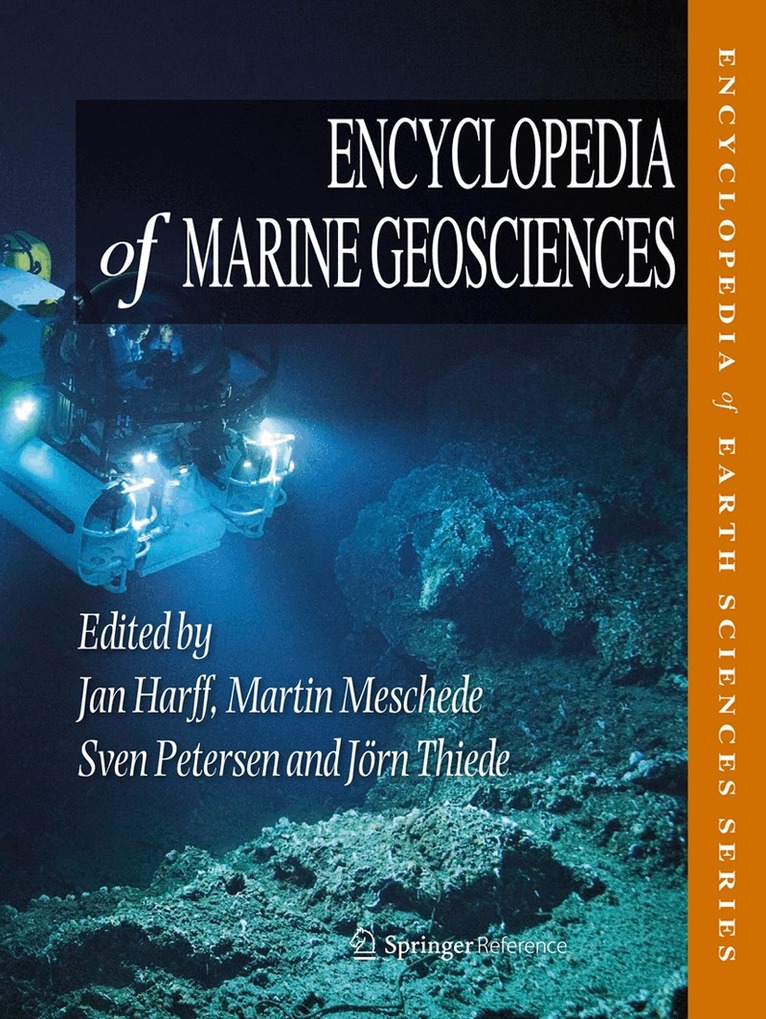
    Encyclopedia of Marine Geosciences

    AvJan Harff,Martin Meschede

    Inbunden, Engelska, 2016

    Del i serien Encyclopedia of Earth Sciences Series

    7 021 kr

    Beställningsvara. Skickas inom 10-15 vardagar. Fri frakt över 249 kr.

    Beskrivning

    This Encyclopedia comprises the current knowledge in marine geosciences whereby not only basic but also applied and technical sciences are covered. Through this concept a broad scale of users in the field of marine sciences and techniques is addressed, from students and scholars in academia to engineers and decision makers in industry and politics. Globally growing demand of energy and mineral resources, reliable future projection of climate processes and the protection of coasts to mitigate the threats of disasters and hazards require a comprehensive understanding of the structure, ongoing processes and genesis of the marine geosphere. Beyond the “classical” research fields in marine geology in current time more general concepts have been evolved integrating marine geophysics, hydrography, marine biology, climatology and ecology. As an umbrella the term “marine geosciences” has been broadly accepted for this new complex field of research and the solutions of practical tasks in the marine realm.

    Produktinformation

    • Utgivningsdatum:2016-07-05
    • Mått:210 x 279 x 43 mm
    • Vikt:2 926 g
    • Format:Inbunden
    • Språk:Engelska
    • Serie:Encyclopedia of Earth Sciences Series
    • Antal sidor:961
    • Upplaga:2016
    • Förlag:Springer
    • ISBN:9789400762374

    Utforska kategorier

    • Geovetenskap inom Naturvetenskap och teknik
    • Geologi inom Naturvetenskap och teknik
    • Biovetenskap inom Naturvetenskap och teknik

    Mer om författaren

    Jan Harff is Professor of Geosciences and Seafloor Geology at the University of Szczecin, Poland. His previous research focused on  sedimentary basin analysis at the Central Institute for Physics of the Earth (ZIPE, subsequently the GeoForschungsZentrum, GFZ), Potsdam, and  marine geology at the Leibniz Institute for Baltic Sea Research Warnemünde and the University of Greifswald, Germany. He cooperates, on a permanent basis,  with marine research institutes of the Chinese Academy of Sciences, Chinese universities and the  Guangzhou Marine Geological Survey, Guangzhou, China. His research interests concern marine geology in general, sedimentology, coastal geology, palaeo-oceanography, palaeoclimatology, mathematical geology and basin modelling. In addition to having authored and co-authored numerous research papers and having served as editor of other scientific publications, he acted as corresponding editor of “Modeling of Sedimentary Systems” (Springer,1999) and “The Baltic Sea Basin” (Springer, 2011).Martin Meschede is Professor of “Regional and Structural Geology” at the Institute of Geography and Geology, University of Greifswald, Germany. His research interests focus on geodynamic processes at plate margins, subduction, large igneous provinces, exhumation, paleogeography, paleoclimatology, basin evolution, and glacial tectonics. He participated in several marine research expeditions, among these are the Joides Resolution of IODP and a diving cruise with Shinkai 6500. Besides a number of scientific publications, he is author and coauthor of several textbooks on plate tectonics, structural geology, and regional geology of Germany.Sven Petersen is a senior researcher at GEOMAR, Helmholtz Centre for Ocean Research Kiel in Germany. His research focuses on understanding the processes that form and change seafloor hydrothermal systems and associated mineral deposits with time. He participated in more than 30 researchcruises to submarine hydrothermal systems in the Pacific, Atlantic, and Indian Ocean. Major aims of his research are to understand their chemical variability, the use of mobile drilling techniques and geophysical methods to investigate their sub-seafloor extent as well as the use of autonomous underwater vehicles for their exploration.Jörn Thiede is the leader of the KÖPPEN-Laboratory of the Institute of Earth Sciences of Saint Petersburg State University. He worked 1967-1987 at the universities of Aarhus (Denmark), Bergen (Norway), Oregon State University in Corvallis (USA), Oslo (Norway) and Kiel (Germany) and learned to sail the world’s oceans to understand their history. Afterwards he pursued the foundation of GEOMAR. In 1997 he joined  The Alfred Wegener Institute-Helmholtz Centre for Polar and Marine Research. In 2008 he served at the Geocenter Denmark as well as at UNIS (Longyearbyen/Svalbard) and in 2011 was invited to join the St. Petersburg State University (Russia).

    Recensioner i media

    “This title in the Encyclopedia of Earth Sciences Series covers approximately 195 topics under the umbrella term marine geosciences, which incorporates marine geophysics, hydrography, climatology, marine biology, and ecology. … The writing and subject matter are advanced. For those libraries (academic and public) looking for a reliable and authoritative reference on marine geosciences, this is a highly recommended resource.” (American Reference Books Annual ARBA, June, 2018)Encyclopedia of Marine Geosciences wins GSIS Mary B. Ansari Best 2017 Research Resource Work Award The Encyclopedia of Marine Geosciences has been selected to receive the 2017 GSIS Mary B. Ansari Best Research Resource Work Award. J. Harff, M. Meschede, S. Petersen and J. Thiede are the editors of this reference work published by Springer in 2016.The Geoscience Information Society has presented the GSIS Mary B. Ansari Best Reference Work Award annually since 1988. The award honors an outstanding reference work published in the field of geoscience information during the previous three years“This Encyclopedia from Springer Reference is an excellent source. The information is clear, concise and easy to use for multiple levels of users. Those users at advanced levels can find additional information through the bibliography and cross-references. … Overall this is a good multilevel resource that can be used by all levels of university and a basic resource for the serious researcher in the area of marine geosciences.” (Victoria Packard, Reference Reviews, Vol. 37 (5), 2017)

    Innehållsförteckning

    • Abyssal plain.- Accretionary wedge.- Acidification.- Active continental margin.- Anoxic oceans.- Asphalt volcanism.- Axial magma chamber.- Axial summit graben, axial summit trough.- Backarc basins and backarc spreading center.- Beach.- Beach nourishment.- Beach processes.- Biochronology.- Biogenic barium.- Biostratigraphy.- Bioturbation.- Black and white smoker.- Boninites.- Bottom simulating seismic reflector (BSR).- Bottom-boundary layer.- Bouma sequence.- Break waters.- Carbon dioxide and climate (carbon cycle).- Carbon isotopes/-stratigraphy.- Carbon pump.- Carbonate dissolution.- Carbonate factory.- CCD.- Chemosynthetic life.- Clay minerals.- Coastal bio-geochemical cycles.- Coastal engineering.- Coasts.- Cold seeps.- Continental margin sediments.- Continental rift system, graben.- Continental rise.- Continental slope.- Contour currents.- Convergence texture of seismic reflectors.- Core-complex formation.- Crustal accretion (incl. gabbro glacier model).- Cumulate.- Curie temperature.- Currents.- Data banks (Pangaea).- Decollement.- Deep biosphere.- Deep Sea Fans.- Deep sea sediments.- Delta.- Depleted mantle.- Detachment fault.- Diatoms.- Dinoflagellates.- Driving forces (slab pull, ridge push).- Dunes.- Dust in the ocean.- Dykes.- Earthquake.- El Nino.- Energy resources.- Epicenter, hypocenter.- Erosion and hiatusses.- Estuary, estuarine/anti-estuarine current system.- Eustasy .- Events in ocean history.- Explosive volcanism in the deep sea.- Export production.- Fault-plane solution.- Fjord.- Foraminifers (benthic).- Foraminifers (planktonic).- Forebulge (lithospheric).- Fracture zone.- Fresh water in the oceans.- Gabbro.- Gas hydrates.- GEBCO.- Geochronology.- Geohazards (coastal disasters).- Geological effects of ocean circulation.- Geomagnetic field.- Glacial marine sedimentation.- Glacio-isostatic adjustment.- Gravity field.- Grounding line.- Groynes.- Guyot, atoll.- Heat flow.- High-pressure/low temperature metamorphism.- History of Marine Geology.- Hot spots and mantle plumes .- Hurricanes/ Typhoons.- Hydrocarbons (natural oil and gas).- Hydrothermalism.- Hydrothermal plumes.- Hydrothermal vent fluids.- IBCAO.- Ice rafted debris (IRD).- Impacts and their products.- Integrated Coastal Zone Management.- Intracontinental rifting.- Intraoceanic subduction zone.- Intraplate volcanism.- Island arc volcanism, volcanic arcs.- Lagoon.- Laminated sediments.- Large igneous provinces (LIP).- Lava types (pillow lava, sheet flows, lobate, etc).- Layering of oceanic crust.- Lithosphere.- Lithospheric mantle.- Lithostratigraphy.- Magmatism at convergent plate boundaries.- Magnetostratigraphy.- Magnetism and paleomagnetism.- Manganese crusts, Co-rich manganese crusts.- Manganese nodules.- Mangrove coast.- Mantle plume.- Marginal seas.- Marine evaporites.- Marine microfossils .- Marine mineral resources.- Marine sedimentary basins.- Mass wasting (slides).- Methane in sediments.- Mid-ocean ridges .- Mid-ocean ridge magmatism.- Milankovitch frequencies/-cyclicities.- Modelling past oceans.- Modern analog technique.- Mohorovicic-discontinuity (Moho).- Morain.- Morphology of a subuction zone (forearc, backarc, deep sea trench).- Mud volcano.- Nannoplankton/ coccolithophorids.- Nitrogene (stable) isotopes.- North Atlantic Oscillation (NAO).- Oceanic crust.- Ocean drilling.- Ocean margin systems.- Oceanic rift system, Mid-Oceanic Ridge.- Oil spill.- Ophiolite.- Organic matter.- Orogeny.- Overlapping spreading center .- Oxygen isotopes and –stratigraphy.- Paired metamorphic belt.- Paleoceanographic proxies.- Paleoceanography.- Paleophysiography of ocean basins.- Paleoproductivity.- Passive plate margin.- Peridotite.- Petroleum, natural gas.- phosphorites .- Placer deposits.- Plate motion.- Plate stratigraphy.- Pollen/spores.- Precambrian ocean basins.- Propagating rift.- Pteropods.- Pull-apart basin.- Push-up block.- Radiocarbon dating.- Radiogenic tracers.- Radiolarians.- Reef coast.- Reefs.- Regional marine geology.- Regional oceanography and sediments.- Reflection/refraction seismology.- Regression.- Relative sea level (RSL) cycle.- Ridge-plume interaction.- Salt domes in the ocean.- Sapropel.- Sclerochronology.- Sea floor spreading .- Sea level dynamics.- Sea walls / revetments.- Seamounts.- Sediment dynamic.- Sediment transport models.- Sedimentary Sequence / parasequence.- Seismic layers.- Seismogenic zone.- Sequence stratigraphy.- Serpentinization.- Shelf.- Silica.- Source rocks, reservoirs.- Spreading axis.- Spreading rates and ridge morphology.- Stratigraphy (table).- Subduction.- Subduction erosion.- Submarine canyon.- Subsidence.- Systems tracts (highstand, lowstand, transgressive, shelf margin).- Technology in marine geosciences.- Terrane.- Tidal coast.- Transform fault .- Transgression.- Triple junction.- Tsunamis.- Turbidite / contourite.- Underwater archaeology.- Upwelling in the ocean and its geological effects.- Volcanic eruptions as hazards.- Volcanism and climate.- Volcanogenic massive sulfides .- Wadati- Benioff-zone.- Wadden Sea.- Waves.- Wilson cycle.