• Fri frakt över 249 kr
  • •
  • Snabba leveranser
  • •
  • Billiga böcker
Kundservice

Du är på sajten för privatpersoner.

Företag, bibliotek eller offentlig verksamhet?

Du handlar på classic.bokus.com, där alla dina funktioner finns intakta.
Till classic.bokus.com
Bokus logotyp. Gå till startsidan.
  • Erbjudanden
  • Nyheter
  • Student
  • Topplistor
  • Barn & ungdom
  • Bokus Play
  • E-böcker
  • Pocketböcker
  • Spel & pussel

10% rabatt på allt med kod: NYSTART10 →

Sidfot

Mina sidor

    Hjälp

    • Kundservice
    • Vanliga frågor och svar
    • Frakt och leverans
    • Retur vid ångerrätt
    • Reklamera vara
    • Betalning
    • Köpvillkor
    • Allmänna villkor
    • Information om webbplatsens tillgänglighet

    Om Bokus

    • Om oss
    • Pressrum
    • För studenter
    • För företag
    • För bibliotek och offentlig verksamhet
    • För leverantörer
    • Hållbarhet

    Populärt

    • Aktuella erbjudanden
    • Presentkort
    • Studentlitteratur
    • Nya böcker
    • Topplistor
    • Signerade böcker
    • Engelska böcker

    Inspiration

    • Boktips
    • BookTok
    • Populära bokserier
    • Barnbokskaraktärer
    • Populära författare
    Logotyp för Bokus
    Följ oss på Facebook (extern länk)Följ oss på Instagram (extern länk)Följ oss på YouTube (extern länk)Följ oss på TikTok (extern länk)
    bokus @ CookiesAnpassa cookiesIntegritetspolicyKöpvillkor
    Till Citymail hemsida (extern länk)Till Budbee hemsida (extern länk)Till Postnord hemsida (extern länk)Till Schenker hemsida (extern länk)Till Early Bird hemsida (extern länk)Till Walleys hemsida (extern länk)
    1. Historia och arkeologi
    2. Arkeologi

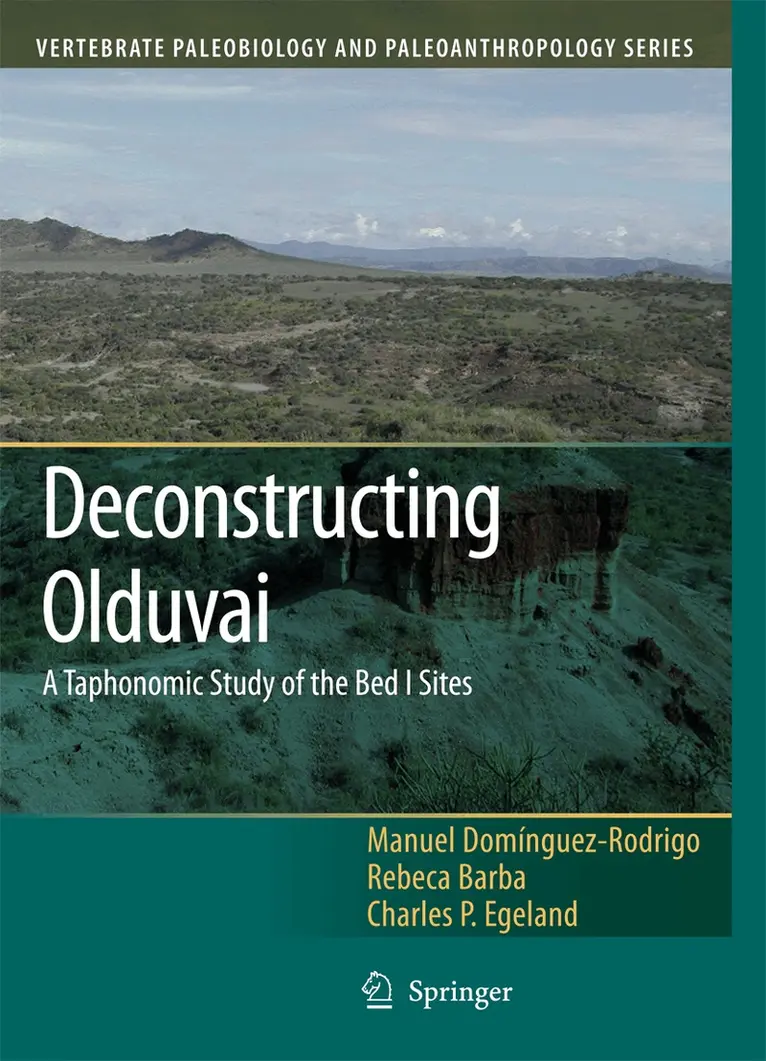
    Deconstructing Olduvai: A Taphonomic Study of the Bed I Sites

    AvManuel Domínguez-Rodrigo,Rebeca Barba

    Häftad, Engelska, 2014

    Del i serien Vertebrate Paleobiology and Paleoanthropology

    563 kr

    Beställningsvara. Skickas inom 10-15 vardagar. Fri frakt över 249 kr.

    Fler format och utgåvor

    Inbunden

    563 kr

    Beskrivning

    Plio-Pleistocene sites are a rare occurrence in same sites. This combination of factors is the archaeological record. When they are unique in East African Plio-Pleistocene uncovered, the faunal materials so crucial to archaeology and has stimulated much debate unlocking their behavioral meaning are often over the socioeconomic function of early sites. poorly preserved. For example, at Koobi Fora, Influential models of early hominid behavior Kenya, a prolific region that preserves several in the late 1960s and early 1970s were based classic Plio-Pleistocene sites, many bones are exclusively on information from Olduvai affected by poor cortical surface preservation Gorge (Leakey, 1971). Although Isaac’s (e. g. , (Isaac, 1997). Such taphonomic vagaries limit 1978) work at Koobi Fora expanded their the range of questions that can be addressed application, the subsequent critiques, modi- with these assemblages. In other instances, cations, and reformulations of these models access to materials can be limited due to local were based almost solely on studies from politics or rivalries between individual Olduvai (Binford, 1981, 1984; Bunn, 1981; research teams. As a result, many important Potts, 1982, 1988; Bunn and Kroll, 1986; assemblages either remain unstudied or have Blumenschine, 1995; Rose and Marshall, been interpreted without the advantage of a 1996; Domínguez-Rodrigo, 1997a, 2002; fully developed taphonomic framework, a sit- Plummer, 2004). Having said that, it is also uation that all but guarantees stagnant inter- clear that continued work at Koobi Fora and pretations.

    Produktinformation

    • Utgivningsdatum:2014-09-18
    • Mått:210 x 280 x 20 mm
    • Vikt:871 g
    • Format:Häftad
    • Språk:Engelska
    • Serie:Vertebrate Paleobiology and Paleoanthropology
    • Antal sidor:292
    • Upplaga:2007
    • Förlag:Springer
    • ISBN:9789400786776

    Utforska kategorier

    • Arkeologi inom Historia och arkeologi
    • Antropologi inom Samhälle och politik
    • Geologi inom Naturvetenskap och teknik

    Mer om författaren

    Manuel Domínguez-Rodrigo is a professor of Archaeology in the Department of Prehistory of the Complutense University, Madrid. He is co-editor of Journal of Taphonomy. He has been the head of research projects on human evolution conducted in Peninj, Eyasi and Olduvai Gorge (Tanzania), as well as having participated in research conducted in Gona (Ethiopia) and Swartkrans (South Africa). He is associate researcher of the National Museums of Kenya.Rebeca Barba got her doctorate in Archaeology in the Complutense University under the supervision of MDR. She has conducted research in Peninj and Olduvai. He is associate researcher of the National Museums of Kenya.Charles P. Egeland recently recieved his Ph.D. in Anthropology from Indiana University in Bloomington. In addition to his work in Tanzania, he has conducted field and lab research in South Africa, Kenya, Germany and several U.S. states.

    Recensioner i media

    From the reviews: "The book is divided into 16 chapters. ... The monograph is data-rich, with abundant tables for each studied strata listing species and skeletal part representation, as well as graphical summaries of the locations of each individual surface modification (whether by hominin or carnivore) on bovid long bones. ... Deconstructing Olduvai is an important paleoanthropological contribution ... ." Christian A. Tryon, Journal of Mammalian Evolution, 2008. "This volume provides a fresh look at an old issue - i.e. that hominins were primary agents in the formation of these sites - and suggests that site formation is heterogeneous and complicated during Bed I times at Olduvai Gorge." Journal of Human Evolution, 31 August 2009

    Innehållsförteckning

    • The “home base” debate.- The Hunting-versus-scavenging debate.- The “physical attribute” taphonomic approach.- Geological and paleoecological overview of Olduvai Gorge.- New estimates of tooth-mark and percussion-mark frequencies at the FLK Zinjanthropus level: the carn.- The behavioral meaning of cut marks at the FLK Zinj level: the carnivore-hominid-carnivore hypothesis falsified (II).- A cautionary tale about early archaeological sites: a reanalysis of FLK North 6.- A palimpsest at FLK North 1-2: independent carnivore- and hominid-made bone accumulations.- A taphonomic study of FLK North 3 and 4: a felid-hyaenid and hominid palimpsest.- Zooarchaeology and taphonomy of FLK North 5.- Natural background bone assemblages and their ravaging stages in Olduvai Bed I.- FLK North North 1: “living floor” or natural accumulation?.- Zooarchaeology and taphonomy of FLK North North 2.- Reanalysis of FLK North North 3: yet another case of a palimpsest?.- Zooarchaeology and taphonomy of the DK site.