• Fri frakt över 249 kr
  • •
  • Snabba leveranser
  • •
  • Billiga böcker
Kundservice

Du är på sajten för privatpersoner.

Företag, bibliotek eller offentlig verksamhet?

Du handlar på classic.bokus.com, där alla dina funktioner finns intakta.
Till classic.bokus.com
Bokus logotyp. Gå till startsidan.
  • Erbjudanden
  • Student
  • Topplistor
  • Barn & ungdom
  • Bokus Play
  • E-böcker
  • Ljudböcker
  • Pocketböcker
  • Spel & pussel

10% rabatt på allt med kod NYSTART10 →

Sidfot

Mina sidor

    Hjälp

    • Kundservice
    • Vanliga frågor och svar
    • Frakt och leverans
    • Retur vid ångerrätt
    • Reklamera vara
    • Betalning
    • Köpvillkor
    • Allmänna villkor
    • Information om webbplatsens tillgänglighet

    Om Bokus

    • Om oss
    • Pressrum
    • För studenter
    • För företag
    • För bibliotek och offentlig verksamhet
    • För leverantörer
    • Hållbarhet

    Populärt

    • Aktuella erbjudanden
    • Presentkort
    • Studentlitteratur
    • Nya böcker
    • Topplistor
    • Signerade böcker
    • Engelska böcker

    Inspiration

    • Boktips
    • BookTok
    • Populära bokserier
    • Barnbokskaraktärer
    • Populära författare
    Logotyp för Bokus
    Följ oss på Facebook (extern länk)Följ oss på Instagram (extern länk)Följ oss på YouTube (extern länk)Följ oss på TikTok (extern länk)
    bokus @ CookiesAnpassa cookiesIntegritetspolicyKöpvillkor
    Till Citymail hemsida (extern länk)Till Budbee hemsida (extern länk)Till Postnord hemsida (extern länk)Till Schenker hemsida (extern länk)Till Early Bird hemsida (extern länk)Till Walleys hemsida (extern länk)
    1. Psykologi och pedagogik
    2. Pedagogik
    3. Skolväsen och utbildningssystem
    4. Examination och betygsättning

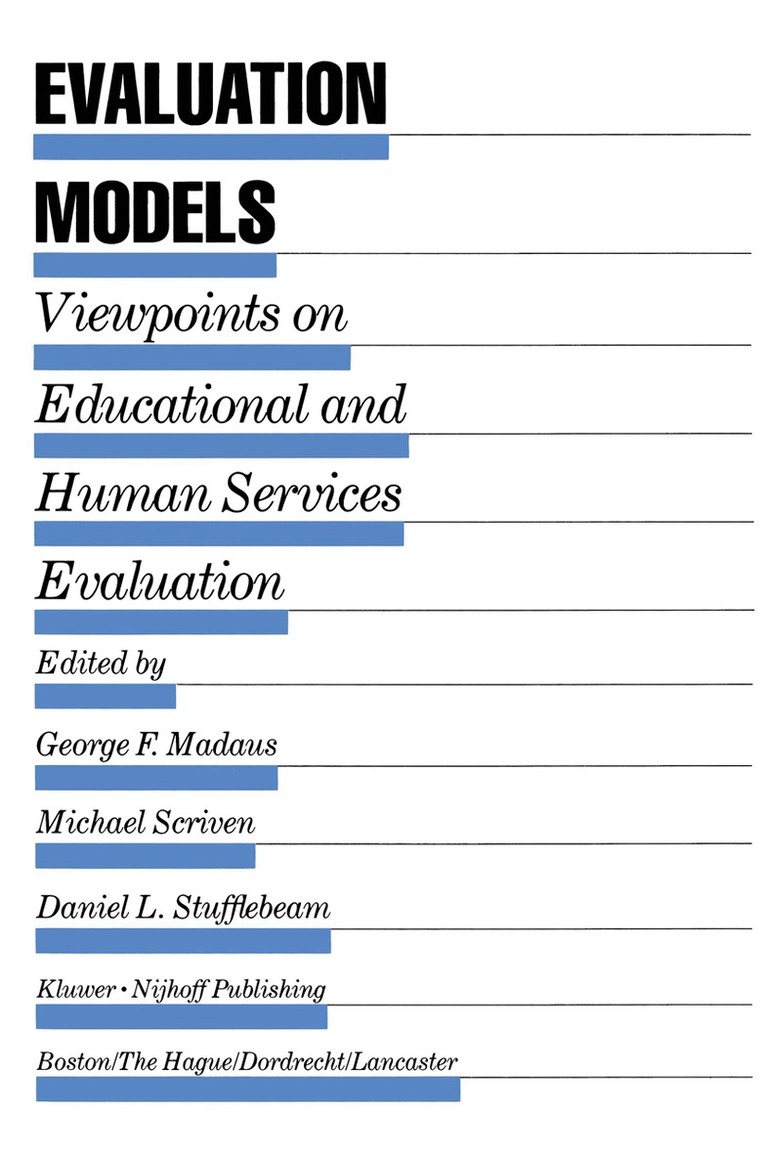
    Evaluation Models

    Viewpoints on Educational and Human Services Evaluation

    AvGeorge F. Madaus,M. Scriven

    Häftad, Engelska, 2011

    Del 6 i serien Evaluation in Education and Human Services

    530 kr

    Beställningsvara. Skickas inom 10-15 vardagar. Fri frakt över 249 kr.

    Beskrivning

    Attempting fonnally to evaluate something involves the evaluator coming to grips with a number of abstract concepts such as value, merit, worth, growth, criteria, standards, objectives, needs, nonns, client, audience, validity, reliability, objectivity, practical significance, accountability, improvement, process, pro­ duct, fonnative, summative, costs, impact, infonnation, credibility, and - of course - with the tenn evaluation itself. To communicate with colleagues and clients, evaluators need to clarify what they mean when they use such tenns to denote important concepts central to their work. Moreover, evaluators need to integrate these concepts and their meanings into a coherent framework that guides all aspects of their work. If evaluation is to lay claim to the mantle of a profession, then these conceptualizations of evaluation must lead to the conduct of defensible evaluations. The conceptualization of evaluation can never be a one-time activity nor can any conceptualization be static. Conceptualizations that guide evaluation work must keep pace with the growth of theory and practice in the field. Further, the design and conduct of any particular study involves a good deal of localized conceptualization.

    Produktinformation

    • Utgivningsdatum:2011-11-03
    • Mått:152 x 229 x 24 mm
    • Vikt:633 g
    • Format:Häftad
    • Språk:Engelska
    • Serie:Evaluation in Education and Human Services
    • Antal sidor:385
    • Förlag:Springer
    • ISBN:9789400966710

    Utforska kategorier

    • Examination och betygsättning inom Psykologi och pedagogik

    Innehållsförteckning

    • I An Overview of Models and Conceptualizations.- 1 Program Evaluation: A Historical Overview.- 2 An Analysis of Alternative Approaches to Evaluation.- 3 Assumptions Underlying Evaluation Models.- II Models and Conceptualizations.- 4 A Rationale for Program Evaluation.- 5 The Discrepancy Evaluation Model.- 6 Course Improvement through Evaluation.- 7 The CIPP Model for Program Evaluation.- 8 The Evaluation of Broad-Aim Programs: Experimental Design, Its Difficulties, and an Alternative.- 9 Societal Experimentation.- 10 Rationality to Ritual: The Multiple Roles of Evaluation in Governmental Processes.- 11 The Use of Judicial Evaluation Methods in the Formulation of Educational Policy.- 12 Deep Dark Deficits of the Adversary Evaluation Model.- 13 The Clarification Hearing: A Personal View of the Process.- 14 Evaluation Ideologies.- 15 Flexner, Accreditation, and Evaluation.- 16 The Case Study Method in Social Inquiry.- 17 Program Evaluation, Particularly Responsive Evaluation.- 18 Epistemological and Methodological Bases of Naturalistic Inquiry.- 19 Educational Connoisseurship and Criticism: Their Form and Functions in Educational Evaluation.- 20 The Explication Model: An Anthropological Approach to Program Evaluation.- 21 Designing Evaluations of Educational and Social Progress by Lee J. Cronbach: A Synopsis.- 22 The Progress of Educational Evaluation: Rounding the First Bends in the River.- III The Standards and the Ninety-five Theses.- 23 The Standards for Evaluation of Educational Programs, Projects, and Materials: A Description and Summary.- 24 Ninety-five Theses for Reforming Program Evaluation.- Contributing Authors.