• Fri frakt över 249 kr
  • •
  • Snabba leveranser
  • •
  • Billiga böcker
Kundservice

Du är på sajten för privatpersoner.

Företag, bibliotek eller offentlig verksamhet?

Du handlar på classic.bokus.com, där alla dina funktioner finns intakta.
Till classic.bokus.com
Bokus logotyp. Gå till startsidan.
  • Erbjudanden
  • Nyheter
  • Student
  • Topplistor
  • Barn & ungdom
  • Bokus Play
  • E-böcker
  • Pocketböcker
  • Spel & pussel

10% rabatt på allt med kod: NYSTART10 →

Sidfot

Mina sidor

    Hjälp

    • Kundservice
    • Vanliga frågor och svar
    • Frakt och leverans
    • Retur vid ångerrätt
    • Reklamera vara
    • Betalning
    • Köpvillkor
    • Allmänna villkor
    • Information om webbplatsens tillgänglighet

    Om Bokus

    • Om oss
    • Pressrum
    • För studenter
    • För företag
    • För bibliotek och offentlig verksamhet
    • För leverantörer
    • Hållbarhet

    Populärt

    • Aktuella erbjudanden
    • Presentkort
    • Studentlitteratur
    • Nya böcker
    • Topplistor
    • Signerade böcker
    • Engelska böcker

    Inspiration

    • Boktips
    • BookTok
    • Populära bokserier
    • Barnbokskaraktärer
    • Populära författare
    Logotyp för Bokus
    Följ oss på Facebook (extern länk)Följ oss på Instagram (extern länk)Följ oss på YouTube (extern länk)Följ oss på TikTok (extern länk)
    bokus @ CookiesAnpassa cookiesIntegritetspolicyKöpvillkor
    Till Citymail hemsida (extern länk)Till Budbee hemsida (extern länk)Till Postnord hemsida (extern länk)Till Schenker hemsida (extern länk)Till Early Bird hemsida (extern länk)Till Walleys hemsida (extern länk)
    1. Filosofi och religion
    2. Filosofi
    3. Filosofiska discipliner

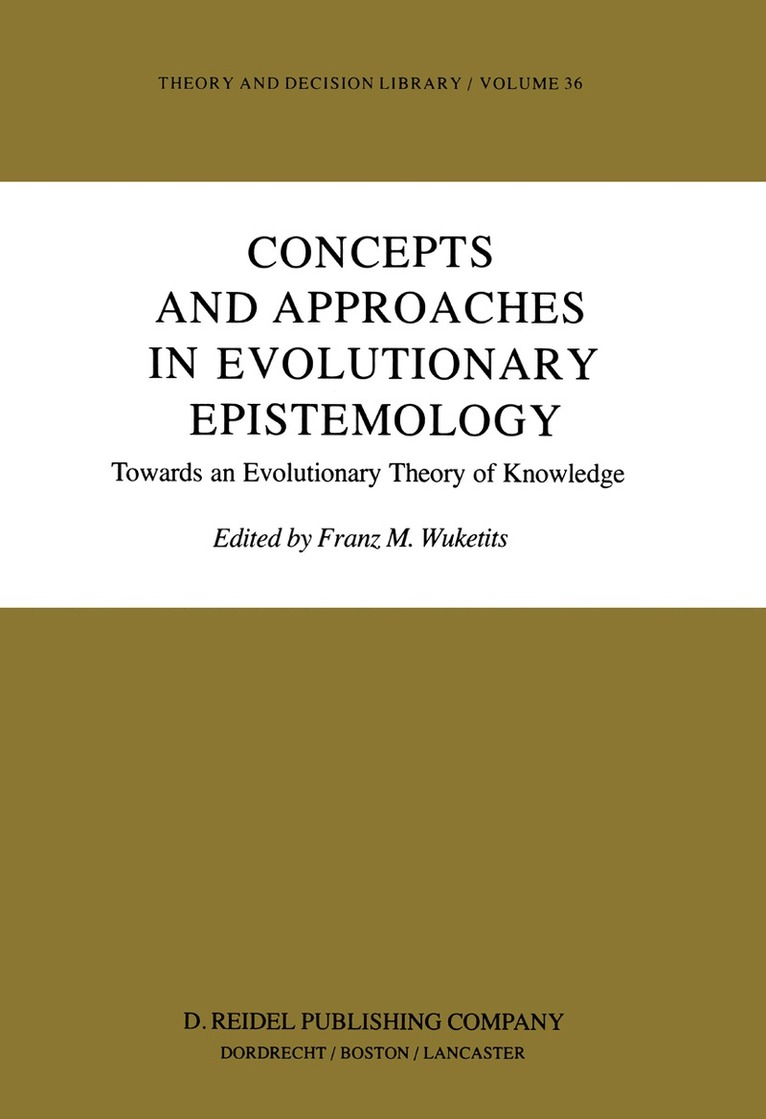
    Concepts and Approaches in Evolutionary Epistemology

    Towards an Evolutionary Theory of Knowledge

    AvFranz M. Wuketits

    Häftad, Engelska, 2011

    Del 36 i serien Theory and Decision Library

    1 626 kr

    Beställningsvara. Skickas inom 10-15 vardagar. Fri frakt över 249 kr.

    Beskrivning

    The present volume brings together current interdisciplinary research which adds up to an evolutionary theory of human knowledge, Le. evolutionary epistemology. It comprises ten papers, dealing with the basic concepts, approaches and data in evolutionary epistemology and discussing some of their most important consequences. Because I am convinced that criticism, if not confused with mere polemics, is apt to stimulate the maturation of a scientific or philosophical theory, I invited Reinhard Low to present his critical view of evolutionary epistemology and to indicate some limits of our evolutionary conceptions. The main purpose of this book is to meet the urgent need of both science and philosophy for a comprehensive up-to-date approach to the problem of knowledge, going beyond the traditional disciplinary boundaries of scientific and philosophical thought. Evolutionary epistemology has emerged as a naturalistic and science-oriented view of knowledge taking cognizance of, and compatible with, results of biological, psychological, anthropological and linguistic inquiries concerning the structure and development of man's cognitive apparatus. Thus, evolutionary epistemology serves as a frame­ work for many contemporary discussions of the age-old problem of human knowledge.

    Produktinformation

    • Utgivningsdatum:2011-11-12
    • Mått:152 x 223 x 19 mm
    • Vikt:481 g
    • Format:Häftad
    • Språk:Engelska
    • Serie:Theory and Decision Library
    • Antal sidor:322
    • Upplaga:1984
    • Förlag:Springer
    • ISBN:9789400971295

    Utforska kategorier

    • Filosofiska discipliner inom Filosofi och religion

    Innehållsförteckning

    • Evolutionary Epistemology — A Challenge to Science and Philosophy.- 1. Introduction.- 2. The Notion of the Innate — Immanuel Kant and Beyond.- 3. Patterns of Nature and the Nature of Cognition or, ‘Why the Eye is Attuned to the Sun’.- 4. The Interdisciplinary Foundation of Evolutionary Epistemology.- 5. The Challenge to Science and Philosophy.- 6. Summary and Conclusion.- Notes.- Evolution and Evolutionary Knowledge — On the Correspondence Between Cognitive Order and Nature.- 1. Separate Approaches.- 2. Judgements and Prejudices.- 3. The Theory of Evolution.- 4. Epistemological Questions.- 5. Nature and Thinking.- 6. A System of Hypotheses.- 7. Natural and Cognitive Order 45.- 8. The Kantian Apriori.- 9. Summary.- Notes.- A Short Introduction to the Biological Principles of Evolutionary Epistemology.- 1. Life as a Cognition Process.- 2. The “Hypotheses” of the Ratiomorphic Apparatus.- 3. Summary.- Notes.- Mesocosm and Objective Knowledge — On Problems Solved by Evolutionary Epistemology.- 1. Introduction.- 2. Facts and Fits — What Evolutionary Epistemology Tries to Explain.- 3. Tenets and Traits — What Evolutionary Epistemology Does Assert.- 4. Caveats and Corrections — What Evolutionary Epistemology Does Not Assert.- 5. Mesocosm and Visualization.- 6. Projection and Reconstruction.- 7. Objectivity and Invariance.- 8. Mathematics and Reality.- 9. Causality and Energy Transfer.- 10. Mind and Evolution.- 11. Unfinished Tasks and Unsolved Problems.- Neurobiological Aspects of Intelligence.- The Evolution of Scientific Method.- 1. The Historical Background.- 2. Objective Scientific Knowledge as a Break with the Ratiomorphic Past: The “Third” Evolution.- 3. The Systematic Relationship of Empirical-Evolutionary Epistemology and Meta-Empirical or Pure“Transcendental” Epistemology.- 4. Information and Knowledge.- 5. Science as an Evolutionary Information System.- 6. The “Law of Three Stages” of the Evolution of Method.- Notes.- The Ethics of Science: Compatible with the Concept of Evolutionary Epistemology?.- 1. The Traditional Viewpoint.- 2. Values.- 3. Science.- 4. Motivation of Science.- 5. Scientific Communities.- 6. The Ethics of Science.- 7. Justification of the Code (Compatibility with Evolutionary Epistemology).- 8. The Ethics of Science as a Partial Code of Conduct.- 9. Extention of the Ethics of Science to Society?.- 10. Homo investigans versus Homo politicus.- 11. Threats Bearing upon the Ethics of Science.- The Metaphysical Limits of Evolutionary Epistemology.- 1. Evolutionary Epistemology is a Philosophical Proposal.- 2. As a Philosophical Theory, Evolutionary Epistemology is a Variant of Naturalistic Realism.- 3. Evolutionary Epistemology and Causality.- 4. Difficulties with the Principle of “Fulguration”.- 5. By Its Claim to Truth, Evolutionary Epistemology Annuls Itself.- 6. Evolutionary Epistemology is Unable to Support Its Own Ethical Claims.- 7. Evolutionary Epistemology and Ethics.- Notes.- Selected Bibliography.- Evolutionary Causality, Theory of Games, and Evolution of Intelligence.- 1. A Model for Evolutionary Causality.- 2. The Equivalence of the Theory of Evolution and Dynamic Games.- 3. Evolutionary Epistemology, Memory, and Intelligence.- References.- Evolutionary Epistemology — A New Copernican Revolution?.- Notes.- Appendix. The Logical Basis of Evolutionary Epistemology.- 1. The Limits of the Analytical Approach.- 2. The Logical Structure of the Evolutionary Approach to Epistemological Questions.- 3. Consistency Proof for Riedl’s Probability Hypothesis.- 4. The Problemof Theoretical Terms in Evolutionary Perspective.- Notes.- Index Of Names.- Index of Subjects.