• Fri frakt över 249 kr
  • •
  • Snabba leveranser
  • •
  • Billiga böcker
Kundservice

Du är på sajten för privatpersoner.

Företag, bibliotek eller offentlig verksamhet?

Du handlar på classic.bokus.com, där alla dina funktioner finns intakta.
Till classic.bokus.com
Bokus logotyp. Gå till startsidan.
  • Erbjudanden
  • Nyheter
  • Student
  • Topplistor
  • Barn & ungdom
  • Bokus Play
  • E-böcker
  • Pocketböcker
  • Spel & pussel

10% rabatt på allt med kod: NYSTART10 →

Sidfot

Mina sidor

    Hjälp

    • Kundservice
    • Vanliga frågor och svar
    • Frakt och leverans
    • Retur vid ångerrätt
    • Reklamera vara
    • Betalning
    • Köpvillkor
    • Allmänna villkor
    • Information om webbplatsens tillgänglighet

    Om Bokus

    • Om oss
    • Pressrum
    • För studenter
    • För företag
    • För bibliotek och offentlig verksamhet
    • För leverantörer
    • Hållbarhet

    Populärt

    • Aktuella erbjudanden
    • Presentkort
    • Studentlitteratur
    • Nya böcker
    • Topplistor
    • Signerade böcker
    • Engelska böcker

    Inspiration

    • Boktips
    • BookTok
    • Populära bokserier
    • Barnbokskaraktärer
    • Populära författare
    Logotyp för Bokus
    Följ oss på Facebook (extern länk)Följ oss på Instagram (extern länk)Följ oss på YouTube (extern länk)Följ oss på TikTok (extern länk)
    bokus @ CookiesAnpassa cookiesIntegritetspolicyKöpvillkor
    Till Citymail hemsida (extern länk)Till Budbee hemsida (extern länk)Till Postnord hemsida (extern länk)Till Schenker hemsida (extern länk)Till Early Bird hemsida (extern länk)Till Walleys hemsida (extern länk)
    1. Historia och arkeologi
    2. Historia
    3. Historia: teori och metod

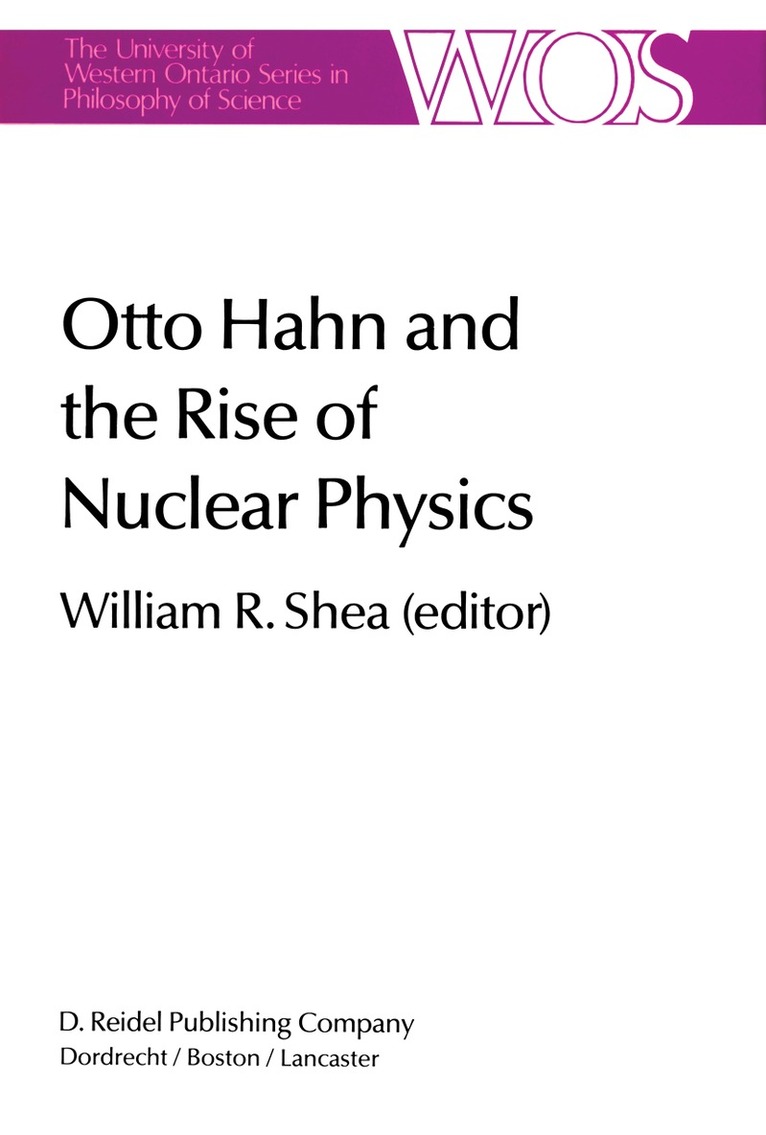
    Otto Hahn and the Rise of Nuclear Physics

    AvW.R. Shea

    Häftad, Engelska, 2012

    Del i serien Western Ontario Series in Philosophy of Science

    1 674 kr

    Beställningsvara. Skickas inom 10-15 vardagar. Fri frakt över 249 kr.

    Beskrivning

    and less as the emanation unden\'ent radioactive decay, and it became motion­ less after about 30 seconds. Since this process was occurring very rapidly, Hahn and Sackur marked the position of the pointer on a scale with pencil marks. As a timing device they used a metronome that beat out intervals of approximately 1. 3 seconds. This simple method enabled them to determine that the half-life of the emanations of actinium and emanium were the same. Although Giesel's measurements had been more precise than Debierne's, the name of actinium was retained since Debierne had made the discovery first. Hahn now returned to his sample of barium chloride. He soon conjectured that the radium-enriched preparations must harbor another radioactive sub­ stance. The liquids resulting from fractional crystallization, which were sup­ posed to contain radium only, produced two kinds of emanation. One was the long-lived emanation of radium, the other had a short life similar to the emanation produced by thorium. Hahn tried to separate this substance by adding some iron to the solutions that should have been free of radium, but to no avail. Later the reason for his failure became apparent. The element that emitted the thorium emanation was constantly replenished by the ele­ ment believed to be radium. Hahn succeeded in enriching a preparation until it was more than 100,000 times as intensive in its radiation as the same quantity of thorium.

    Produktinformation

    • Utgivningsdatum:2012-01-19
    • Mått:155 x 235 x 15 mm
    • Vikt:411 g
    • Format:Häftad
    • Språk:Engelska
    • Serie:Western Ontario Series in Philosophy of Science
    • Antal sidor:254
    • Förlag:Springer
    • ISBN:9789400971356

    Utforska kategorier

    • Historia: teori och metod inom Historia och arkeologi
    • Naturvetenskapens filosofi inom Naturvetenskap och teknik
    • Historia inom Historia och arkeologi

    Recensioner i media

    '...articles which provide much interesting material on a period of the development of physics which has been relatively neglected by historians of science.' Centaurus, 28:1

    Innehållsförteckning

    • Introduction: from Rutherford to Hahn.- The Nuclear Electron Hypothesis.- The Evolution of Matter: Nuclear Physics, Cosmic Rays, and Robert Millikan’s Research Program.- The Discovery of Fission and a Nuclear Physics Paradigm.- Internal and External Conditions for the Discovery of Fission by the Berlin Team.- Otto Hahn, Science, and Social Responsibility.- The Politics of British Science in the Munich Era.- Why Hahn’s Radiothorium Surprised Rutherford in Montreal.- The Discovery of Uranium Z by Otto Hahn: The First Example of Nuclear Isomerism.- Nuclear Physics in Candada in the 1930s.