• Fri frakt över 249 kr
  • •
  • Snabba leveranser
  • •
  • Billiga böcker
Kundservice

Du är på sajten för privatpersoner.

Företag, bibliotek eller offentlig verksamhet?

Du handlar på classic.bokus.com, där alla dina funktioner finns intakta.
Till classic.bokus.com
Bokus logotyp. Gå till startsidan.
  • Erbjudanden
  • Nyheter
  • Student
  • Topplistor
  • Barn & ungdom
  • Bokus Play
  • E-böcker
  • Pocketböcker
  • Spel & pussel

10% rabatt på allt med kod NYSTART10 →

Sidfot

Mina sidor

    Hjälp

    • Kundservice
    • Vanliga frågor och svar
    • Frakt och leverans
    • Retur vid ångerrätt
    • Reklamera vara
    • Betalning
    • Köpvillkor
    • Allmänna villkor
    • Information om webbplatsens tillgänglighet

    Om Bokus

    • Om oss
    • Pressrum
    • För studenter
    • För företag
    • För bibliotek och offentlig verksamhet
    • För leverantörer
    • Hållbarhet

    Populärt

    • Aktuella erbjudanden
    • Presentkort
    • Studentlitteratur
    • Nya böcker
    • Topplistor
    • Signerade böcker
    • Engelska böcker

    Inspiration

    • Boktips
    • BookTok
    • Populära bokserier
    • Barnbokskaraktärer
    • Populära författare
    Logotyp för Bokus
    Följ oss på Facebook (extern länk)Följ oss på Instagram (extern länk)Följ oss på YouTube (extern länk)Följ oss på TikTok (extern länk)
    bokus @ CookiesAnpassa cookiesIntegritetspolicyKöpvillkor
    Till Citymail hemsida (extern länk)Till Budbee hemsida (extern länk)Till Postnord hemsida (extern länk)Till Schenker hemsida (extern länk)Till Early Bird hemsida (extern länk)Till Walleys hemsida (extern länk)
    1. Samhälle och politik
    2. Sociologi och antropologi
    3. Sociologi

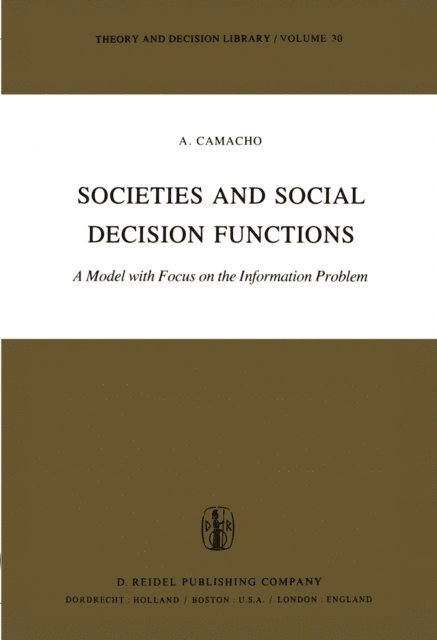
    Societies and Social Decision Functions

    A Model with Focus on the Information Problem

    AvA. Camacho

    Häftad, Engelska, 2011

    Del 30 i serien Theory and Decision Library

    546 kr

    Beställningsvara. Skickas inom 10-15 vardagar. Fri frakt över 249 kr.

    Fler format och utgåvor

    E-bok

    710 kr

    Beskrivning

    A model is an idealization. It is an abstract representation of a given perceived reality. To construct a model one abstracts from the unimportant features of that reality and replaces it by a formal structure, whose properties, explicitly assumed or logically de­ ducible from the stated assumptions, correspond to the interesting relationships of the reality being studied. The purpose of constructing a model is twofold: first, to help better understand a complex reality; second, to help make pre­ dictions with regard to still unobserved phenomena. The first purpose will be satisfied if the constructor of the model is able to identify and disregard the unimportant features of the reality being studied and replaces this reality by an easier to understand formal structure. By applying then the techniques of mathematics and logic to this formal structure we might be able to reach conclusions with regard to still unobserved phenomena, which will be of help in making predictions.

    Produktinformation

    • Utgivningsdatum:2011-10-19
    • Mått:152 x 223 x 10 mm
    • Vikt:242 g
    • Format:Häftad
    • Språk:Engelska
    • Serie:Theory and Decision Library
    • Antal sidor:164
    • Förlag:Springer
    • ISBN:9789400978157

    Utforska kategorier

    • Sociologi inom Samhälle och politik

    Innehållsförteckning

    • 1/Comparison of Approaches to Social Choice.- 2/Intensity of Preferences and Cardinal Utility.- 3/Unsatisfactoriness of Ordinal Methods in Dealing with Problems of Social Choice.- 4/A System of Axioms for Cardinal Utility.- 5/A More General System of Axioms for Cardinal Utility.- 6/An Abstract Model of Society.- 7/Social Decision Functions.- 8/A Theorem Proving the Unsatisfactoriness of the Ordinal Approach to Social Choice.- 9/Strengthening the Theorem Proved in Chapter 8: Informal Discussion.- 10/Unsatisfactoriness of the Ordinal Approach to Social Choice: Further Results.- 11/ Justifying the Use of Ordinal Methods.- 12/Conclusion.- Appendix 1 /The Utility Differences Approach to Cardinal Utility.- Appendix 2/The Expected Utility Approach to Cardinal Utility.- Index of Names.- Index of Subjects.