• Fri frakt över 249 kr
  • •
  • Snabba leveranser
  • •
  • Billiga böcker
Kundservice

Du är på sajten för privatpersoner.

Företag, bibliotek eller offentlig verksamhet?

Du handlar på classic.bokus.com, där alla dina funktioner finns intakta.
Till classic.bokus.com
Bokus logotyp. Gå till startsidan.
  • Erbjudanden
  • Nyheter
  • Student
  • Topplistor
  • Barn & ungdom
  • Bokus Play
  • E-böcker
  • Pocketböcker
  • Spel & pussel

10% rabatt på allt med kod: NYSTART10 →

Sidfot

Mina sidor

    Hjälp

    • Kundservice
    • Vanliga frågor och svar
    • Frakt och leverans
    • Retur vid ångerrätt
    • Reklamera vara
    • Betalning
    • Köpvillkor
    • Allmänna villkor
    • Information om webbplatsens tillgänglighet

    Om Bokus

    • Om oss
    • Pressrum
    • För studenter
    • För företag
    • För bibliotek och offentlig verksamhet
    • För leverantörer
    • Hållbarhet

    Populärt

    • Aktuella erbjudanden
    • Presentkort
    • Studentlitteratur
    • Nya böcker
    • Topplistor
    • Signerade böcker
    • Engelska böcker

    Inspiration

    • Boktips
    • BookTok
    • Populära bokserier
    • Barnbokskaraktärer
    • Populära författare
    Logotyp för Bokus
    Följ oss på Facebook (extern länk)Följ oss på Instagram (extern länk)Följ oss på YouTube (extern länk)Följ oss på TikTok (extern länk)
    bokus @ CookiesAnpassa cookiesIntegritetspolicyKöpvillkor
    Till Citymail hemsida (extern länk)Till Budbee hemsida (extern länk)Till Postnord hemsida (extern länk)Till Schenker hemsida (extern länk)Till Early Bird hemsida (extern länk)Till Walleys hemsida (extern länk)
    1. Filosofi och religion
    2. Filosofi
    3. Filosofiska discipliner

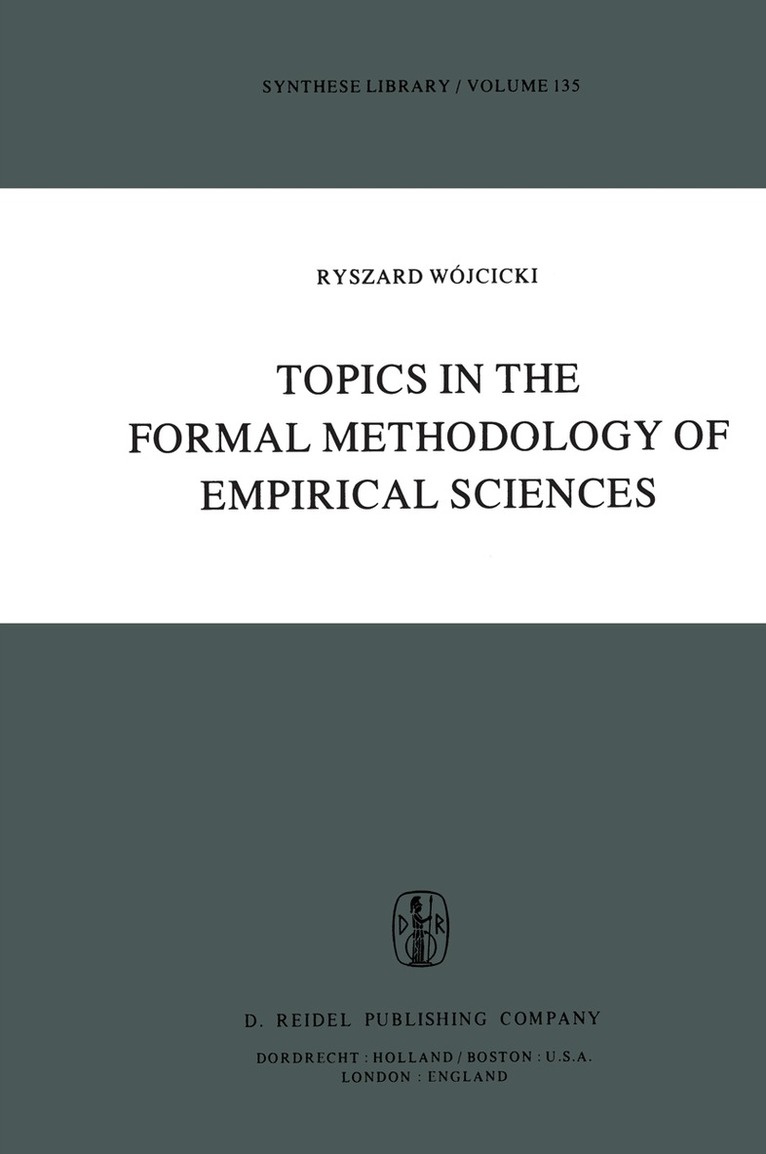
    Topics in the Formal Methodology of Empirical Sciences

    AvRyszard Wójcicki

    Häftad, Engelska, 2011

    Del 135 i serien Synthese Library

    547 kr

    Beställningsvara. Skickas inom 10-15 vardagar. Fri frakt över 249 kr.

    Fler format och utgåvor

    E-bok

    710 kr

    Beskrivning

    11 original. Modifications which I introduced are radical and often far going. In my opinion the Polish text had two main drawbacks. It was overloaded with informal considerations and at the same time formal concepts included in some parts of the book were presented in a too complicated way. Of course one of the motives to revise it was also the fact that much time has passed since I finished writing the Polish version and obviously certain decisions and ideas contained in the first edition seem not quite relevant now. So it is not only the desire to make the exposition clearer but also the reasons of substantial nature which motivated writing a revised version. I do not think it desirable to bother the reader with a detailed discussion of all changes to which the Polish version was subjected and that is why I will confine myself to pointing out only the most significant ones. Explanations concerning logical and set-theoretical notions applied in the book have been shortened as much as possible, in the Polish version one whole chapter was devoted to the discussion of them.

    Produktinformation

    • Utgivningsdatum:2011-11-11
    • Mått:152 x 229 x 16 mm
    • Vikt:427 g
    • Format:Häftad
    • Språk:Engelska
    • Serie:Synthese Library
    • Antal sidor:290
    • Upplaga:1979
    • Förlag:Springer
    • ISBN:9789400989467

    Utforska kategorier

    • Filosofiska discipliner inom Filosofi och religion
    • Naturvetenskapens filosofi inom Naturvetenskap och teknik

    Innehållsförteckning

    • Preface to the English edition.- Preface to the Polish edition.- I Introduction.- 1.1. Mathematical notation.- 1.2. Numerical systems.- 1.3. Elementary systems.- 1.4. States and histories.- 1.5. Complex systems.- 1.6. Empirical phenomena.- 1.7. Phase-space of a phenomenon and some related technical notions.- 1.8. Semi-interpreted languages.- 1.9. Fundamental semantic concepts.- 1.10. Formalized languages and the deductive concept of a theory.- 1.11. A criterion of consistency.- 1.12. The concept of a theory.- II Regularities.- 2.0. Two conventions.- 2.1. Two types of regularities.- 2.2. State-determined phenomena.- 2.3. Mathematical models for state transformations.- 2.4. History-determined phenomena.- 2.5. Definability.- 2.6. Ontological versus semantic definability.- 2.7. Surrounding conditions.- 2.8. Self-determined phenomena.- 2.9. Invariancy.- 2.10. Notes.- III Empirical Theories.- 3.1. Axiomatic versus set theoretical way of defining theories.- 3.2. Theories as deductive systems.- 3.3. The concept of truth.- 3.4. Empirical theories.- 3.5. Two examples of empirical theories.- 3.6. Models and theories of empirical phenomena.- IV Measurement.- 4.1. Semantic conception of measurement.- 4.2. Complete measurement structures.- 4.3. Approximate measurement.- 4.4. Theoretical versus operational conception of measurement.- 4.5. Notes.- V Operational Structures.- 5.0. Introductory assumptions.- 5.1. Verification procedures.- 5.2. Operational structures.- 5.3. A revised notion of regularity.- 5.4. The concept of truth as related to operational structures.- 5.5. Truth by convention.- 5.6. Confirmation procedures.- 5.7. Probabilistic models.- 5.8. Dispersive operational structures.- 5.9. Evolution of empirical theories.- VI Appendix.- 6.1. Complementary tests.- 6.2. Physical systems.- Index of Symbols.- Index of Names.