• Fri frakt över 249 kr
  • •
  • Snabba leveranser
  • •
  • Billiga böcker
Kundservice

Du är på sajten för privatpersoner.

Företag, bibliotek eller offentlig verksamhet?

Du handlar på classic.bokus.com, där alla dina funktioner finns intakta.
Till classic.bokus.com
Bokus logotyp. Gå till startsidan.
  • Erbjudanden
  • Nyheter
  • Student
  • Topplistor
  • Barn & ungdom
  • Bokus Play
  • E-böcker
  • Pocketböcker
  • Spel & pussel

10% rabatt på allt med kod NYSTART10 →

Sidfot

Mina sidor

    Hjälp

    • Kundservice
    • Vanliga frågor och svar
    • Frakt och leverans
    • Retur vid ångerrätt
    • Reklamera vara
    • Betalning
    • Köpvillkor
    • Allmänna villkor
    • Information om webbplatsens tillgänglighet

    Om Bokus

    • Om oss
    • Pressrum
    • För studenter
    • För företag
    • För bibliotek och offentlig verksamhet
    • För leverantörer
    • Hållbarhet

    Populärt

    • Aktuella erbjudanden
    • Presentkort
    • Studentlitteratur
    • Nya böcker
    • Topplistor
    • Signerade böcker
    • Engelska böcker

    Inspiration

    • Boktips
    • BookTok
    • Populära bokserier
    • Barnbokskaraktärer
    • Populära författare
    Logotyp för Bokus
    Följ oss på Facebook (extern länk)Följ oss på Instagram (extern länk)Följ oss på YouTube (extern länk)Följ oss på TikTok (extern länk)
    bokus @ CookiesAnpassa cookiesIntegritetspolicyKöpvillkor
    Till Citymail hemsida (extern länk)Till Budbee hemsida (extern länk)Till Postnord hemsida (extern länk)Till Schenker hemsida (extern länk)Till Early Bird hemsida (extern länk)Till Walleys hemsida (extern länk)
    1. Samhälle och politik
    2. Sociologi och antropologi
    3. Sociologi

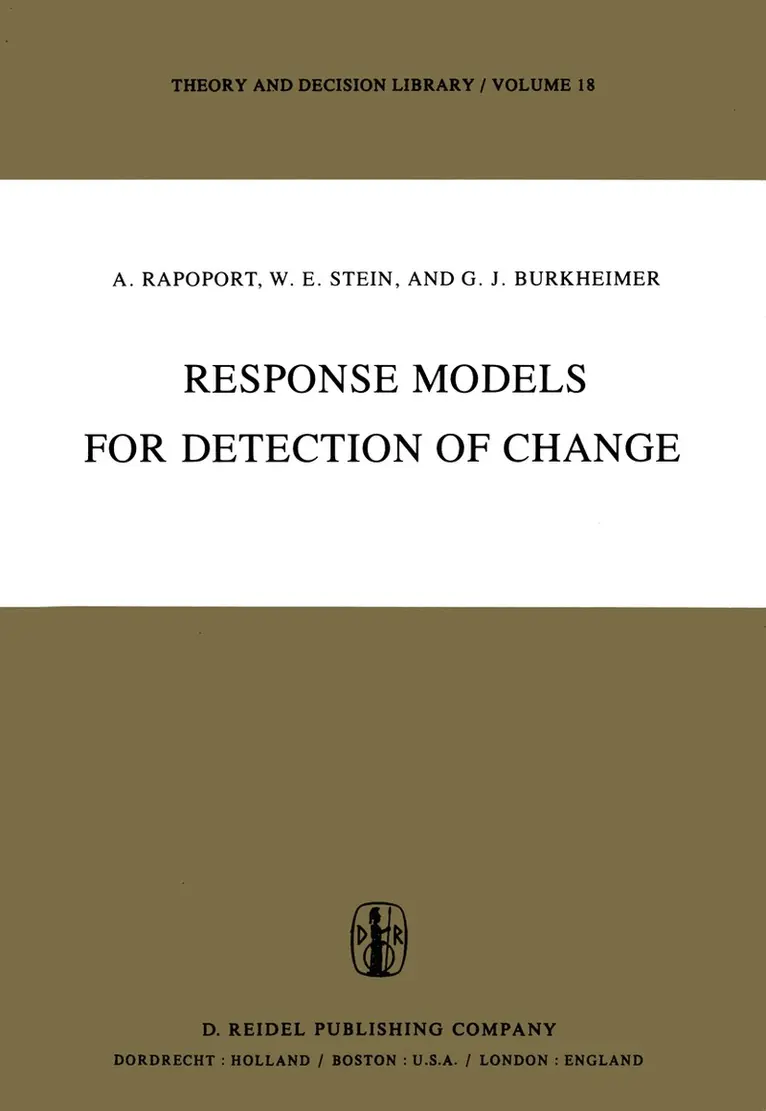
    Response Models for Detection of Change

    AvAnatol Rapoport,W. Stein

    Häftad, Engelska, 2013

    Del 18 i serien Theory and Decision Library

    546 kr

    Beställningsvara. Skickas inom 10-15 vardagar. Fri frakt över 249 kr.

    Fler format och utgåvor

    Övrigt

    646 kr

    Beskrivning

    This book reports our research on detection of change processes that underlie psychophysical, learning, medical diagnosis, military, and pro­ duction control situations, and share three major features. First, the states of the process are not directly observable but become gradually known with the sequential acquisition of fallible information over time. Second, the mechanism that generates the fallible information is not stationary; rather, it is subjected to a sudden and irrevocable change. Thirdly, in­ complete, probabilistic information about the time of change is available when the process commences. The purpose of the book is to characterize this class of detection of change processes, to derive the optimal policy that minimizes total expected loss, and, most importantly, to develop testable response models, based on simple decision rules, for describing detection of change behavior. The book is theoretical in the sense that it offers mathematical models of multi-stage decision behavior and solutions to optimization problems. However, it is not anti-empirical, as it aims to stimulate new experimental research and to generate applications. Throughout the book, questions of experimental verification are briefly considered, and existing data from two studies are brought to bear on the validity of the models. The work is not complete; it only provides a starting point for investigating how people detect a change in an uncertain environment, balancing between the cost of delay in detecting the change and the cost of making an incor­ rect terminal decision.

    Produktinformation

    • Utgivningsdatum:2013-10-03
    • Mått:152 x 229 x 12 mm
    • Vikt:315 g
    • Format:Häftad
    • Språk:Engelska
    • Serie:Theory and Decision Library
    • Antal sidor:201
    • Förlag:Springer
    • ISBN:9789400993884

    Utforska kategorier

    • Sociologi inom Samhälle och politik

    Innehållsförteckning

    • 1. Introduction.- 1.1. Behavioral Decision Theory.- 1.2. Introduction to Detection of Change.- 1.3. Plan of the Book.- 2. The Optimal Policy.- 2.1. Problems TDC and DC.- 2.2. Sufficient Statistics.- 2.3. The Probability of Change.- 2.4. The Optimal Policy.- 2.5. The Nature of the Optimal Policy.- 2.6. Examples.- 3. A Response Model with a Fixed Probability Boundary.- 3.1. Introduction.- 3.2. Problem TDC.- 3.3. Problem DC.- 3.4. Relationships between Problems DC and TDC.- 3.5. Recursive Equations for Mean Values.- 3.6. Relation of Model FPB to the Optimal Policy.- 4. A Response Model with a Fixed Number of Observations.- 4.1. Model FNOB.- 4.2. The Case of No Information.- 4.3. Problem TDC.- 4.4. Problem DC.- 4.5. Parameter Estimation.- 5. A Response Model with a Fixed Number of Successive Observations.- 5.1. Model FNSOB.- 5.2. Problem TDC.- 5.3. Problem DC.- 6. Sensitivity Analysis.- 6.1. Validation by Cupidity.- 6.2. The Curse of Insensitivity.- 6.3. Within Model Insensitivity.- 6.4. Between Model Insensitivity.- 6.5. The System Operating Characteristic (SOC).- 6.6. Conclusions.- 7. Multi-State Detection of Change.- 7.1. Introduction.- 7.2. Problem Formulation.- 7.3. The Optimal Policies.- 7.4. Discussion.- 8. Experimental Research.- 8.1. An Experimental Comparison of the Models.- 8.2. A Psychophysical Experiment.- 8.3. Applications to Performance Evaluation.- 9. Extensions.- 9.1. Arbitrary Distribution of Trial of Change.- 9.2. Further Research.- Appendix. Solution Program for Optimal Policy.- Glossary of Symbols.- Index of Names.- Index of Subjects.