• Fri frakt över 249 kr
  • •
  • Snabba leveranser
  • •
  • Billiga böcker
Kundservice

Du är på sajten för privatpersoner.

Företag, bibliotek eller offentlig verksamhet?

Du handlar på classic.bokus.com, där alla dina funktioner finns intakta.
Till classic.bokus.com
Bokus logotyp. Gå till startsidan.
  • Erbjudanden
  • Nyheter
  • Student
  • Topplistor
  • Barn & ungdom
  • Bokus Play
  • E-böcker
  • Pocketböcker
  • Spel & pussel

10% rabatt på allt med kod NYSTART10 →

Sidfot

Mina sidor

    Hjälp

    • Kundservice
    • Vanliga frågor och svar
    • Frakt och leverans
    • Retur vid ångerrätt
    • Reklamera vara
    • Betalning
    • Köpvillkor
    • Allmänna villkor
    • Information om webbplatsens tillgänglighet

    Om Bokus

    • Om oss
    • Pressrum
    • För studenter
    • För företag
    • För bibliotek och offentlig verksamhet
    • För leverantörer
    • Hållbarhet

    Populärt

    • Aktuella erbjudanden
    • Presentkort
    • Studentlitteratur
    • Nya böcker
    • Topplistor
    • Signerade böcker
    • Engelska böcker

    Inspiration

    • Boktips
    • BookTok
    • Populära bokserier
    • Barnbokskaraktärer
    • Populära författare
    Logotyp för Bokus
    Följ oss på Facebook (extern länk)Följ oss på Instagram (extern länk)Följ oss på YouTube (extern länk)Följ oss på TikTok (extern länk)
    bokus @ CookiesAnpassa cookiesIntegritetspolicyKöpvillkor
    Till Citymail hemsida (extern länk)Till Budbee hemsida (extern länk)Till Postnord hemsida (extern länk)Till Schenker hemsida (extern länk)Till Early Bird hemsida (extern länk)Till Walleys hemsida (extern länk)
    1. Naturvetenskap och teknik
    2. Matematik och naturvetenskap
    3. Matematik
    4. Matematikens grunder

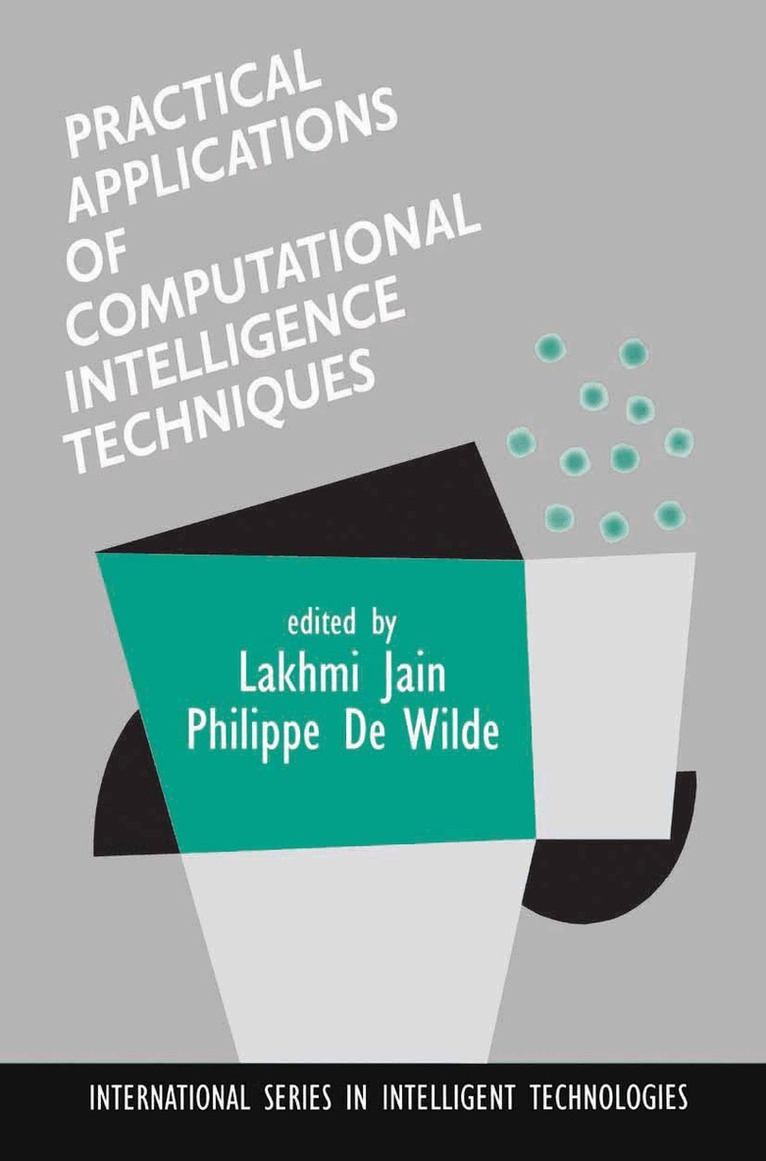
    Practical Applications of Computational Intelligence Techniques

    AvLakhmi Jain,Philippe De Wilde

    Häftad, Engelska, 2012

    Del i serien International Series in Intelligent Technologies

    2 162 kr

    Beställningsvara. Skickas inom 10-15 vardagar. Fri frakt över 249 kr.

    Beskrivning

    Computational intelligence paradigms have attracted the growing interest of researchers, scientists, engineers and application engineers in a number of everyday applications. These applications are not limited to any particular field and include engineering, business, banking and consumer electronics. Computational intelligence paradigms include artificial intelligence, artificial neural networks, fuzzy systems and evolutionary computing. Artificial neural networks can mimic the biological information processing mechanism in a very limited sense. Evolutionary computing algorithms are used for optimisation applications, and fuzzy logic provides a basis for representing uncertain and imprecise knowledge.Practical Applications of Computational Intelligence Techniques contains twelve chapters providing actual application of these techniques in the real world. Such examples include, but are not limited to, intelligent household appliances, aerial spray models, industrial applications and medical diagnostics and practice. This book will be useful to researchers, practicing engineers/scientists and students, who are interested in developing practical applications in a computational intelligence environment.

    Produktinformation

    • Utgivningsdatum:2012-09-14
    • Mått:155 x 235 x 22 mm
    • Vikt:604 g
    • Format:Häftad
    • Språk:Engelska
    • Serie:International Series in Intelligent Technologies
    • Antal sidor:381
    • Förlag:Springer
    • ISBN:9789401038683

    Utforska kategorier

    • Matematikens grunder inom Naturvetenskap och teknik
    • Artificiell intelligens inom Data och IT

    Innehållsförteckning

    • 1. An introduction to computational intelligence paradigms.- 1 Computational intelligence – a formal definition.- 2 The logic of fuzzy sets.- 3 Computational models of neural nets.- 4 Genetic algorithms.- 5 Belief networks.- 6 Computational learning theory.- 7 Synergism of the computational intelligence paradigms.- 8 Conclusions and future directions.- References.- 2. Networked virtual park.- 1 Introduction.- 2 The attraction builder.- 3 Networked virtual environment system.- 4 The server.- 5 Conclusion.- Acknowledgements.- References.- 3. Commercial coin recognisers using neural and fuzzy techniques.- 1 Introduction.- 2 Problem analysis and database compilation.- 3 Approach using artificial neural networks models.- 4 Approach using fuzzy logic models.- 5 Conclusions.- References.- 4. Fuzzy techniques in intelligent household appliances.- 1 Introduction.- 2 Fuzzy approaches for intelligent devices.- 3 Introducing fuzziness to kitchen oven.- 4 Refrigerator-freezer control using fuzzy logic.- 5 Model and simulation of refrigerating-freezing appliance using one compressor.- 6 Hardware implementation.- 7 Decrease of energy consumption from national point-of-view.- 8 Conclusion.- References.- 5. Neural prediction in industry: increasing reliability through use of confidence measures and model combination.- 1 Introduction.- 2 Paper curl prediction.- 3 Neural network model development.- 4 Model combination.- 5 Confidence measures.- 6 Results.- 7 Discussion.- Acknowledgments.- References.- 6. Handling the back calculation problem in aerial spray models using a genetic algorithm.- 1 Introduction.- 2 Early spray models.- 3 Genetic algorithms.- 4 Development of Fortran-SAGA.- 5 Development of VB-SAGA 1.0.- 6 Development of VB-SAGA 2.0.- 7 Summary and conclusions.- References.-7. Genetic algorithm optimization of a filament winding process modeled in WITNESS.- 1 Introduction.- 2 Filament winding model.- 3 Genetic algorithm interface.- 4 Results.- 5 Conclusions.- 6 Summary.- Acknowledgments.- References.- 8.Genetic algorithm for optimizing the gust loads for predicting aircraft loads and dynamic response.- 1 Introduction.- 2 Problem statement and related mathematical underpinnings.- 3 An approach using genetic algorithm.- 4 Results of approach on linear aircraft model.- 5 Summary and conclusion.- Acknowledgments.- References.- 9. A stochastic dynamic programming technique for property market timing.- 1 Introduction.- 2 Review of theoretical considerations.- 3 Specification of market timing model.- 4 Stochastic dynamic programming.- 5 Data used in the simulation study.- 6 Performance and evaluation tests.- 7 Conclusions.- References.- 10. A hybrid approach to breast cancer diagnosis.- 1 Introduction.- 2 KBANNs.- 3 Metabolic features of cancerous breast tissues.- 4 Knowledge elicitation and refinement.- 5 31P MRS data.- 6 KBANN topology.- 7 Results.- 8 Conclusions.- Acknowledgements.- References.- 11. Artificial neural networks as a computer aid for lung disease detection and classification in ventilation-perfusion lung scans.- 1 Introduction.- 2 Artificial neural networks.- 3 Materials and methods.- 4 Results.- 5 Discussion.- Acknowledgments.- References.- 12. Neural network for classification of focal liver lesions in ultrasound images.- 1 Introduction.- 2 Texture analysis of focal liver lesions by neural networks.- 3 Experimental results.- 4 Discussion.- 5 Conclusions.- Acknowledgments.- Entropy.- Root mean square (RMS) variation.- First moment of power spectrum.- References.