• Fri frakt över 249 kr
  • •
  • Snabba leveranser
  • •
  • Billiga böcker
Kundservice

Du är på sajten för privatpersoner.

Företag, bibliotek eller offentlig verksamhet?

Du handlar på classic.bokus.com, där alla dina funktioner finns intakta.
Till classic.bokus.com
Bokus logotyp. Gå till startsidan.
  • Erbjudanden
  • Student
  • Topplistor
  • Barn & ungdom
  • Bokus Play
  • E-böcker
  • Ljudböcker
  • Pocketböcker
  • Spel och pussel

Pocketfynda! Hundratals böcker för 49 kr/st →

Sidfot

Mina sidor

    Hjälp

    • Kundservice
    • Vanliga frågor och svar
    • Frakt och leverans
    • Retur vid ångerrätt
    • Reklamera vara
    • Betalning
    • Köpvillkor
    • Allmänna villkor
    • Information om webbplatsens tillgänglighet

    Om Bokus

    • Om oss
    • Pressrum
    • För studenter
    • För företag
    • För bibliotek och offentlig verksamhet
    • För leverantörer
    • Hållbarhet

    Populärt

    • Aktuella erbjudanden
    • Presentkort
    • Studentlitteratur
    • Nya böcker
    • Topplistor
    • Signerade böcker
    • Engelska böcker

    Inspiration

    • Boktips
    • BookTok
    • Barnbokskaraktärer
    • Populära författare
    Logotyp för Bokus
    Följ oss på Facebook (extern länk)Följ oss på Instagram (extern länk)Följ oss på YouTube (extern länk)Följ oss på TikTok (extern länk)
    bokus @ CookiesAnpassa cookiesIntegritetspolicyKöpvillkor
    Till Citymail hemsida (extern länk)Till Budbee hemsida (extern länk)Till Postnord hemsida (extern länk)Till Schenker hemsida (extern länk)Till Early Bird hemsida (extern länk)Till Walleys hemsida (extern länk)
    1. Ekonomi och Ledarskap
    2. Nationalekonomi
    3. Mikroekonomi

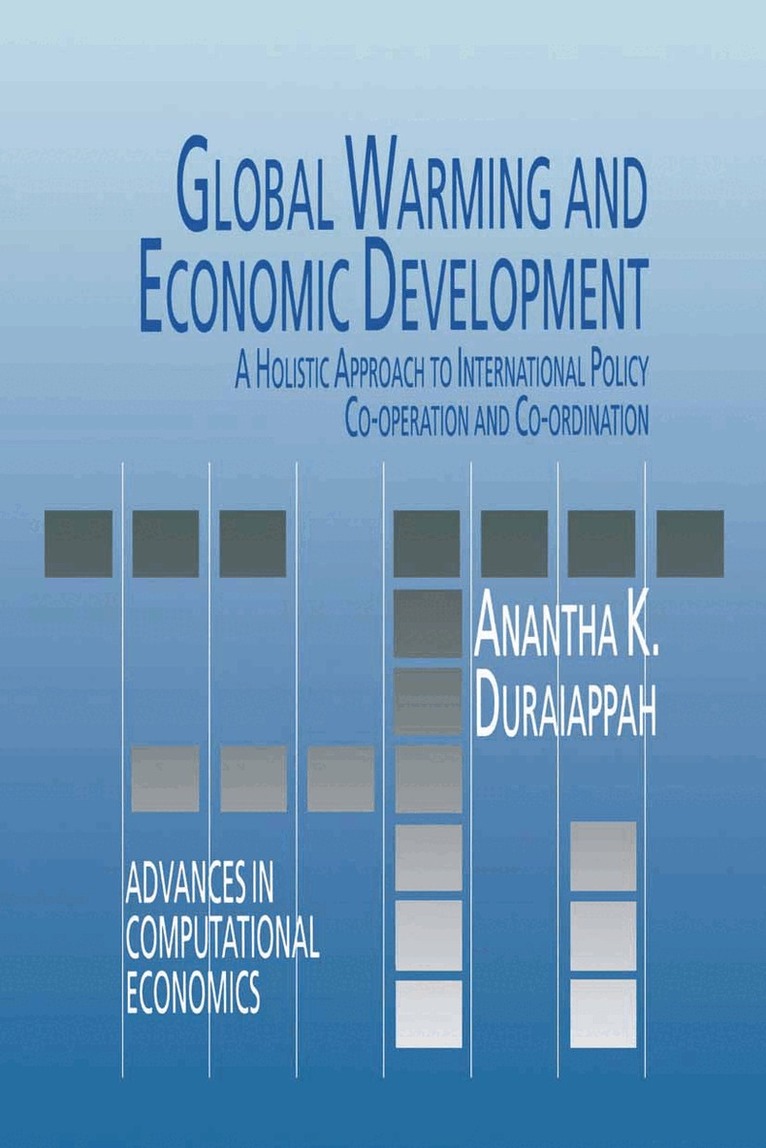
    Global Warming and Economic Development

    A Holistic Approach to International Policy Co-operation and Co-ordination

    AvA.K. Duraiappah

    Häftad, Engelska, 2012

    Del i serien Advances in Computational Economics

    1 078 kr

    Beställningsvara. Skickas inom 10-15 vardagar. Fri frakt över 249 kr.

    Fler format och utgåvor

    Inbunden

    1 078 kr

    E-bok

    1 413 kr

    Beskrivning

    The computer revolution both in the hardware as well as in software has made it possible for economists to analyze complex issues which could not be solved in the past by analytical methods. A large library of numerical techniques are now available to economists for solving models ranging from a simple system of linear simultaneous equations to large non-linear dynamic optimization models. We attempt to take advantage of these advancements in computational economics to address the issue of global warming and economic development. The use of computer simulation models has enhanced the understanding of some of the underlying issues in the global warming literature which would have been impossible without these models. However, to date, the global warming issue has been addressed in a partial equilibrium framework. In other words, the climate scientists tend to specify economic variables as exogenous variables in their global warming models while the economists do the same by specifying the climate variables as exogenous variables in their global warming models. Both approaches ignore important feedback relationships which will be triggered when either economic or climate variables are perturbed. The ideal model structure would be one in which both systems are incorporated within one framework with emphasis on the long run effects of greenhouse gas curbing policies and the corresponding effect on the economic growth potential of the economies.

    Produktinformation

    • Utgivningsdatum:2012-09-23
    • Mått:160 x 240 x 14 mm
    • Vikt:403 g
    • Format:Häftad
    • Språk:Engelska
    • Serie:Advances in Computational Economics
    • Antal sidor:224
    • Förlag:Springer
    • ISBN:9789401047715

    Utforska kategorier

    • Mikroekonomi inom Ekonomi och Ledarskap
    • Optimering inom Naturvetenskap och teknik
    • Miljöekonomi inom Ekonomi och Ledarskap

    Innehållsförteckning

    • One: The Global Warming Problem.- 1.1 Introduction.- 1.2 The Greenhouse Effect.- 1.3 Historical Data Substantiating the Greenhouse Effect.- 1.4 Uncertainties in Estimating Global Warming.- 1.5 Impacts of Global Warming.- 1.6 Conclusion.- Two: Policy Responses and International Coordination.- 2.1 Introduction.- 2.2 Policy Objectives.- 2.3 Policy Coordination and International Cooperation.- 2.4 Conclusion.- Three: The Mathematical Model.- 3.1 Introduction.- 3.2 Model Nomenclature.- 3.3 Set Specifications.- 3.4 The Model Equations.- Four: Numerical Data for a Multi-Regional, Multi-Sectorial, and Multi-Process Optimal Growth Model.- 4.1 Introduction.- 4.2 Input-Output Coefficients (A Matrix).- 4.3 Capital Coefficients (B matrix).- 4.4 Capital-Output Coefficient.- 4.5 Land-Output Coefficients.- 4.6 Energy-Output Coefficients.- 4.7 Carbon Dioxide Emission Coefficients.- 4.8 Carbon Dioxide Emission Coefficients from Deforestation.- 4.9 Initial Conditions.- 4.10 Transfer Coefficients for the Carbon Cycle.- Five: Numerical Results of Policy Experiments.- 5.1 Introduction.- 5.2 Experiment One: Business As Usual (BASE).- 5.3 Experiment Two: Stabilizing CO2 Emissions Levels (SCE).- 5.4 Experiment Three: The Developed Region Accepts a CO2 Protocol, “PayBack” (PB).- 5.5 Experiment Four: The Developing Region Accepts a CO2 Protocol, the “Bribe” Experiment(B).- 5.6 Experiment Five: Holistic Model Simulation (Holistic Base).- 5.7 Conclusion.- Six: Sensitivity Analysis.- 6.1 Introduction.- 6.2 Sensitivity Analysis on Feedback Parameters.- 6.3 Sensitivity Analysis on Land-Output Coefficient.- 6.4 Conclusion.- Seven: Summary and Conclusion.- Appendix ONE The GAMS Statement.- Appendix TWO Data Calibration.