• Fri frakt över 249 kr
  • •
  • Snabba leveranser
  • •
  • Billiga böcker
Kundservice

Du är på sajten för privatpersoner.

Företag, bibliotek eller offentlig verksamhet?

Du handlar på classic.bokus.com, där alla dina funktioner finns intakta.
Till classic.bokus.com
Bokus logotyp. Gå till startsidan.
  • Erbjudanden
  • Nyheter
  • Student
  • Topplistor
  • Barn & ungdom
  • Bokus Play
  • E-böcker
  • Pocketböcker
  • Spel & pussel

10% rabatt på allt med kod: NYSTART10 →

Sidfot

Mina sidor

    Hjälp

    • Kundservice
    • Vanliga frågor och svar
    • Frakt och leverans
    • Retur vid ångerrätt
    • Reklamera vara
    • Betalning
    • Köpvillkor
    • Allmänna villkor
    • Information om webbplatsens tillgänglighet

    Om Bokus

    • Om oss
    • Pressrum
    • För studenter
    • För företag
    • För bibliotek och offentlig verksamhet
    • För leverantörer
    • Hållbarhet

    Populärt

    • Aktuella erbjudanden
    • Presentkort
    • Studentlitteratur
    • Nya böcker
    • Topplistor
    • Signerade böcker
    • Engelska böcker

    Inspiration

    • Boktips
    • BookTok
    • Populära bokserier
    • Barnbokskaraktärer
    • Populära författare
    Logotyp för Bokus
    Följ oss på Facebook (extern länk)Följ oss på Instagram (extern länk)Följ oss på YouTube (extern länk)Följ oss på TikTok (extern länk)
    bokus @ CookiesAnpassa cookiesIntegritetspolicyKöpvillkor
    Till Citymail hemsida (extern länk)Till Budbee hemsida (extern länk)Till Postnord hemsida (extern länk)Till Schenker hemsida (extern länk)Till Early Bird hemsida (extern länk)Till Walleys hemsida (extern länk)
    1. Djur och Natur
    2. Naturböcker
    3. Växtböcker

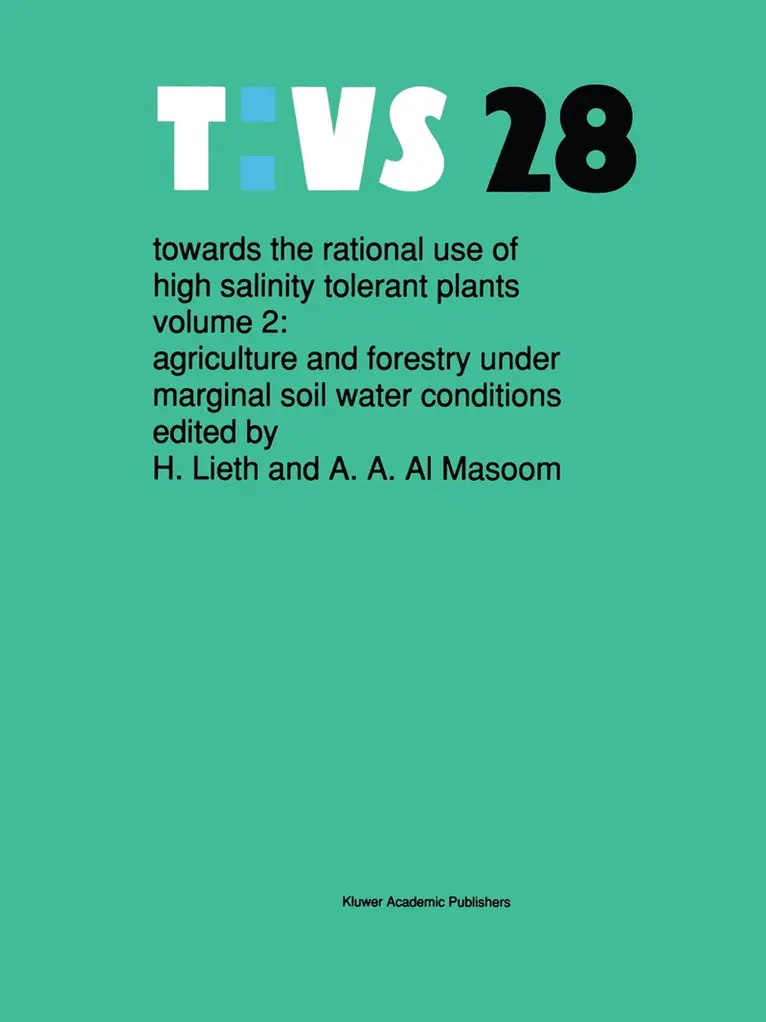
    Towards the rational use of high salinity tolerant plants

    Vol 2: Agriculture and forestry under marginal soil water conditions

    AvHelmut Lieth,A.A. Al Masoom

    Häftad, Engelska, 2012

    Del i serien Tasks for Vegetation Science

    2 165 kr

    Beställningsvara. Skickas inom 10-15 vardagar. Fri frakt över 249 kr.

    Beskrivning

    The Symposium on high salinity tolerant plants, held at the University of Al Ain in December 1990, dealt primarily with plants tolerating salinity levels exceeding that of ocean water and which at the same time are promising for utilization in agriculture or forestry. These plants could be very useful for a country like the UAE where fresh water resources are very scarce and the groundwater available at some places is already very salty. More than 60 million woody trees/shrubs have been planted so far and more are planned for the inland plains underlain with brackish groundwater. These species were no solution for the widely barren shoreline of the UAE. Here mangrove species were of potential use, and one species, Avicennia Marina, occurs widely and has been successfully planted for about a decade. Converting the tree plantations into economically useful cropping systems is still a problem requiring much research and development. The book deals in several sections with conventional irrigation systems using marginal water. The species used in these systems are mostly hybrids of conventional crops. The irrigation systems, however, have similar problems as may be expected for irrigation with seawater. Papers show the participants' experiments in this area. The volume serves as a link between scientists working for the improvement of classical irrigation systems and those interested in the application of a new dimension of salinity levels for irrigation water.

    Produktinformation

    • Utgivningsdatum:2012-10-13
    • Mått:195 x 260 x 26 mm
    • Vikt:987 g
    • Format:Häftad
    • Språk:Engelska
    • Serie:Tasks for Vegetation Science
    • Antal sidor:447
    • Förlag:Springer
    • ISBN:9789401048224

    Utforska kategorier

    • Växtböcker inom Djur och Natur
    • Botanik inom Naturvetenskap och teknik
    • Agronomi inom Naturvetenskap och teknik

    Innehållsförteckning

    • Preface to Volume 2 of the Al Ain Symposium.- Quotations of the Sheiks.- General studies for the improvement of salinity tolerance of plants.- Physiological responses of crops to sea water: Minimizing constraints that limit yield.- Plant responses to drought and salinity stresses.- Utilization of Triticeae for improving salt tolerance in wheat.- A practical approach to improving salinity tolerance in winter cereals.- Control of wheat leaf growth under saline conditions.- Salt tolerant Rhizobia from wild legumes and nitrogen fixation in groundnut in semiarid tropics.- Growing different field crops under high salinity levels and utilization of genetically engineered Rhizobia and Azotobacter salt and drought tolerant strains.- Effects of salinity on plant diseases development.- Isozymes in population genetic studies.- Improvement of salt tolerance in plants by in vitro selection at the cellular level.- Field studies to analyse salinity tolerance of conventional crops.- Grain crops.- Possibilities of using brackish water for crop production.- Effect of irrigation water quality on wheat grown on a calcareous soil.- Effect of some nitrogen forms and levels on barley tolerance to salinity.- Interactive effects of salinity and both forms and levels of nitrogen fertility on growth and yield of barley.- Root temperature and salinity: Interacting effects on tillering, growth, and sodium content of barley.- Mechanisms of salinity tolerance in rice (Oryza sativa L.).- Effect of soil management on the NPK uptake and rice production in saline-alkali soil at Sharkia Governorate.- Salt tolerance of rice and cotton crops grown in salt affected soils.- Salt tolerance of grain sorghum.- Legumes and Fodder crops Use of saline water for crop production.- Performance of selected tropical foodlegumes in a dry environment.- Salt tolerance in the Edkawy tomato.- Salt tolerance of tomato cultivars as affected by irrigation time.- Salt tolerance of Beta vulgaris L.: A comparison of the growth of seabeet and fodderbeet in response to salinity.- Response of some sugar beet varieties to potassic fertilizers under salinity conditions.- Productivity of fodder beet grown under saline conditions in Sinai.- Studies of salt-tolerance and chemical analysis of fodder shrubs in Egypt and Utah (USA).- Woody plants.- Performance of date palm in saline alkali soils of Thar desert in Western Rajasthan.- Tolerance range of Populus pruinosa on saline soils of South Tadjikistan.- High salinity tolerance of Eucalyptus and interactions with soil and plant nematodes of pathogenic significance.- Utilization of salt tolerant plants from arid wastelands of Northwest India as fuel and fodder.- Performance of selected tree species under saline-sodic field conditions in Pakistan.- Reclamation potentials of saline degraded lands in Abu Dhabi eastern region using high salinity-tolerant woody plants and some salt marsh species.- Trials on energy plantation on waste land.- Salt resistance of bald cypress.- Field trials with new salinity tolerant crops.- Studies on selection of salt-tolerant plants for food, fodder and fuel from world flora.- Considerations for the selection, adaptation, and application of halophyte crops to highly saline desert environments as exemplified by the long-term development of cereal and forage cultivars of Distichlis spp. (Poaceae).- Response of four species of Atriplex to irrigation with highly saline water in Upper Egypt.- Preliminary evaluation of Salicornia production and utilization in Kuwait.- On the ecology of Juncus acutus and J. rigidus as fiber producinghalophytes in arid regions.- Rubber Rabbitbrush (Chrysothamnus nauseosus), a multi-use desert shrub.- Analyses of soil and water conditions under elevated salinities.- Saline irrigation practices and management.- Water management strategies for salinity control.- Practices to control salinity in irrigated soils.- Water quality criteria for irrigation with highly saline water.- Effect of soil management on some physical and chemical properties of salt-affected soil.- Potentially beneficial uses of inland saline waters in the Southwestern USA.- Using high salinity and SAR waters for crop production ¡ª some Indian experiences.- Long term use of sodic waters in North India and the reliability of empirical equations for predicting their sodium hazard.- Soil characteristics and irrigation management for use in highly saline waters.- Index of keywords.