• Fri frakt över 249 kr
  • •
  • Snabba leveranser
  • •
  • Billiga böcker
Kundservice

Du är på sajten för privatpersoner.

Företag, bibliotek eller offentlig verksamhet?

Du handlar på classic.bokus.com, där alla dina funktioner finns intakta.
Till classic.bokus.com
Bokus logotyp. Gå till startsidan.
  • Erbjudanden
  • Nyheter
  • Student
  • Topplistor
  • Barn & ungdom
  • Bokus Play
  • E-böcker
  • Pocketböcker
  • Spel & pussel

10% rabatt på allt med kod: NYSTART10 →

Sidfot

Mina sidor

    Hjälp

    • Kundservice
    • Vanliga frågor och svar
    • Frakt och leverans
    • Retur vid ångerrätt
    • Reklamera vara
    • Betalning
    • Köpvillkor
    • Allmänna villkor
    • Information om webbplatsens tillgänglighet

    Om Bokus

    • Om oss
    • Pressrum
    • För studenter
    • För företag
    • För bibliotek och offentlig verksamhet
    • För leverantörer
    • Hållbarhet

    Populärt

    • Aktuella erbjudanden
    • Presentkort
    • Studentlitteratur
    • Nya böcker
    • Topplistor
    • Signerade böcker
    • Engelska böcker

    Inspiration

    • Boktips
    • BookTok
    • Populära bokserier
    • Barnbokskaraktärer
    • Populära författare
    Logotyp för Bokus
    Följ oss på Facebook (extern länk)Följ oss på Instagram (extern länk)Följ oss på YouTube (extern länk)Följ oss på TikTok (extern länk)
    bokus @ CookiesAnpassa cookiesIntegritetspolicyKöpvillkor
    Till Citymail hemsida (extern länk)Till Budbee hemsida (extern länk)Till Postnord hemsida (extern länk)Till Schenker hemsida (extern länk)Till Early Bird hemsida (extern länk)Till Walleys hemsida (extern länk)
    1. Naturvetenskap och teknik
    2. Geovetenskap
    3. Geografi

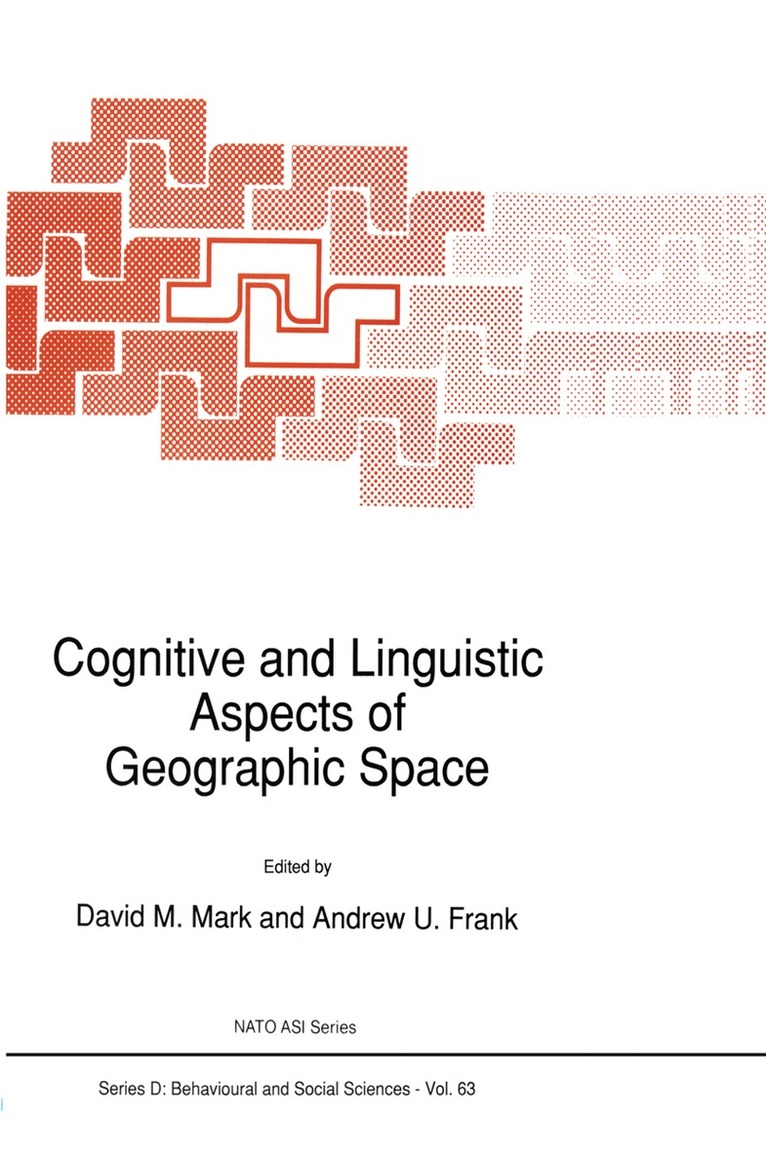
    Cognitive and Linguistic Aspects of Geographic Space

    AvD.M. Mark,Andrew U. Frank

    Häftad, Engelska, 2012

    Del 63 i serien NATO Science Series D:

    3 244 kr

    Beställningsvara. Skickas inom 10-15 vardagar. Fri frakt över 249 kr.

    Beskrivning

    This book contains twenty-eight papers by participants in the NATO Advanced Study Institute (ASI) on "Cognitive and Linguistic Aspects of Geographic Space," held in Las Navas del Maxques, Spain, July 8-20, 1990. The NATO ASI marked a stage in a two-year research project at the U. S. National Center for Geographic Infonnation and Analysis (NCOIA). In 1987, the U. S. National Science Foundation issued a solicitation for proposals to establish the NCGIA-and one element of that solicitation was a call for research on a "fundamental theory of spatial relations". We felt that such a fundamental theory could be searched for in mathematics (geometry, topology) or in cognitive science, but that a simultaneous search in these two seemingly disparate research areas might produce novel results. Thus, as part of the NCGIA proposal from a consortium consisting of the University of California at Santa Barbara, the State University of New York at Buffalo, and the University of Maine, we proposed that the second major Research Initiative (two year, multidisciplinary research project) of the NCOIA would address these issues, and would be called "Languages of Spatial Relations" The grant to establish the NCOIA was awarded to our consortium late in 1988.

    Produktinformation

    • Utgivningsdatum:2012-10-16
    • Mått:155 x 235 x 29 mm
    • Vikt:791 g
    • Format:Häftad
    • Språk:Engelska
    • Serie:NATO Science Series D:
    • Antal sidor:519
    • Upplaga:1991
    • Förlag:Springer
    • ISBN:9789401051514

    Utforska kategorier

    • Geografi inom Naturvetenskap och teknik
    • Kognitiv psykologi inom Psykologi och pedagogik

    Innehållsförteckning

    • Cognitive and Linguistic Aspects of Geographic Space: An Introduction.- Section 1: Geographic Space.- 1.1 Geographic Space as a Set of Concrete Geographical Entities.- 1.2 Some Notes on Geographic Information Systems: The Relationship Between their Practical Application and their Theoretical Evolution.- 1.3 A Hand-In-Glove Paradigm for Geography.- Section 2: Cultural Influences on the Conceptualization of Geographic Space.- 2.1 “Through the Door”: A View of Space from an Anthropological Perspective.- 2.2 Culture as Input and Output of the Cognitive-Linguistic Processes.- 2.3 Dialogic and Argumentative Structures of Bumper Stickers.- Section 3: Wayfinding and Spatial Cognition.- 3.1 The Development of the Abilities Required to Understand Spatial Representations.- 3.2 Making Sense of Human Wayfinding: Review of Cognitive and Linguistic Knowledge for Personal Navigation with a New Research Directioa.- 3.3 Wayfinding Theory and Research: The Need for a New Approach.- 3.4 The Effect of the Pattern of the Environment on Spatial Knowledge Acquisition.- 3.5 Methods for Measuring Spatial Cognition.- 3.6 Path Finding in Free Space Using Sinusoidal Transforms: III.- Section 4: Cartographic Perspectives.- 4.1 Mapping as Language or Semiotic System: Review and Comment.- 4.2 Plan Information and its Retrieval in Map Interpretation: The View from Semiotics.- 4.3 An Approach to Map/Text Interrelationships.- 4.4 Spatial Knowledge for Image Understanding.- Section 5: Formal Treatment of Space in Mathematics.- 5.1 The Mathematical Modeling of Spatial and Non-Spatial Information in Geographic Information Systems.- 5.2 Map Algebra as a Spatial Language.- 5.3 Qualitative Spatial Reasoning.- 5.4 Relative Representation of Spatial Knowledge: The 2-D Case.- 5.5 Matching Representations ofGeographic Locations.- 5.6 The Role of Modal Logics in the Description of a Geographical Information System.- Section 6: User Interfaces and Human-Computer Interaction.- 6.1 A Formalization of Metaphors and Image-Schemas in User Interfaces.- 6.2 Elicitation of Spatial Language to Support Cross-Cultural Geographic Information Systems.- 6.3 UGIX: A Layer Based Model For A GIS User Interface.- 6.4 Deficiencies of SQL as a GIS Query Language.- 6.5 The Role of the User in Generalization within Geographic Information Systems.- 6.6 Virtual Worlds, Inside and Out.- Appendix: NATO Advanced Study Institute Participants.