• Fri frakt över 249 kr
  • •
  • Snabba leveranser
  • •
  • Billiga böcker
Kundservice

Du är på sajten för privatpersoner.

Företag, bibliotek eller offentlig verksamhet?

Du handlar på classic.bokus.com, där alla dina funktioner finns intakta.
Till classic.bokus.com
Bokus logotyp. Gå till startsidan.
  • Erbjudanden
  • Nyheter
  • Student
  • Topplistor
  • Barn & ungdom
  • Bokus Play
  • E-böcker
  • Pocketböcker
  • Spel & pussel

10% rabatt på allt med kod: NYSTART10 →

Sidfot

Mina sidor

    Hjälp

    • Kundservice
    • Vanliga frågor och svar
    • Frakt och leverans
    • Retur vid ångerrätt
    • Reklamera vara
    • Betalning
    • Köpvillkor
    • Allmänna villkor
    • Information om webbplatsens tillgänglighet

    Om Bokus

    • Om oss
    • Pressrum
    • För studenter
    • För företag
    • För bibliotek och offentlig verksamhet
    • För leverantörer
    • Hållbarhet

    Populärt

    • Aktuella erbjudanden
    • Presentkort
    • Studentlitteratur
    • Nya böcker
    • Topplistor
    • Signerade böcker
    • Engelska böcker

    Inspiration

    • Boktips
    • BookTok
    • Populära bokserier
    • Barnbokskaraktärer
    • Populära författare
    Logotyp för Bokus
    Följ oss på Facebook (extern länk)Följ oss på Instagram (extern länk)Följ oss på YouTube (extern länk)Följ oss på TikTok (extern länk)
    bokus @ CookiesAnpassa cookiesIntegritetspolicyKöpvillkor
    Till Citymail hemsida (extern länk)Till Budbee hemsida (extern länk)Till Postnord hemsida (extern länk)Till Schenker hemsida (extern länk)Till Early Bird hemsida (extern länk)Till Walleys hemsida (extern länk)
    1. Djur och Natur
    2. Djurböcker
    3. Vilda djur
    4. Vattendjur

    Visual System of Fish

    AvRon Douglas,Mustafa Djamgoz

    Häftad, Engelska, 2011

    1 086 kr

    Beställningsvara. Skickas inom 10-15 vardagar. Fri frakt över 249 kr.

    Beskrivning

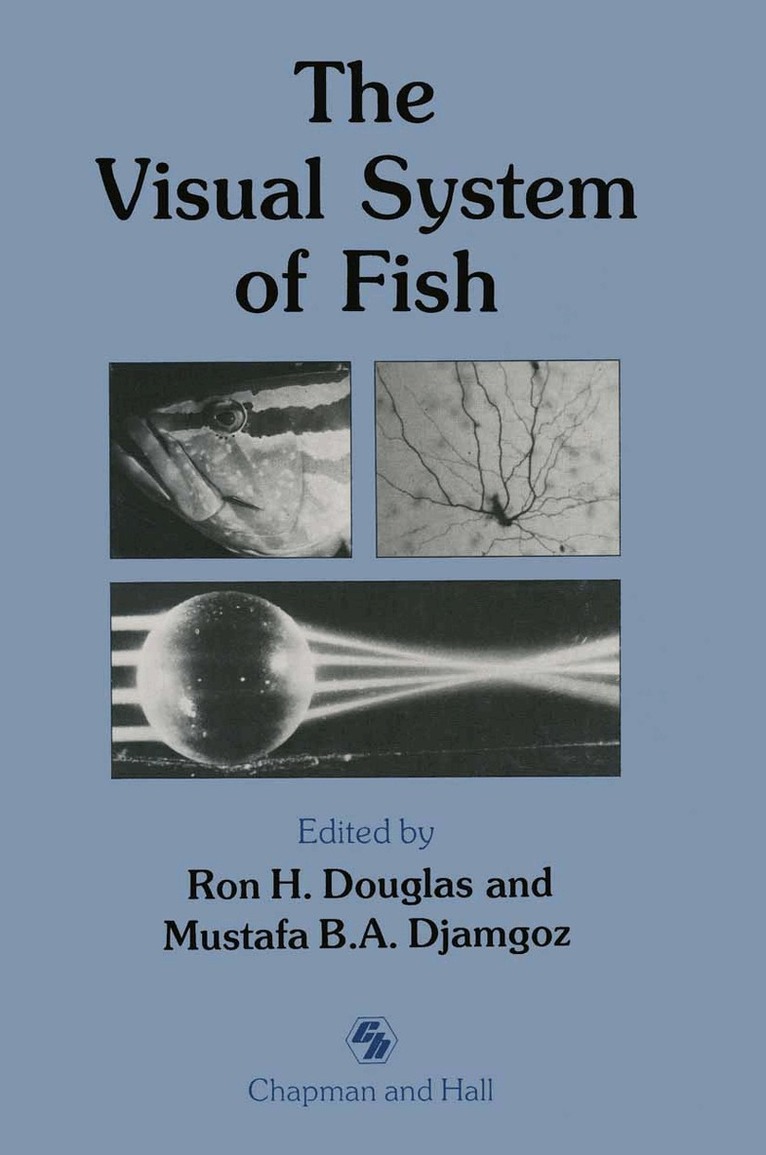
    A question often asked of those of us who work in the seemingly esoteric field of fish vision is, why? To some of us the answer seems obvious - how many other visual scientists get to dive in a tropical lagoon in the name of science and then are able to eat their subjects for dinner? However, there are better, or at least scientifically more acceptable, reasons for working on the visual system of fish. First, in terms of numbers, fish are by far the most important of all vertebrate classes, probably accounting for over half (c. 22 000 species) of all recognized vertebrate species (Nelson, 1984). Furthermore, many of these are of commercial importance. Secondly, if one of the research aims is to understand the human visual system, animals such as fish can tell us a great deal, since in many ways their visual systems, and specifically their eyes, are similar to our own. This is fortunate, since there are several techniques, such as intracellular retinal recording, which are vital to our understanding of the visual process, that cannot be performed routinely on primates. The cold­ blooded fish, on the other hand, is an ideal subject for such studies and much of what we know about, for example, the fundamentals of information processing in the retina is based on work carried out on fish (e. g. Svaetichin, 1953).

    Produktinformation

    • Utgivningsdatum:2011-09-26
    • Mått:155 x 235 x 33 mm
    • Vikt:812 g
    • Format:Häftad
    • Språk:Engelska
    • Antal sidor:526
    • Förlag:Springer
    • ISBN:9789401066723

    Utforska kategorier

    • Vattendjur inom Djur och Natur
    • Fiskar inom Naturvetenskap och teknik

    Innehållsförteckning

    • 1 The underwater visual environment.- 1.1 Introduction.- 1.2 Definition of terms.- 1.3 The photic environment.- 1.4 Underwater vision and ultraviolet light.- 1.5 Dynamic changes in underwater light - spatiotemporal properties.- 1.6 The underwater polarized light field.- Acknowledgements.- References.- 2 The optical system of fishes.- 2.1 Introduction.- 2.1 Optics.- 2.3 Accommodation.- Acknowledgements.- References.- 3 Optical variability of the fish lens.- 3.1 Introduction.- 3.2 Lens shape.- 3.3 Relative focal length (Matthiessen’s ratio).- 3.4 Spherical aberration.- 3.5 Chromatic aberration.- 3.6 Functional significance of fish lens quality.- 3.7 Concluding remarks.- References.- 4 Visual pigments of fishes.- 4.1 Introduction.- 4.2 Visual pigment structure.- 4.3 Receptor types.- 4.4 Distribution of visual pigments.- References.- 5 Retinal structure of fishes.- 5.1 Introduction.- 5.2 Diversity of retinal structure.- 5.3 Differentiation, structure and connectivity of retinal cells.- 5.4 Cyclic changes of cell morphology in the outer retina.- Acknowledgements.- References.- 6 Electrophysiological characteristics of retinal neurones: synaptic interactions and functional outputs.- 6.1 Introduction.- 6.2 Receptive field organizations: spatial and spectral aspects.- 6.3 Voltage-dependent conductances.- 6.4 Specific synaptic interactions.- 6.5 Efferent inputs.- 6.6 Concluding remarks.- Acknowledgements.- Abbreviations.- References.- 7 Neurotransmitters and neuromodulators of the fish retina.- 7.1 Introduction.- 7.2 Neurotransmitters of the distal retina.- 7.3 Neurotransmitters of the proximal retina.- 7.4 Summary.- Acknowledgements.- Abbreviations.- References.- 8 Tectal morphology: connections, neurones and synapses.- 8.1 Introduction.- 8.2 Retinal projections.- 8.3 Tectalposition and lamination.- 8.4 Tectal afferents.- 8.5 Intrinsic structural organization of the tectum.- 8.6 Tectal efferents.- 8.7 Concluding remarks.- Abbreviations.- References.- 9 The physiology of the teleostean optic tectum.- 9.1 Introduction.- 9.2 General physiological properties.- 9.3 Tectal input pathways: the retinotectal pathway.- 9.4 The marginal fibre pathway.- 9.5 The retinal efferents (retinopetal component).- 9.6 The tectoreticular pathway.- 9.7 Conclusion.- Acknowledgements.- Abbreviations.- References.- 10 The visual pathways and central non-tectal processing.- 10.1 Introduction.- 10.2 Visual structures in the diencephalon including the pretectum.- 10.3 Visual structures in the telencephalon.- 10.4 Visual structures in the ventral mesencephalon.- Acknowledgements.- Abbreviations.- References.- 11 Behavioural studies of fish vision: an analysis of visual capabilities.- 11.1 Introduction.- 11.2 Behavioural methods.- 11.3 Visual capabilities.- References.- 12 Development of the visual system.- 12.1 Introduction.- 12.2 Development of the optics of the eye.- 12.3 Development of the retina.- 12.4 Development of the optic tectum.- References.- 13 Haplochromis burtoni: a case study.- 13.1 Introduction.- 13.2 Visually guided behaviour.- 13.3 Social regulation of growth.- 13.4 Retinal structure.- 13.5 Retinal growth.- 13.6Summary.- Acknowledgements.- References.- 14 Vision in elasmobranchs.- 14.1 Introduction.- 14.2 Physiological optics.- 14.3 Tapetum lucidum.- 14.4 Retinal anatomy and physiology.- 14.5 Concluding remarks.- Acknowledgements.- Abbreviations.- References.- 15 Stimulus, environment and vision in fishes.- 15.1 Introduction.- 15.2 The underwater light environment.- 15.3 Visual adaptations to the environment.- 15.4 Fish as visual stimuli.- 15.5 Summary.- References.- Species index.