• Fri frakt över 249 kr
  • •
  • Snabba leveranser
  • •
  • Billiga böcker
Kundservice

Du är på sajten för privatpersoner.

Företag, bibliotek eller offentlig verksamhet?

Du handlar på classic.bokus.com, där alla dina funktioner finns intakta.
Till classic.bokus.com
Bokus logotyp. Gå till startsidan.
  • Erbjudanden
  • Nyheter
  • Student
  • Topplistor
  • Barn & ungdom
  • Bokus Play
  • E-böcker
  • Pocketböcker
  • Spel & pussel

10% rabatt på allt med kod NYSTART10 →

Sidfot

Mina sidor

    Hjälp

    • Kundservice
    • Vanliga frågor och svar
    • Frakt och leverans
    • Retur vid ångerrätt
    • Reklamera vara
    • Betalning
    • Köpvillkor
    • Allmänna villkor
    • Information om webbplatsens tillgänglighet

    Om Bokus

    • Om oss
    • Pressrum
    • För studenter
    • För företag
    • För bibliotek och offentlig verksamhet
    • För leverantörer
    • Hållbarhet

    Populärt

    • Aktuella erbjudanden
    • Presentkort
    • Studentlitteratur
    • Nya böcker
    • Topplistor
    • Signerade böcker
    • Engelska böcker

    Inspiration

    • Boktips
    • BookTok
    • Populära bokserier
    • Barnbokskaraktärer
    • Populära författare
    Logotyp för Bokus
    Följ oss på Facebook (extern länk)Följ oss på Instagram (extern länk)Följ oss på YouTube (extern länk)Följ oss på TikTok (extern länk)
    bokus @ CookiesAnpassa cookiesIntegritetspolicyKöpvillkor
    Till Citymail hemsida (extern länk)Till Budbee hemsida (extern länk)Till Postnord hemsida (extern länk)Till Schenker hemsida (extern länk)Till Early Bird hemsida (extern länk)Till Walleys hemsida (extern länk)
    1. Ekonomi och Ledarskap
    2. Nationalekonomi
    3. Mikroekonomi

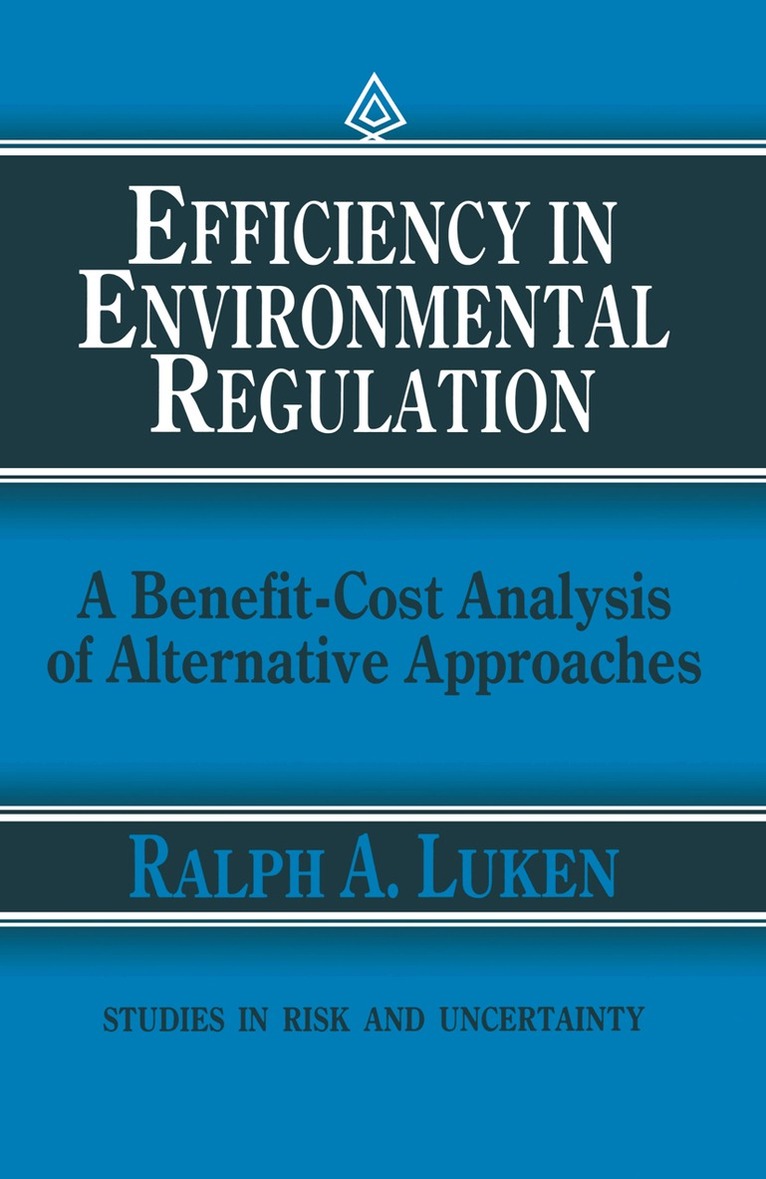
    Efficiency in Environmental Regulation

    A Benefit-Cost Analysis of Alternative Approaches

    AvRalph A. Luken

    Häftad, Engelska, 2011

    Del 1 i serien Studies in Risk and Uncertainty

    546 kr

    Beställningsvara. Skickas inom 10-15 vardagar. Fri frakt över 249 kr.

    Fler format och utgåvor

    E-bok

    710 kr

    Beskrivning

    A management agency --such as a publicly or privately owned electric utility -- must, if it is to be efficient in carrying out its day-to-day tasks, have a means of monitoring its performance to assess the efficiency of its operations and the effectiveness of its planning. For example, how did the demand for electricity compare with that assumed in planning? How effective were the incentives applied to induce energy conservation by users? Such ex post analyses are essential for improving the planning process and hence for improving decisions with respect to efficiency and resource allocation. Unfortunately, it seems to be very difficult for public agencies to make such ex post evaluations an integral part of agency activities, whether the agencies are "producers," e. g. , the Corps of Engineers or the Bureau of Reclamation with respect to water resources management, or are regulatory agencies such as the Environmental Protection Agency or the Food and Drug Administration. Here and there a few ex post analyses of agency programs have been done, but rarely by the responsible agency itself. These analyses have attempted to compare the results actually achieved with the results estimated in planning, either in terms of project outputs or in terms of effectiveness of regulatory and/or economic incentives in inducing desired changes in behavior.

    Produktinformation

    • Utgivningsdatum:2011-09-27
    • Mått:155 x 235 x 22 mm
    • Vikt:593 g
    • Format:Häftad
    • Språk:Engelska
    • Serie:Studies in Risk and Uncertainty
    • Antal sidor:400
    • Förlag:Springer
    • ISBN:9789401068161

    Utforska kategorier

    • Mikroekonomi inom Ekonomi och Ledarskap
    • Miljövetenskap och miljöpolitik inom Naturvetenskap och teknik
    • Miljöekonomi inom Ekonomi och Ledarskap

    Innehållsförteckning

    • 1. Introduction.- 2. Regulatory Approaches.- Elements of a Regulatory Program.- The Clean Water Act.- The Clean Air Act.- The Resource Conservation and Recovery Act.- 3. Technology Approach.- Pollution Control Costs And Effluents.- Water Quality Impacts.- Monetary Benefits.- Findings.- Appendix 3-A. Costs for Indirect-Discharging Mills.- Appendix 3-B. Pulp and Paper Mills Evaluated in this Study.- Appendix 3-C. Water Pollution Control Cost Estimation.- Appendix 3-D. Water Pollution Control Cost Comparisons.- Appendix 3-E. Loadings Data.- Appendix 3-F. Water Quality Model.- Appendix 3-G. Model Validation.- Appendix 3-H. Visitation Estimates.- Appendix 3-I. Recreation Benefit Studies.- Appendix 3-J. Sensitivity Analysis for Benefit Calculations.- 4. Ambient Approach.- Pollution Control Costs and Emissions.- Air Quality Impacts.- Monetary Benefits.- Findings.- Appendix 4-A SO2 Emissions and Costs.- Appendix 4-B. Pulp-Producing Mills Evaluated in this Study.- Appendix 4-C. Air Pollution Control Costs (TSP).- Appendix 4-D. Air Pollution Control Cost Comparisons.- Appendix 4-E. Loadings Data.- Appendix 4-F. Air Quality Model.- Appendix 4-G. Emissions Versus Concentrations.- Appendix 4-H. Model Validation.- Appendix 4-I Derivation of Concentration Response Functions for Health Effects.- 5. Benefits Approach.- Pollution Control Costs and Emissions.- Air Quality Impacts.- Monetary Benefits.- Findings.- Appendix 5-A Kraft Pulp Mills Evaluated in this Study.- Appendix 5-B. Air Pollution Control Cost Estimation (TRS).- Appendix 5-C. TRS Emissions.- Appendix 5-D. The MPTER Model.- 6. Compliance.- Measuring Compliance.- Water Compliance.- Air Compliance.- Findings.- 7. Growth.- Conventional Water Pollutants.- Criteria Air Pollutants - TSP.- Designated Air Pollutants - TRS.- Findings.- Appendix 7-A. 1984—1994 TRS Emission Reduction Policies.- 8. Toxic Pollutants.- Water Pollutants - Dioxin.- Chloroform - Air Pollutant.- Chloroform - Hazardous Waste.- Findings.- Appendix 8-A. Mills in the TOX Analysis.- Appendix 8-B. Critique of the Chloroform Risk Assessment.- Appendix 8-C. Process Modification Costs.- Appendix 8-D. Mill-Specific Costs for Hypochlorite Elimination.- Appendix 8-E. Mill-Specific Costs for Chloroform Reduction.- 9. Conclusions.- Regulatory Approaches.- Historical Perspective.- Future Direction.- Appendix A. The Pulp and Paper Industry.- Industry Profile.- Capacity.- Geographic Distribution.- Standard Manufacturing Processes.- Preparing Raw Material.- Pulping.- Bleaching of Wood Pulps.- Papermaking.- Converting.- Sources of Wastes.- Water Effluents.- Air Emissions.- Solid Wastes.- Estimated Generation of Wastes.- Appendix B. Mills Evaluated in the Study.- Appendix C. Inflation Indexes.- Appendix D. Glossary of Environmental Terms.- Author Index.