• Fri frakt över 249 kr
  • •
  • Snabba leveranser
  • •
  • Billiga böcker
Kundservice

Du är på sajten för privatpersoner.

Företag, bibliotek eller offentlig verksamhet?

Du handlar på classic.bokus.com, där alla dina funktioner finns intakta.
Till classic.bokus.com
Bokus logotyp. Gå till startsidan.
  • Erbjudanden
  • Nyheter
  • Student
  • Topplistor
  • Barn & ungdom
  • Bokus Play
  • E-böcker
  • Pocketböcker
  • Spel & pussel

10% rabatt på allt med kod: NYSTART10 →

Sidfot

Mina sidor

    Hjälp

    • Kundservice
    • Vanliga frågor och svar
    • Frakt och leverans
    • Retur vid ångerrätt
    • Reklamera vara
    • Betalning
    • Köpvillkor
    • Allmänna villkor
    • Information om webbplatsens tillgänglighet

    Om Bokus

    • Om oss
    • Pressrum
    • För studenter
    • För företag
    • För bibliotek och offentlig verksamhet
    • För leverantörer
    • Hållbarhet

    Populärt

    • Aktuella erbjudanden
    • Presentkort
    • Studentlitteratur
    • Nya böcker
    • Topplistor
    • Signerade böcker
    • Engelska böcker

    Inspiration

    • Boktips
    • BookTok
    • Populära bokserier
    • Barnbokskaraktärer
    • Populära författare
    Logotyp för Bokus
    Följ oss på Facebook (extern länk)Följ oss på Instagram (extern länk)Följ oss på YouTube (extern länk)Följ oss på TikTok (extern länk)
    bokus @ CookiesAnpassa cookiesIntegritetspolicyKöpvillkor
    Till Citymail hemsida (extern länk)Till Budbee hemsida (extern länk)Till Postnord hemsida (extern länk)Till Schenker hemsida (extern länk)Till Early Bird hemsida (extern länk)Till Walleys hemsida (extern länk)
    1. Ekonomi och Ledarskap
    2. Nationalekonomi

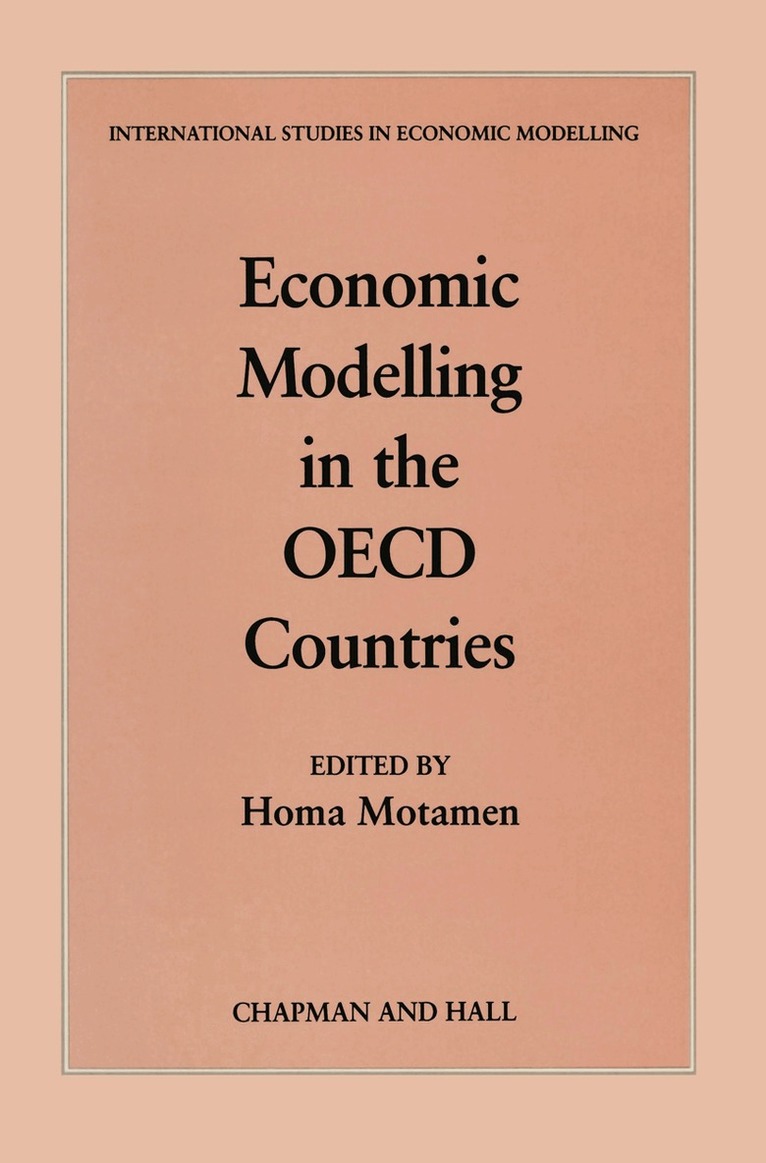
    Economic Modelling in the OECD Countries

    AvHoma Motamen-Scobie

    Häftad, Engelska, 2011

    Del i serien International Studies in Economic Modelling

    547 kr

    Beställningsvara. Skickas inom 10-15 vardagar. Fri frakt över 249 kr.

    Beskrivning

    among the 159 member countries of the United Nations Organization which are treated as country units, while smaller countries are grouped together in regions. The number of equations used is approximately 13 700, while the number of software steps for computation is approximately 100000. Computation, including tabulation, can nevertheless be performed very rapidly, and only about 20 minutes is required to make forecasts from the present up to the year 2000. The FUGI model is at present being used by the Projections and Perspectives Studies Branch, Department of International Economic and Social Affairs of the United Nations, for simulations of United Nations medium- and long-term international development strategies, while the Project LINK model is being used for short-term forecasts (Onishi, 1985). Stimulated by our latest joint research with the United Nations University on a 'global early warning system for displaced persions', we have felt the need for our FUGI model to go beyond its present capacities centred on an 'economic' model (in the rather traditional, restricted sense of the term) and to develop into a model that can in the future analyse 'global problematiques' or 'global complexes of symptoms' and complicated questions including various types of environmental problems and the sorts of displaced persons issues to which we are now directing our attention. We are thus expanding the scope of our fifth-generation FUGI model, presently under development, to deal with such issues.

    Produktinformation

    • Utgivningsdatum:2011-09-26
    • Mått:155 x 235 x 41 mm
    • Vikt:1 142 g
    • Format:Häftad
    • Språk:Engelska
    • Serie:International Studies in Economic Modelling
    • Antal sidor:776
    • Förlag:Springer
    • ISBN:9789401070393

    Utforska kategorier

    • Nationalekonomi inom Ekonomi och Ledarskap
    • Matematisk statistik inom Naturvetenskap och teknik

    Innehållsförteckning

    • 1 The LINK model and its use in international scenario analysis.- 2 Projections of the OECD economies in the global perspective, 1986—2000: policy simulations by the FUGI global macroeconomic model.- 3 Supply-side policies in four OECD countries.- 4 An empirical analysis of policy co-ordination in the United States, Japan and Europe.- 5 How much could the international co-ordination of economic policies achieve? An example from US-EEC policy-making.- 6 Capital risk and models of investment behaviour.- 7 Adjustment costs and mean-variance efficiency in UK financial markets.- 8 The macroeconomic and sectoral effects of the Economic Recovery Tax Act: some simulation results.- 9 Use of anticipations data in the anticipations model.- 10 An endogenously time-varying parameter (TVP) model of investment behaviour: theory and application to Belgian data.- 11 Budget consolidation, effective demand and employment.- 12 Interaction between economic growth and financial flows: presentation of a model analysing the impact of short-term financial disturbances on economic growth.- 13 Asymmetry in conservation: a capital stock analysis.- 14 Adjustment options for the US economy.- 15 Model building for decision aid in the agri-economic field.- 16 Estimated optimal lags for the optimization models: a method for estimating the optimal lag between economic variables.- 17 Macroeconomic policy and aggregate supply in the UK.- 18 Two recent trends combined in an econometric model for the Netherlands: the supply-side and sectoral approach.- 19 The supply-side of RIKMOD: short-run producer behaviour in a model of monopolistic competition.- 20 Direct interventions, interest rate shocks and monetary disturbances in the Canadian Foreign Exchange market: a simulation study.- 21 Effects of a fall inthe price of oil: the case of a small oil-exporting country.- 22 Modelling the effects of investment subsidies.- 23 Collective bargaining and macroeconomic performance: the case of West Germany.- 24 A cost—push model of galloping inflation: the case of Yugoslavia.- 25 Short-term forecasting of wages, employment and output in Barbados.- 26 Reducing working time for reducing unemployment? A macro-economic simulation study for the Belgian economy.- 27 An econometric model for the determination of banking system excess reserves.- 28 Forecasting versus policy analysis with the ORANI model.- 29 An applied general equilibrium model of the United States economy.- 30 A quarterly econometric model for the Spanish economy.- 31 Macroeconomic policies and adjustment in Yugoslavia: some counter-factual simulations.