• Fri frakt över 249 kr
  • •
  • Snabba leveranser
  • •
  • Billiga böcker
Kundservice

Du är på sajten för privatpersoner.

Företag, bibliotek eller offentlig verksamhet?

Du handlar på classic.bokus.com, där alla dina funktioner finns intakta.
Till classic.bokus.com
Bokus logotyp. Gå till startsidan.
  • Erbjudanden
  • Nyheter
  • Student
  • Topplistor
  • Barn & ungdom
  • Bokus Play
  • E-böcker
  • Pocketböcker
  • Spel & pussel

10% rabatt på allt med kod NYSTART10 →

Sidfot

Mina sidor

    Hjälp

    • Kundservice
    • Vanliga frågor och svar
    • Frakt och leverans
    • Retur vid ångerrätt
    • Reklamera vara
    • Betalning
    • Köpvillkor
    • Allmänna villkor
    • Information om webbplatsens tillgänglighet

    Om Bokus

    • Om oss
    • Pressrum
    • För studenter
    • För företag
    • För bibliotek och offentlig verksamhet
    • För leverantörer
    • Hållbarhet

    Populärt

    • Aktuella erbjudanden
    • Presentkort
    • Studentlitteratur
    • Nya böcker
    • Topplistor
    • Signerade böcker
    • Engelska böcker

    Inspiration

    • Boktips
    • BookTok
    • Populära bokserier
    • Barnbokskaraktärer
    • Populära författare
    Logotyp för Bokus
    Följ oss på Facebook (extern länk)Följ oss på Instagram (extern länk)Följ oss på YouTube (extern länk)Följ oss på TikTok (extern länk)
    bokus @ CookiesAnpassa cookiesIntegritetspolicyKöpvillkor
    Till Citymail hemsida (extern länk)Till Budbee hemsida (extern länk)Till Postnord hemsida (extern länk)Till Schenker hemsida (extern länk)Till Early Bird hemsida (extern länk)Till Walleys hemsida (extern länk)
    1. Samhälle och politik
    2. Sociologi och antropologi
    3. Sociologi

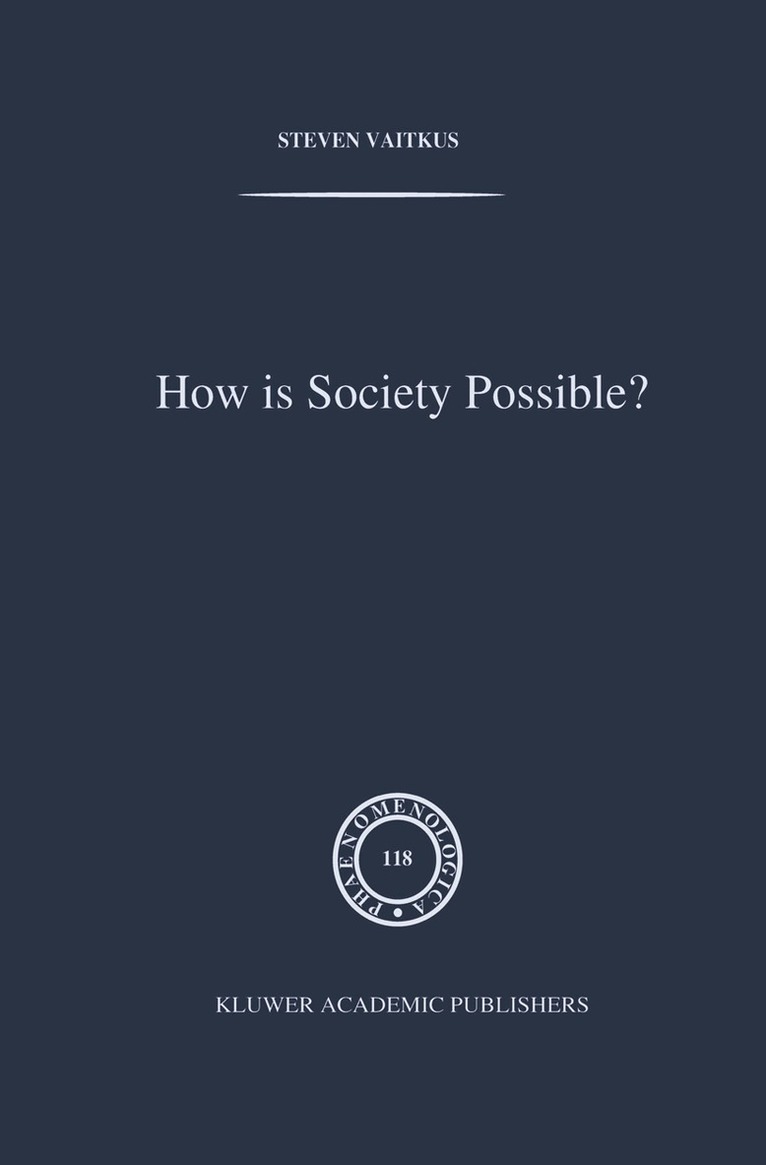
    How is Society Possible?

    Intersubjectivity and the Fiduciary Attitude as Problems of the Social Group in Mead, Gurwitsch, and Schutz

    AvS. Vaitkus

    Häftad, Engelska, 2011

    Del 118 i serien Phaenomenologica

    1 623 kr

    Beställningsvara. Skickas inom 10-15 vardagar. Fri frakt över 249 kr.

    Fler format och utgåvor

    Inbunden

    1 623 kr

    E-bok

    2 044 kr

    Beskrivning

    How is society possible? In Die Krisis der europiiischen Wissenschaflen und die transzendentale Phiinomenoiogie, I Edmund Husserl is found with a pathos send­ ing out pleas for belief ("Glauben") in his transcendental philosophy and tran­ scendental ego. The traditional idea of theoretical reflection instituted in ancient Greece as the suspension of all taken for granted worldly interests has, through a partial realization of itself, forsaken itself in the one-sided development of the objective mathematical-natural sciences as they themselves have become so taken for granted, with the method and validity of their results held as so self-evident, that they appear as resting self-sufficiently on their own grounds, while pursuing an increasingly abstract mathematization of nature. The sciences are left without a foundation and their meaning within the world consequently unintelligible, while their objective and valid abstract concepts continually tend to supercede the everyday life-world and render it questionable. In the end, these of belief in the everyday life-world or reflective evolving and exchanging attitudes doubt (science) ultimately leads to a disbelief in both, and a search in one direction for idol leaders and in the other for the cult of experience. This collapse of Western belief systems becomes particularly threatening as it turns into nihilism which is the development of beliefs in societal forms which employ 2 natural and social science for the liquidation of humanity and nature. Society starts becoming impossible.

    Produktinformation

    • Utgivningsdatum:2011-10-01
    • Mått:155 x 235 x 13 mm
    • Vikt:341 g
    • Format:Häftad
    • Språk:Engelska
    • Serie:Phaenomenologica
    • Antal sidor:208
    • Upplaga:1991
    • Förlag:Springer
    • ISBN:9789401074322

    Utforska kategorier

    • Sociologi inom Samhälle och politik
    • Filosofiska discipliner inom Filosofi och religion

    Innehållsförteckning

    • One: Mead’s Theory of Intersubjectivity.- I. Intersubjectivity as a Problem of the Social Group.- II. Critical Remarks to Mead’s Theory of Intersubjectivity.- Two: Gurwitsch’s Theory of Intersubjectivity.- III. Intersubjectivity as a Problem of Context and the Milieu-World.- IV. Critical Remarks to Gurwitsch’s Theory of Intersubjectivity.- Three: Schutz’s Theory of Intersubjectivity.- V. The Fundamental Levels to the Problem of Intersubjectivity.- VI. Towards an Integrated Theory of Intersubjectivity: The Person and The Social Group.- VII. Critical Remarks to Schutz’s Theory of Intersubjectivity.- Four: Intersubjectivity and the Social Group.- VIII. A General Program for Any Future Analysis of the Problem of Intersubjectivity.- IX. Reflections on the Problem of Intersubjectivity and the Social Group.- Name Index.