• Fri frakt över 249 kr
  • •
  • Snabba leveranser
  • •
  • Billiga böcker
Kundservice

Du är på sajten för privatpersoner.

Företag, bibliotek eller offentlig verksamhet?

Du handlar på classic.bokus.com, där alla dina funktioner finns intakta.
Till classic.bokus.com
Bokus logotyp. Gå till startsidan.
  • Erbjudanden
  • Nyheter
  • Student
  • Topplistor
  • Barn & ungdom
  • Bokus Play
  • E-böcker
  • Pocketböcker
  • Spel & pussel

10% rabatt på allt med kod: NYSTART10 →

Sidfot

Mina sidor

    Hjälp

    • Kundservice
    • Vanliga frågor och svar
    • Frakt och leverans
    • Retur vid ångerrätt
    • Reklamera vara
    • Betalning
    • Köpvillkor
    • Allmänna villkor
    • Information om webbplatsens tillgänglighet

    Om Bokus

    • Om oss
    • Pressrum
    • För studenter
    • För företag
    • För bibliotek och offentlig verksamhet
    • För leverantörer
    • Hållbarhet

    Populärt

    • Aktuella erbjudanden
    • Presentkort
    • Studentlitteratur
    • Nya böcker
    • Topplistor
    • Signerade böcker
    • Engelska böcker

    Inspiration

    • Boktips
    • BookTok
    • Populära bokserier
    • Barnbokskaraktärer
    • Populära författare
    Logotyp för Bokus
    Följ oss på Facebook (extern länk)Följ oss på Instagram (extern länk)Följ oss på YouTube (extern länk)Följ oss på TikTok (extern länk)
    bokus @ CookiesAnpassa cookiesIntegritetspolicyKöpvillkor
    Till Citymail hemsida (extern länk)Till Budbee hemsida (extern länk)Till Postnord hemsida (extern länk)Till Schenker hemsida (extern länk)Till Early Bird hemsida (extern länk)Till Walleys hemsida (extern länk)
    1. Historia och arkeologi
    2. Historia
    3. Historia: teori och metod

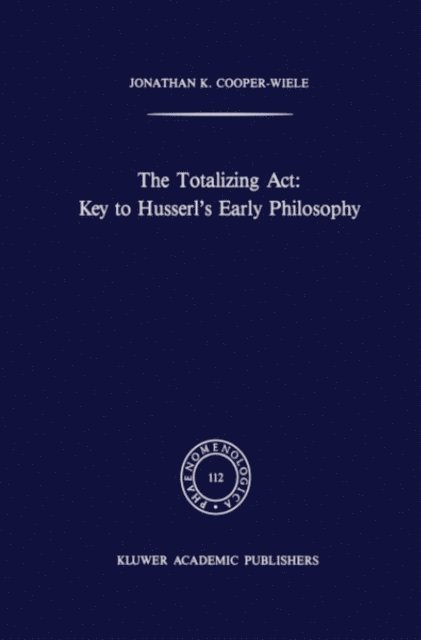
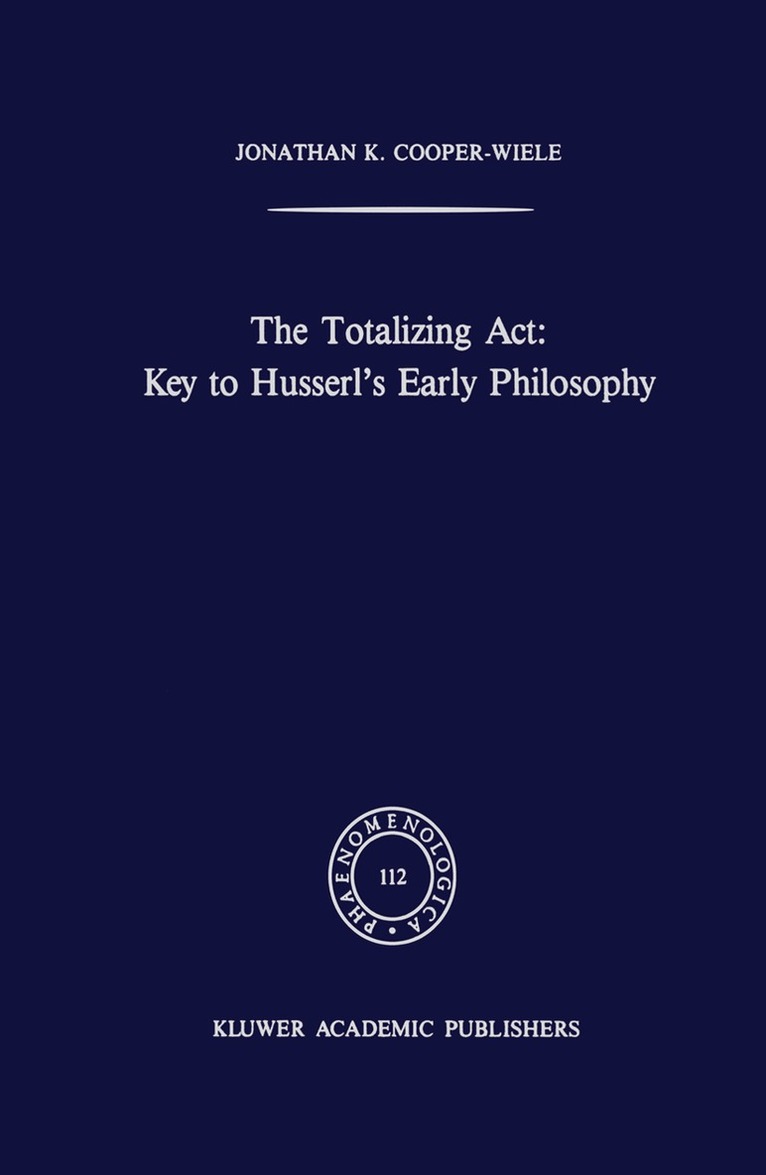
    Totalizing Act: Key to Husserl’s Early Philosophy

    AvJ.K. Cooper-Wiele

    Häftad, Engelska, 2013

    Del i serien Phaenomenologica

    1 625 kr

    Beställningsvara. Skickas inom 10-15 vardagar. Fri frakt över 249 kr.

    Fler format och utgåvor

    Inbunden

    1 625 kr

    E-bok

    2 044 kr

    Beskrivning

    The Origins of Husserl's Totalizing Act At noon on Monday, October 24th, 1887, Dr. Edmund G. Husserl defended the dissertation that would qualify him as a university lecturer at Halle. Entitled "On the Concept of Number," it was written under Carl Stumpf who, like Husserl, had been a student of Franz Brentano. In this, his first published philosophical work, Husserl sought to secure the foundations of mathematics by deriving its most fundamental concepts from psychical acts.! In the same year, Heinrich Hertz published an article entitled, "Con­ cerning an Influence of Ultraviolet Light on the Electrical Discharge." The article detailed his discovery of a new "relation between two entirely different forces," those of light and electricity. Hermann von Helmholtz, whose theory guided Hertz's initial research, called it the "most important physical discovery of the century," and Hertz became an immediate sensation. He lectured on his discovery in 1889 before a general session of the German Association meeting in Heidelberg. In this lecture that, as he wrote beforehand to Emil Cohn, he was deter­ mined should not be "entirely unintelligible to the laity," Hertz explained that light ether and electro-magnetic forces were interdependent. He went on to tell his audience that they need not expect their senses to grant them access to these phenomena. Indeed, he said, the latter are not only insusceptible of sense perception, but are false from the standpoint of the senses.


    Produktinformation

    • Utgivningsdatum:2013-10-03
    • Mått:155 x 235 x 10 mm
    • Vikt:260 g
    • Format:Häftad
    • Språk:Engelska
    • Serie:Phaenomenologica
    • Antal sidor:150
    • Förlag:Springer
    • ISBN:9789401075121

    Utforska kategorier

    • Historia: teori och metod inom Historia och arkeologi
    • Filosofiska discipliner inom Filosofi och religion
    • Matematikens historia inom Naturvetenskap och teknik

    Innehållsförteckning

    • Introduction: The Origins of Husserl’s Totalizing Act.- I. The Totalizing Act: Key to Husserl’s Early Philosophy.- The Totalizing Act.- The Totalizing Act as Totality.- II. The Concept of the Totalizing Act as Collective Connection: Progenitor of Number.- The Auto-Abstraction of the Concept of Collective Connection.- Number Concepts: Progeny of the Totalizing Act.- The “Attachment” of Number Concepts: Index of the Totalizing Act.- The Preeminence of the Totalizing Act: Refutation of a Prevalent Interpretation.- III. Symbolizing: Prosthesis of the Totalizing Act.- The Hierarchic Complication of Totalizing Acts.- The Anatomy of Abstracta.- The Self-Extension of the Totalizing Act by Proxy.- IV. The Symbolic Totalization of Sensible Multitudes.- The Sensible Individual as Modified Multitude.- The Symbolic Totalization of the Sensible Multitude.- V. The Intuitive Totalization of the Individual Sense Object.- The Sensible Group: Sufficient Context for Analyzing Intuition of Individuals.- The Problem: Non-Convertibility of Simultaneous and Successive Totalizing.- The Resolution: Successive and Simultaneous Totalizing as Continuous.- The Mutual Implication of Intuiting and Representing in the Intuition of the Sensible Thing.- VI. The Totalizing Act as Mediator of the Ideal and Real.- Hypothesis: The Internal Motivation for the Great Inversion.- Confirmation: The Prolegomena of 1900.- VII. The Ensoulment of Sensation: Triumph of the Totalizing Psyche.- The Immanent Object as Empiricistic Fetish.- The Psychical Production of the Transcendent Object.- The Dilemma: The Uncertainty of the Transcendent and the Imperceptibility of the Immanent.- The Great Reversal: The Causal World as Interpretation.- Afterword: A Hypothetical Answer for Alfred Schutz.- Appendices.- SelectedBibliography.