• Fri frakt över 249 kr
  • •
  • Snabba leveranser
  • •
  • Billiga böcker
Kundservice

Du är på sajten för privatpersoner.

Företag, bibliotek eller offentlig verksamhet?

Du handlar på classic.bokus.com, där alla dina funktioner finns intakta.
Till classic.bokus.com
Bokus logotyp. Gå till startsidan.
  • Erbjudanden
  • Nyheter
  • Student
  • Topplistor
  • Barn & ungdom
  • Bokus Play
  • E-böcker
  • Pocketböcker
  • Spel & pussel

10% rabatt på allt med kod: NYSTART10 →

Sidfot

Mina sidor

    Hjälp

    • Kundservice
    • Vanliga frågor och svar
    • Frakt och leverans
    • Retur vid ångerrätt
    • Reklamera vara
    • Betalning
    • Köpvillkor
    • Allmänna villkor
    • Information om webbplatsens tillgänglighet

    Om Bokus

    • Om oss
    • Pressrum
    • För studenter
    • För företag
    • För bibliotek och offentlig verksamhet
    • För leverantörer
    • Hållbarhet

    Populärt

    • Aktuella erbjudanden
    • Presentkort
    • Studentlitteratur
    • Nya böcker
    • Topplistor
    • Signerade böcker
    • Engelska böcker

    Inspiration

    • Boktips
    • BookTok
    • Populära bokserier
    • Barnbokskaraktärer
    • Populära författare
    Logotyp för Bokus
    Följ oss på Facebook (extern länk)Följ oss på Instagram (extern länk)Följ oss på YouTube (extern länk)Följ oss på TikTok (extern länk)
    bokus @ CookiesAnpassa cookiesIntegritetspolicyKöpvillkor
    Till Citymail hemsida (extern länk)Till Budbee hemsida (extern länk)Till Postnord hemsida (extern länk)Till Schenker hemsida (extern länk)Till Early Bird hemsida (extern länk)Till Walleys hemsida (extern länk)
    1. Historia och arkeologi
    2. Historia
    3. Historia: teori och metod

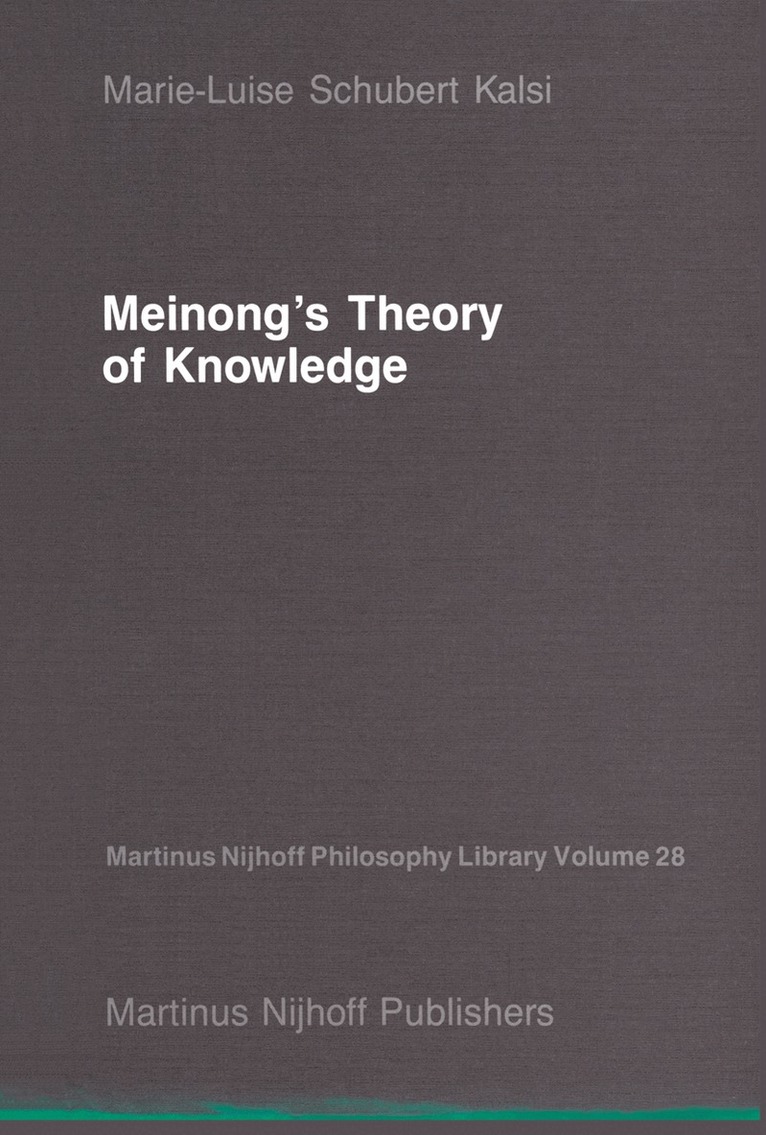
    Meinong’s Theory of Knowledge

    AvMarie-Luise Schubert Kalsi

    Häftad, Engelska, 2011

    Del 28 i serien Martinus Nijhoff Philosophy Library

    1 086 kr

    Beställningsvara. Skickas inom 10-15 vardagar. Fri frakt över 249 kr.

    Fler format och utgåvor

    Inbunden

    1 086 kr

    E-bok

    1 413 kr

    Beskrivning

    In recent years there has been a renewal of interest in Meinong's work; but since the bulk of it is still encased in his quite forbidding German, most students are limited to the few available translations and to secondary sources. Unfortunately Meinong has been much maligned - only in a few instances with good reason - and has consequently been dealt with lightly. Meinong stood at a very important junction of European philosophical and scien­ tific thought. In all fields - physics, chemistry, mathematics, psychology, philolo- revolutionary strides were being made. Philosophy, on the other hand, had run its post-Kantian course. New philosophical thinkers came from different disciplines. For example, Frege and later Russell were mathematicians, Boltzmann and Mach were physicists. Earlier Bolzano and then Brentano were originally theologians, and Meinong was a historian. 1 The sciences with their new insights and theories offered an enormous wealth of information which needed to be absorbed philosophically; but traditional philosophy could not deal with it. Physics presented a picture of reality which did not fit into the traditional schemes of empiricism or idealism. Ontological and epistemological questions became once again wide open issues. For example, atoms at first were still considered to be theoretical entities.

    Produktinformation

    • Utgivningsdatum:2011-10-01
    • Mått:155 x 235 x 9 mm
    • Vikt:236 g
    • Format:Häftad
    • Språk:Engelska
    • Serie:Martinus Nijhoff Philosophy Library
    • Antal sidor:129
    • Förlag:Springer
    • ISBN:9789401081290

    Utforska kategorier

    • Historia: teori och metod inom Historia och arkeologi
    • Filosofiska discipliner inom Filosofi och religion
    • Historia inom Historia och arkeologi

    Innehållsförteckning

    • I. Meinong, Brentano, Chisholm.- A. Alexius Meinong the Person.- B. Meinong and Brentano.- C. Meinong and Chisholm.- II. Perception.- A. General Remarks.- B. Internal Perception.- C. Sphere of Ideas and Sphere of Judgments.- D. Psychic Analysis.- E. Production of Ideas.- F. Perception of Temporally Distributed Objects.- III. Time and the Temporal.- A. General Remarks.- B. Subjective Time.- C. Persistence.- D. Objective Object Time.- E. Perception of Temporal Determinations.- F. Additional Remarks.- IV. Fantasy.- A. Fantasy Ideas and Dispositions.- B. Production of Fantasy Ideas.- V. Memory.- A. General Remarks.- B. Judgments of Existence.- C. Memory Judgments of Being Thus-and-So.- D. Assumption Versus Judgment.- E. Memory of Objects of External Perception.- F. Memory of Feelings and Their Objects.- G. Remembering Judgments of Subsistence.- H. Negative Memories.- VI. Onevidence.- A. Introduction.- B. Judgments.- C. Preliminary Description of Evidence.- D. Presumtive Evidence.- E. Evidence for Certainty.- F. Evidence as Property.- G. Evidence as Fundamental Act.- H. Evidence as Content.- I. Absence of Evidence in Judgments Capable of Evidence, Unawareness of Present Evidence.- J. Evidence and Truth.- K. Evidence and Linguistic Systems.- L. A Principle of Evidence for Internal Perception.- M. Evidence of Memory Judgments.