• Fri frakt över 249 kr
  • •
  • Snabba leveranser
  • •
  • Billiga böcker
Kundservice

Du är på sajten för privatpersoner.

Företag, bibliotek eller offentlig verksamhet?

Du handlar på classic.bokus.com, där alla dina funktioner finns intakta.
Till classic.bokus.com
Bokus logotyp. Gå till startsidan.
  • Erbjudanden
  • Student
  • Topplistor
  • Barn & ungdom
  • Bokus Play
  • E-böcker
  • Ljudböcker
  • Pocketböcker
  • Spel & pussel

Upp till 25% på utvalda nyheter →

Sidfot

Mina sidor

    Hjälp

    • Kundservice
    • Vanliga frågor och svar
    • Frakt och leverans
    • Retur vid ångerrätt
    • Reklamera vara
    • Betalning
    • Köpvillkor
    • Allmänna villkor
    • Information om webbplatsens tillgänglighet

    Om Bokus

    • Om oss
    • Pressrum
    • För studenter
    • För företag
    • För bibliotek och offentlig verksamhet
    • För leverantörer
    • Hållbarhet

    Populärt

    • Aktuella erbjudanden
    • Presentkort
    • Studentlitteratur
    • Nya böcker
    • Topplistor
    • Signerade böcker
    • Engelska böcker

    Inspiration

    • Boktips
    • BookTok
    • Populära bokserier
    • Barnbokskaraktärer
    • Populära författare
    Logotyp för Bokus
    Följ oss på Facebook (extern länk)Följ oss på Instagram (extern länk)Följ oss på YouTube (extern länk)Följ oss på TikTok (extern länk)
    bokus @ CookiesAnpassa cookiesIntegritetspolicyKöpvillkor
    Till Citymail hemsida (extern länk)Till Budbee hemsida (extern länk)Till Postnord hemsida (extern länk)Till Schenker hemsida (extern länk)Till Early Bird hemsida (extern länk)Till Walleys hemsida (extern länk)
    1. Filosofi och religion
    2. Filosofi
    3. Filosofiska discipliner

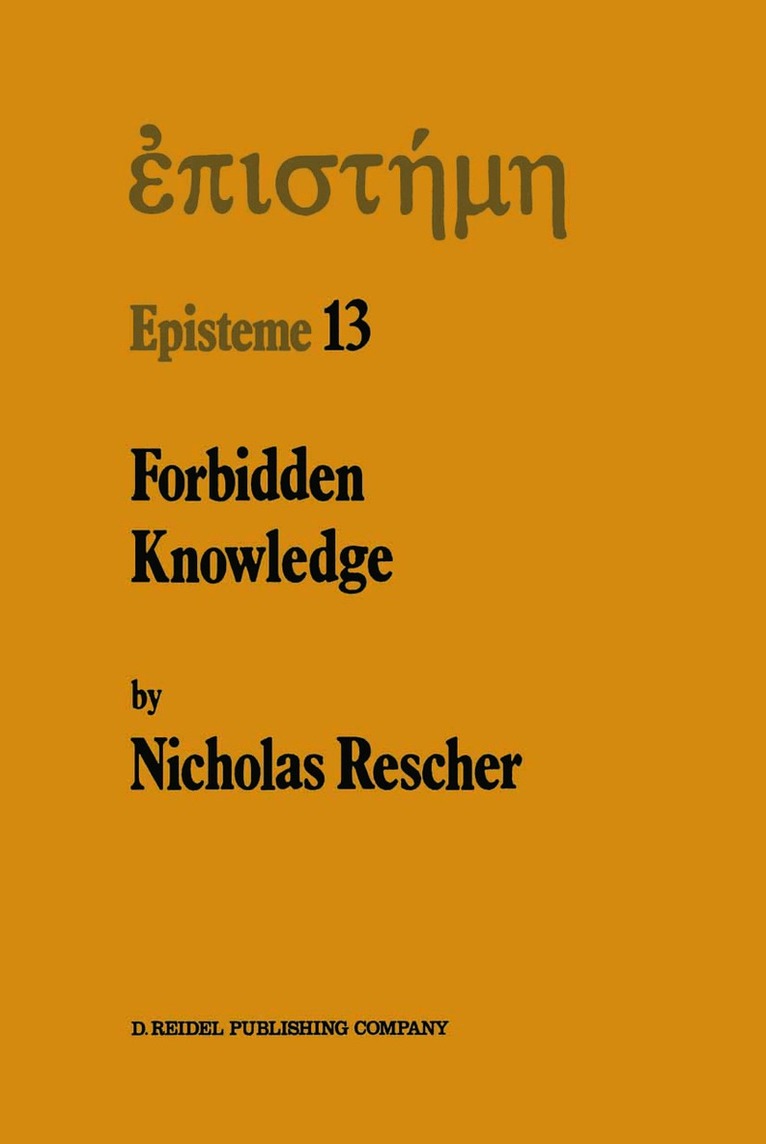
    Forbidden Knowledge

    And Other Essays on the Philosophy of Cognition

    AvN. Rescher

    Häftad, Engelska, 2011

    Del 13 i serien Episteme

    1 087 kr

    Beställningsvara. Skickas inom 10-15 vardagar. Fri frakt över 249 kr.

    Fler format och utgåvor

    Inbunden

    1 087 kr

    E-bok

    1 416 kr

    Beskrivning

    This volume collects together eleven essays in epistemology, written during the past three years. They are mostly unpublished, just four of them having appeared previously (numbers two, three, four and eleven). Detailed acknowledgement of prior publication is made in the notes to the relevant chapters. I am indebted to the editors of the several publications involved for their kind permission to use this material. And I am particularly grateful to my friend, Professor Mario Bunge, for his interest in my work and for his willingness to include this sample of it in his 'Episteme' series. NICHOLAS RESCHER Pittsburgh, PA December, 1986 xi INTRODUCTION The philosophy of knowledge covers a vast and enormously diversified terrain. Within this broad area, the essays that comprise the present book deal specifically with the following issues: 1. The moral dimension of inquiry - in particular, scientific inquiry into the ways of the world (Chapter 1) 2. The epistemic status of such cognitive 'values' of inquiry as - coherence (Chapter 2) - consistency (Chapter 3) - completeness (Chapter 4) 3. The cognitive bearing of probabilistic considerations (Chapters 5 and 6) 4. The epistemic status of certain ideal desiderata of cognition, such as - totality (Chapter 7) - precision (Chapter 8) - exactness (Chapter 9) 5.

    Produktinformation

    • Utgivningsdatum:2011-10-17
    • Mått:152 x 229 x 10 mm
    • Vikt:259 g
    • Format:Häftad
    • Språk:Engelska
    • Serie:Episteme
    • Antal sidor:154
    • Förlag:Springer
    • ISBN:9789401081788

    Utforska kategorier

    • Filosofiska discipliner inom Filosofi och religion

    Innehållsförteckning

    • One/Forbidden Knowledge: Moral Limits of Scientific Research.- 1. A Range of Positions.- 2. Regulation vs. Laissez Faire.- 3. Moral Limits Pertain to Different Aspects of Knowledge.- 4. Can Knowledge as Such be Morally Inappropriate?.- 5. Knowledge is Only One Good among Others.- 6. The Enforcement of Morals.- 7. Coda.- Two/Truth as Ideal Coherence.- 1. The ‘Continuity Condition’ Relating a Criterion to the Definition of Truth.- 2. Truth as Ideal Coherence.- 3. Coherentism and Truth as Adequation.- 4. Postscript: The Gap Between the Real and the Ideal.- Three/Rationality and Consistency.- 1. Consistency: Initial Requisite or Ultimate Ideal?.- 2. Linearly Inferential vs. Dialectically Cyclic Reasoning.- 3. Ampliative vs. Reductive Reasoning.- 4. Two Very Different Sorts of Acceptability: Qualified vs. Outright Belief.- 5. Different Attitudes Towards Consistency.- 6. The Place of Dialectics in the Human Sciences.- 7. Must Inconsistency-Tolerance Be Motivated Epistemically?.- 8. Consistency as a Cognitive Ideal.- Four/An End to Science?.- 1. Is Scientific Discovery an Inherently Bounded Venture?.- 2. Nature Might Exhibit an Unending Complexity of Physical Constitution.- 3. Nature Might Exhibit an Unending Complexity of Lawful Comportment.- 4. The Phenomena of Nature Might Be Unendingly Diverse.- 5. The Basis for an Unending Prospect of Scientific Discovery Might Lie Wholly in the Character of Our Inquiry Processes.- 6. The Regulative Rationale for Supposing the Cognitive Inexhaustibility of Nature.- Five/On the Probabilistic Bearing of Testimony.- 1. Introduction.- 2. The Reliability of Sources.- 3.The Knowledgeability of Sources.- 4. Some Variations.- 5. A Survey of Probative Virtues.- 6. The Taxicab Problem.- 7. Hume and Laplace on Human Testimony.- 8. Laplace onTestimonial Chains.- 9. The Moral of the Story.- Six/The Limits of Probabilistic Epistemology.- 1. The Probabilist Program.- 2. Probability Is Not Enough.- Seven/The Threefold Way.- 1. The Three Levels.- 2. Some Examples.- 3. Man as a Creature of the Threefold Way.- 4. The Question of Legitimacy: The Utility of the Ideal.- Eight/Number Idolatry and Fallacies of Quantification.- Nine/Life’s Seasons: The Conceptual Phenomenology of Age-Periodization.- 1. The General Idea of a Life Cycle.- 2. The Rationale of Human Age-Periodization Phase Transitions.- 3. The Diversity of Age.- 4. The Conventionality of Phase Transition.- 5. Thought Experiments.- 6. The Upshot.- 7. Broader Vistas.- Ten/Philosophical Taxonomy as A Philosophical Issue.- 1. The Shape of Philosophy: Some Ancient Views.- 2. The Middle Ages and Early Modern Times.- 3. A Later Picture.- 4. Taxonomic Dynamics.- 5. The Post-Kantian Transformation.- 6. Taxonomic Proliferation.- 7. The Contemporary Situation.- 8. The Problem of Progress.- 9. The Dialectic of the Individual and the Community.- 10. Conclusion.- Eleven/Is Philosophy a Guide to Life?.- 1. Philosophy: The Problematic Guide.- 2. The Problem of ‘Applied Philosophy’: Only One’s Own Philosophy Can Provide Guidance.- 3. What Philosophy Per Se Can Contribute.- 4. Some Examples of ‘Applied Philosophy’ in the Public Domain.- 5. The Limited Utility of Methodological Applications.- 6. A Danger of ‘Applied Philosophy’.- Notes.- Index of Names.