Häftad, Engelska, 2011
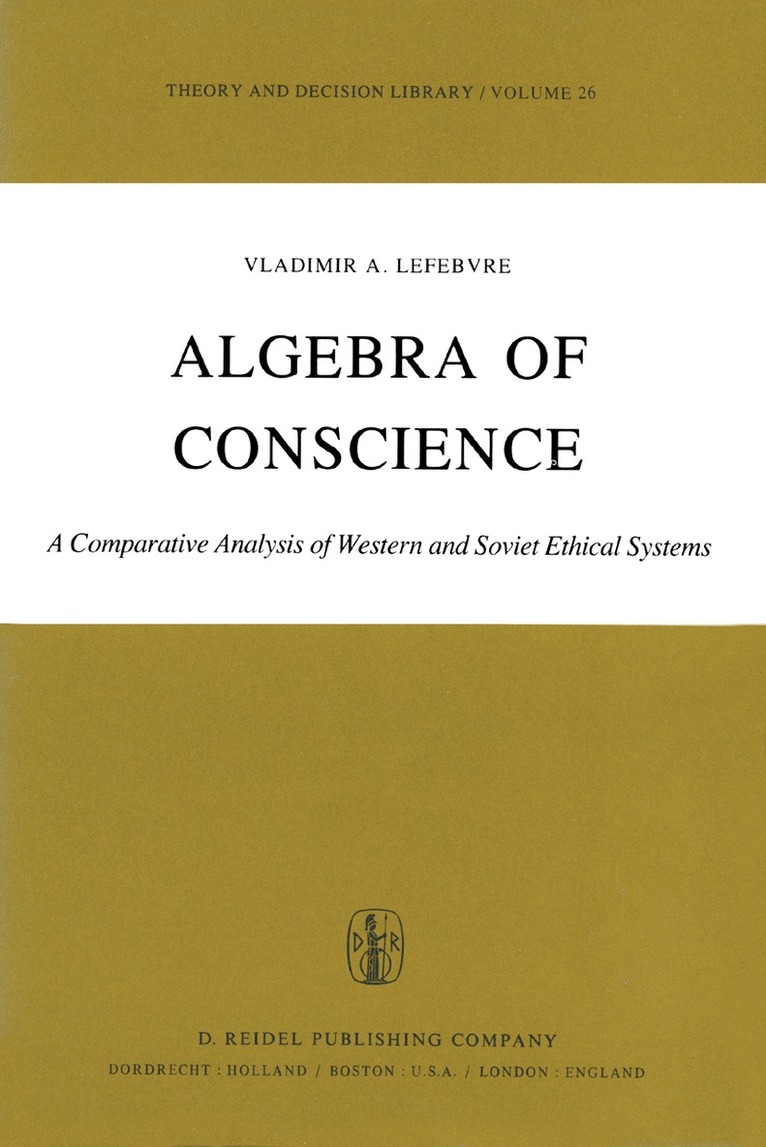
Algebra of Conscience
559 kr
Skickas inom 10-15 vardagar
Beskrivning
In this book two ethical systems are described in the language of mathematics. Ordinarily mathematics is thought to be a science of quantity. Indeed, manipulation of quantities constitutes much of mathematics. Elementary applied mathematics deals with reckoning and measurement, where concrete quantities are objects of attention, such as counting sheep or weighing corno But the operations on these quantities are performed with the help of symbols, from which concrete referents have been 'abstracted out': 3 + 5 = 8 regardless of whether the symbols stand for numbers of sheep or tons of corno Thus, the first principle that exhibits the power of mathematics is abstraction. It is one ofthe three pillars on which the edifice of mathematics rests. Another pillar is precision. Ordinarily, man communicates by words. W ords serve communication to the extent that they refer to things, events, states of affairs, feelings of the speaker, and so on. These are the meanings attributed to words. Communication is successful to the extent that the meanings coded upon words by the speaker correspond to the meanings decoded by the hearer. As is weH known, the degree ofthis correspondence varies enormously in different contexts of discourse and with the back grounds or attitudes of the speakers and hearers. Mathematics is a language in which the meanings ofthe symbols (the 'words' ofthis language) are absolutely precise. This precision is achieved by abstraction. Abstract terms are defined by their relations to other terms and by nothing else.
Produktinformation
- Utgivningsdatum: 2011-12-21
- Mått: 152 x 229 x 13 mm
- Vikt: 332 g
- Format: Häftad
- Språk: Engelska
- Antal sidor: 224
- Förlag: Springer
- Serie: Theory and Decision Library (del 26)
- ISBN: 9789401090537
Utforska kategorier
Betyg & recensioner
0 recensioner
Inga recensioner tillgängliga.