• Fri frakt över 249 kr
  • •
  • Snabba leveranser
  • •
  • Billiga böcker
Kundservice

Du är på sajten för privatpersoner.

Företag, bibliotek eller offentlig verksamhet?

Du handlar på classic.bokus.com, där alla dina funktioner finns intakta.
Till classic.bokus.com
Bokus logotyp. Gå till startsidan.
  • Erbjudanden
  • Nyheter
  • Student
  • Topplistor
  • Barn & ungdom
  • Bokus Play
  • E-böcker
  • Pocketböcker
  • Spel & pussel

10% studentrabatt med kod TERM26

Sidfot

Mina sidor

    Hjälp

    • Kundservice
    • Vanliga frågor och svar
    • Frakt och leverans
    • Retur vid ångerrätt
    • Reklamera vara
    • Betalning
    • Köpvillkor
    • Allmänna villkor
    • Information om webbplatsens tillgänglighet

    Om Bokus

    • Om oss
    • Pressrum
    • För studenter
    • För företag
    • För bibliotek och offentlig verksamhet
    • För leverantörer
    • Hållbarhet

    Populärt

    • Aktuella erbjudanden
    • Presentkort
    • Studentlitteratur
    • Nya böcker
    • Topplistor
    • Signerade böcker
    • Engelska böcker

    Inspiration

    • Boktips
    • BookTok
    • Populära bokserier
    • Barnbokskaraktärer
    • Populära författare
    Logotyp för Bokus
    Följ oss på Facebook (extern länk)Följ oss på Instagram (extern länk)Följ oss på YouTube (extern länk)Följ oss på TikTok (extern länk)
    bokus @ CookiesAnpassa cookiesIntegritetspolicyKöpvillkor
    Till Citymail hemsida (extern länk)Till Budbee hemsida (extern länk)Till Postnord hemsida (extern länk)Till Schenker hemsida (extern länk)Till Early Bird hemsida (extern länk)Till Walleys hemsida (extern länk)
    1. Samhälle och politik
    2. Samhälle och kultur

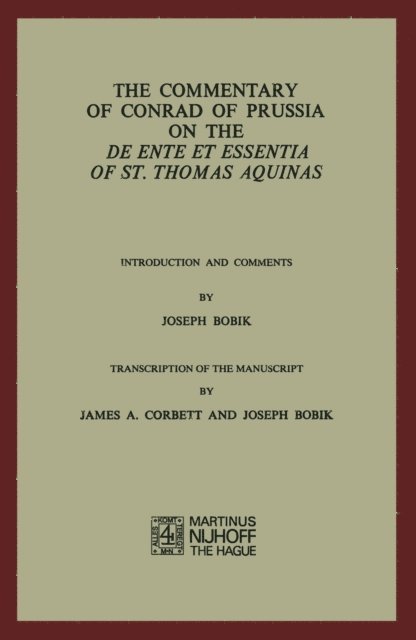
    Commentary of Conrad of Prussia on the De Ente et Essentia of St. Thomas Aquinas

    Introduction and Comments

    AvConradus de Prussia,Joseph Bobik

    Häftad, Engelska, 1974

    549 kr

    Beställningsvara. Skickas inom 10-15 vardagar. Fri frakt över 249 kr.

    Fler format och utgåvor

    E-bok

    710 kr

    Beskrivning

    1. THE MAN, CONRAD OF PRUSSIA Conrad of Prussia is not so much as mentioned in any of the usual sources. And even such notable mediaevalists as Mlle. Marie-Therese d'Alverny, Conservateur en-chef, and J. Reginald O'Donnell, C. S. B. , of the Pontifical Institute of Mediaeval Studies, Toronto, Canada, have been unable to identify him. Nothing at all, therefore, is known about Conrad, if that is the author's name. For there is some doubt that it is. In the colophon of the Admont commentary on Aquinas' De Ente et Essentia,! we find a word, so completely erased that it is illegible, followed by the words "de Prusya. " Martin Grabmann argues that it is correct to feel that the erasure is an erasure of the name "Conradi," since in the colophon of the Admont commentary on Dominicus Gundissalinus' De Unitate et Uno,2 which follows the commentary on the De Ente et Essentia, we find again an erased word followed by the words "de Prusya. " But the erasure is not complete. One can here read the name "Conradi. " 3 And so, the manuscript of the commentary on the De Unitate et Uno clearly attributed this work to Conrad of Prussia before the attempted erasure.


    Produktinformation

    • Utgivningsdatum:1974-01-01
    • Mått:155 x 235 x 12 mm
    • Vikt:335 g
    • Format:Häftad
    • Språk:Engelska
    • Antal sidor:203
    • Upplaga:1974
    • Förlag:Springer
    • ISBN:9789401503556

    Utforska kategorier

    • Samhälle och kultur inom Samhälle och politik
    • Religion: allmänt inom Filosofi och religion
    • Sociologi inom Samhälle och politik

    Innehållsförteckning

    • I. Introduction.- 1. The man, Conrad of Prussia.- 2. The manuscript.- 3. Conrad’s division of the De Ente et Essentia.- 4. The transcription.- 5. Unlocated quotations.- 6. The date of composition of Conrad’s commentary.- 7. Good and bad, worthwhile nonetheless.- 8. Other commentaries on the De Ente et Essentia.- II Conrad’s Commentary.- Prooemium Conradi de Prusya.- Lectio I.- Lectio II.- Lectio III.- Lectio IV.- Lectio V.- Lectio VI.- Lectio VII.- Lectio VIII.- Lectio IX.- Lectio X.- Lectio XI.- Lectio XII.- Lectio XIII.- Lectio XIV.- Lectio XV.- Lectio XVI.- III. Comments on Conred’s Commentary.- Conrad’s prooemium.- 1. The nature of philosophy.- 2. How the De Ente et Essentia is related to other parts of philosophy.- 3. The four causes of the De Ente Essentia.- Conrad’s lectiones.- Opening comment.- Lectio I.- Lectio II.- Lectio III.- Lectio IV.- Lectio V.- Lectio VI.- Lectio VII.- Lectio VIII.- Lectio IX.- Lectio X.- Lectio XI.- Lectio XII.- Lectio XIII.- Lectio XIV.- Lectio XV.- Lectio XVI.- Concluding comment.