• Fri frakt över 249 kr
  • •
  • Snabba leveranser
  • •
  • Billiga böcker
Kundservice

Du är på sajten för privatpersoner.

Företag, bibliotek eller offentlig verksamhet?

Du handlar på classic.bokus.com, där alla dina funktioner finns intakta.
Till classic.bokus.com
Bokus logotyp. Gå till startsidan.
  • Erbjudanden
  • Nyheter
  • Student
  • Topplistor
  • Barn & ungdom
  • Bokus Play
  • E-böcker
  • Pocketböcker
  • Spel & pussel

10% rabatt på allt med kod: NYSTART10 →

Sidfot

Mina sidor

    Hjälp

    • Kundservice
    • Vanliga frågor och svar
    • Frakt och leverans
    • Retur vid ångerrätt
    • Reklamera vara
    • Betalning
    • Köpvillkor
    • Allmänna villkor
    • Information om webbplatsens tillgänglighet

    Om Bokus

    • Om oss
    • Pressrum
    • För studenter
    • För företag
    • För bibliotek och offentlig verksamhet
    • För leverantörer
    • Hållbarhet

    Populärt

    • Aktuella erbjudanden
    • Presentkort
    • Studentlitteratur
    • Nya böcker
    • Topplistor
    • Signerade böcker
    • Engelska böcker

    Inspiration

    • Boktips
    • BookTok
    • Populära bokserier
    • Barnbokskaraktärer
    • Populära författare
    Logotyp för Bokus
    Följ oss på Facebook (extern länk)Följ oss på Instagram (extern länk)Följ oss på YouTube (extern länk)Följ oss på TikTok (extern länk)
    bokus @ CookiesAnpassa cookiesIntegritetspolicyKöpvillkor
    Till Citymail hemsida (extern länk)Till Budbee hemsida (extern länk)Till Postnord hemsida (extern länk)Till Schenker hemsida (extern länk)Till Early Bird hemsida (extern länk)Till Walleys hemsida (extern länk)
    1. Samhälle och politik
    2. Samhälle och kultur
    3. Kultur och medier
    4. Kulturvetenskap

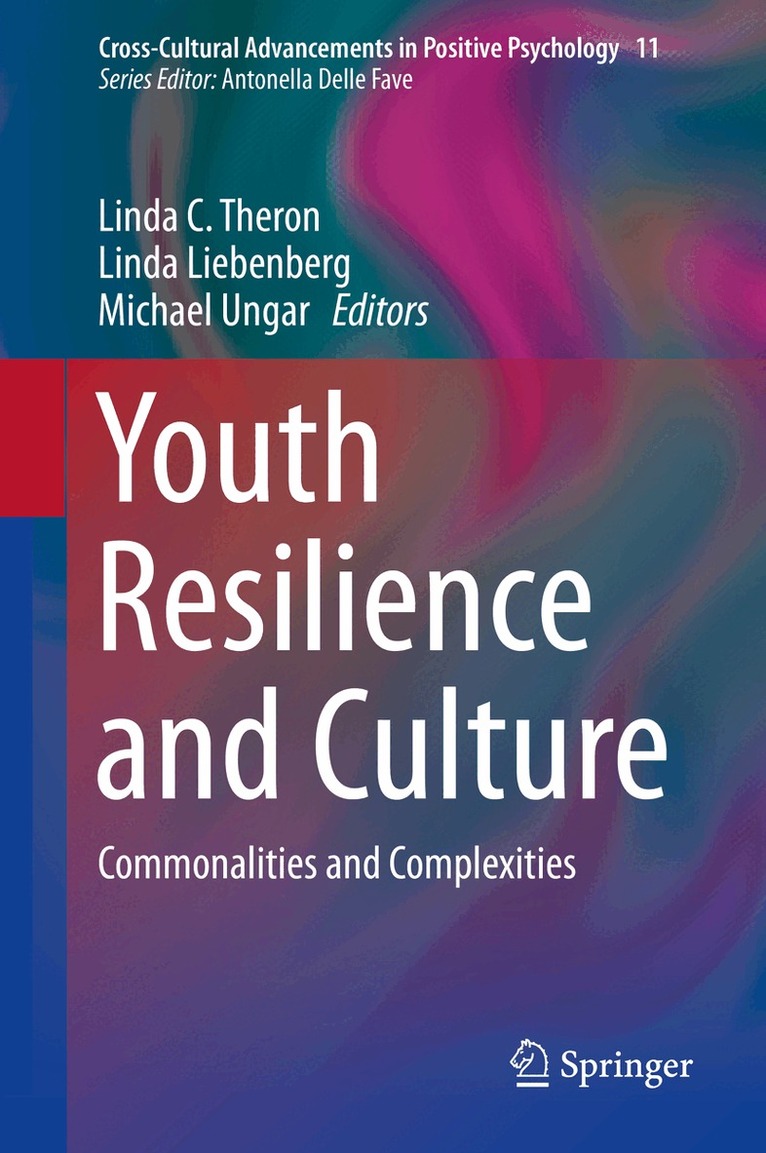
    Youth Resilience and Culture

    Commonalities and Complexities

    AvLinda C. Theron,Linda Liebenberg

    Inbunden, Engelska, 2014

    Del 11 i serien Cross-Cultural Advancements in Positive Psychology

    1 475 kr

    Beställningsvara. Skickas inom 10-15 vardagar. Fri frakt över 249 kr.

    Beskrivning

    Until researchers and theorists account for the complex relationship between resilience and culture, explanations of why some individuals prevail in the face of adversity will remain incomplete. This edited volume addresses this crucial issue by bringing together emerging discussions of the ways in which culture shapes resilience, the theory that informs these various studies, and important considerations for researchers as they continue to investigate resilience. Using research from majority and minority world contexts, ‘Youth Resilience and Culture: Commonalities and Complexities’ highlights that non-stereotypical, critical appreciation of the cultural systems in which youth are embedded, and/or affiliate with, is pivotal to understanding why particular resilience processes matter for particular youth in a particular life-world at a particular point in time. In doing so, this book sensitizes readers to the importance of accounting for the influence of cultural contexts on resilience processes, and to the danger of conceptualising and/or operationalising resilience, culture, and their interplay, simplistically or idealistically. In short, the progressive contents of ‘Youth Resilience and Culture: Commonalities and Complexities’ make it an essential read for resilience-focused scholars, students, academics, and researchers, as well as policy makers, practitioners, and humanitarian workers engaged with high-risk populations.

    Produktinformation

    • Utgivningsdatum:2014-12-04
    • Mått:155 x 235 x 21 mm
    • Vikt:556 g
    • Format:Inbunden
    • Språk:Engelska
    • Serie:Cross-Cultural Advancements in Positive Psychology
    • Antal sidor:250
    • Upplaga:2015
    • Förlag:Springer
    • ISBN:9789401794145

    Utforska kategorier

    • Kulturvetenskap inom Samhälle och politik
    • Socialpsykologi och gruppsykologi inom Psykologi och pedagogik

    Mer om författaren

    Linda Theron, D.Ed. (Educational Psychology), is professor in the Faculty of Humanities, North-West University, South Africa.  Her research explores why, and how, some South African youth adjust well to poverty, orphanhood, and/or learning difficulties, and how sociocultural contexts shape their processes of resilience (see www.Lindatheron.org / www.optentia.co.za). She is an associate editor of the South African Journal of Education and School Psychology International. In 2013, the Education Association of South Africa awarded her a research medal for her contributions to a richer understanding of resilience processes in South African youth. Linda Liebenberg, D.Phil., is Co-Director of the Resilience Research Centre, and Adjunct Professor, Faculty of Graduate Studies, Dalhousie University. Her work focuses on the use of elicitation methods and mixed-methods designs in understanding the lives of children and youth living in challenging contexts, with a focus on resilience processes. Her work also includes the design of measurement instruments used with children and youth. She has published and presented internationally on resilience related themes relevant to the understanding of youth across cultures and contexts.  Her publications include the two co-edited volumes (with Michael Ungar, Ph.D.) Researching Resilience and Resilience in Action.Michael Ungar, Ph.D., is the Killam Professor of Social Work at Dalhousie University, Network Director, CYCC Network, and Co-Director of the Resilience Research Centre. He has published over 100 peer-reviewed articles and chapters and 11 books on the topic of resilience and its application to clinical and community work with children and families with complex needs (the Social Ecological Approach to counseling). His latest work includes a clinical textbook Counseling in Challenging Contexts, an edited volume of international papers, The Social Ecology ofResilience: A Handbook of Theory and Practice, and a novel The Social Worker.

    Innehållsförteckning

    • Part I. The complex interactions of resilience and culture.- Chapter 1. Pathways to Resilience in Context; Margaret O’Dougherty Wright and Ann S.Masten.- Chapter 2. Understanding Cultural Contexts and their Relationship to Resilience Processes; Linda C. Theron and Linda Liebenberg.- Chapter 3. Resilience and Culture: The Diversity of Protective Processes and Positive Adaptation; Michael Ungar.- Part II. Illustrative (Case) Studies: Youth Resilience and Culture.- Chapter 4. Cultural Pathways to Resilience: Opportunities and Obstacles as Recalled by Black South African Students; Linda C. Theron and Nareadi Phasha.- Chapter 5. Resilience among Zimbabwean Youths with Orphanhood; Elias Mpofu, Nancy Ruhode, Megan M. Mutepfa, James January and John Mapfumo.- Chapter 6. The Interaction between Culture, Resilience, Risks and Outcomes: A New Zealand Study; Jackie Sanders & Robyn Munford.- Chapter 7. Cultural Pathways to Resilience: Informal Social Support of At-Risk Youth in China; Guoxiu Tian & Xiying Wang.- Chapter 8. “It’s Just Part of My Culture”: Understanding Language and Land in the Resilience Processes of Aboriginal Youth; Linda Liebenberg, Janice Ikeda and Michele Wood.- Chapter 9. Stigma, Stereotypes and Resilience Identities: The Relationship between Identity Processes and Resilience Processes among Black American Adolescents; Davido Dupree, Tirzah R. Spencer, and Margaret Beale Spencer.- Chapter 10. White Out: The Invisibility of White North American Culture and Resilience Processes; Linda Liebenberg, Patrick Russell and Michael Ungar.- Chapter 11. Deaf culture and youth resilience in diverse American Communities; Elizabeth A. Moore and Donna M. Mertens.- Chapter 12. Barriers to Resilience Processes: Understanding the Experiences and Challenges of Former Child Soldiers Integrating into Canadian Society; Shelly Whitman and Linda Liebenberg.- Chapter 13. Effects of Microcultural Environments of Violence on Resilient Responses amongAdolescents and Young Adults in the City of Itagui, Colombia; Wendy Kliewer, Roberto Meijia and Yolanda Torres.- Part III. Researching Resilience across Cultures.- Chapter 14. The Value of Keeping an Open Eye for Methodological Issues in Research on Resilience and Culture; Jia He and Fons J. R. Van de Vijver.- Chapter 15. Innovative Qualitative Explorations of Culture and Resilience; Linda Liebenberg and Linda C. Theron.- Chapter 16. Ethical Principles in Resilience Research:  Respect, Relevance, Reciprocity and Responsibility; Laurie “Lali” D. McCubbin and Jennifer Moniz.- Part IV. Conclusion.- Chapter 17. Culture and resilience: Next steps for theory and practice; Catherine Panter-Brick.