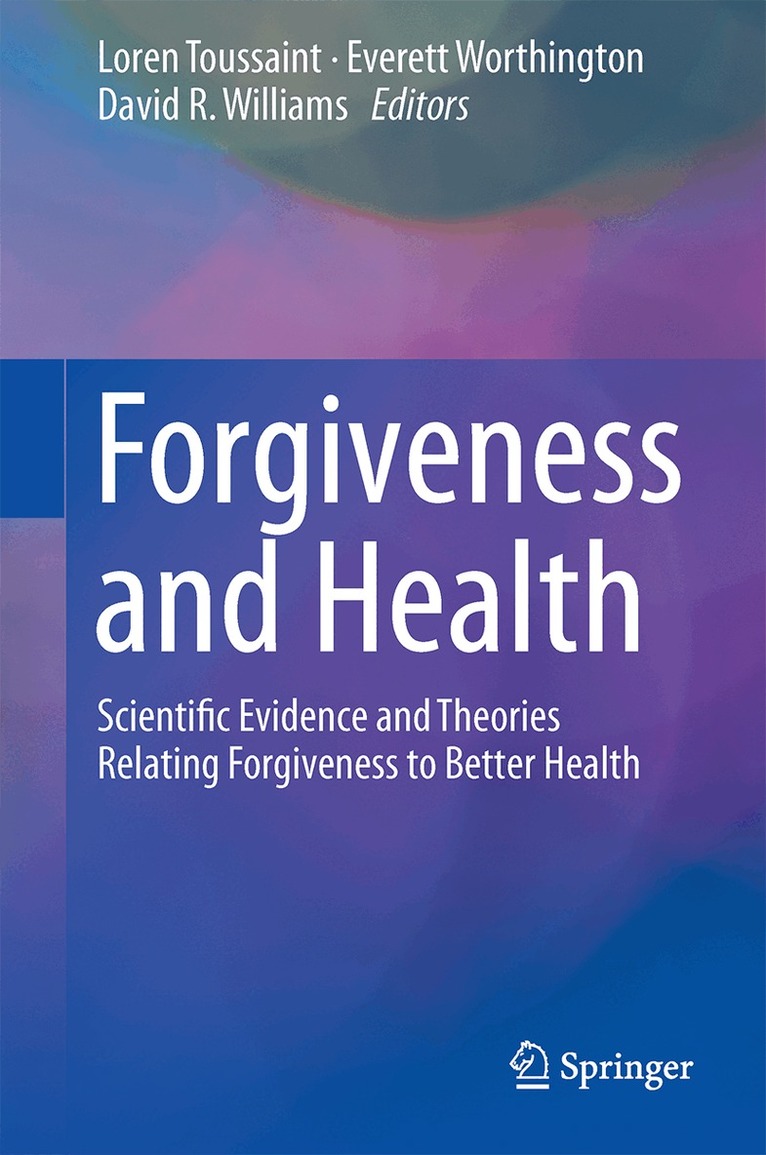
Forgiveness and Health
Scientific Evidence and Theories Relating Forgiveness to Better Health
AvLoren Toussaint,Everett Worthington
1 705 kr
Beställningsvara. Skickas inom 10-15 vardagar. Fri frakt över 249 kr.
Du är på sajten för privatpersoner.
AvLoren Toussaint,Everett Worthington
1 705 kr
Beställningsvara. Skickas inom 10-15 vardagar. Fri frakt över 249 kr.
Loren Toussaint is a professor in the department of psychology at Luther College in Decorah, Iowa. He is a former visiting scientist at Mayo Clinic, the associate director of the Sierra Leone Forgiveness Project, and a consultant in the Department of Pastoral Care at Cancer Treatment Centers of America. Dr. Toussaint’s research examines religious and spiritual factors, especially forgiveness, and how they are related to health and well-being. He directs the Laboratory for the Investigation of Mind, Body, and Spirit, and has mentored over 75 students studying in this laboratory (see: https://www.luther.edu/touslo01/). Everett Worthington, Ph.D., is Commonwealth Professor of Psychology at Virginia Commonwealth University. He is also a licensed Clinical Psychologist in Virginia. He has published over 35 books and about 400 articles and scholarly chapters, mostly on forgiveness, marriage and family, and religion and spirituality. Many of those study the overlap of the topic with physical and mental health (see www.EvWorthington-forgiveness.com).David R. Williams is the Florence and Laura Norman Professor of Public Health, African and African American Studies and Sociology at Harvard University. His prior academic appointments were at Yale University and the University of Michigan. The author of over 350 scientific papers on social influences on health, he directed a national study of forgiveness and health and has studied the association between religious involvement and health. He is a member of the Institute of Medicine and the American Academy of Arts and Sciences and was ranked as one of the World’s Most Influential Scientific Minds in 2014.
The world being what it is, there is no shortage of circumstances where the worst of human behaviors provide the opportunity for one of the best, namely forgiveness. Philosophers have long wrestled with the question of whether forgiveness is better for the forgiver or the forgivee. Remarkably, this question has become a subject of careful scientific research in recent years, and this excellent, important book presents the first thorough overview of the subject. Naturally, the answer to the question, "Is forgiveness good for you" is mighty complicated. Robert M Sapolsky John A. and Cynthia Fry Gunn Professor Departments of Biology, Neurosurgery, and Neurology and Neurological Sciences How we experience life's challenges can profoundly affect our well-being. In this outstanding book, Toussaint, Worthington, and Williams open our eyes to the power of forgiveness, which may be one of the most important tools we have for reducing disease and improving human health. Their review of the subject is the best to date and a must-read for scientists, practitioners, and laypeople alike. George M. Slavich Director, Laboratory for Stress Assessment and Research Cousins Center for Psychoneuroimmunology University of California, Los Angeles
Morgan M. Medlock, Derri Shtasel, Nhi-Ha T. Trinh, David R. Williams
Häftad, 2018
800 kr
Committee on the Future of Nursing 2020–2030, National Academy of Medicine, and Medicine National Academies of Sciences, Engineering, Mary K. Wakefield, David R. Williams, Suzanne Le Menestrel, Jennifer Lalitha Flaubert
1 047 kr
Du är på sajten för privatpersoner.
AvLoren Toussaint,Everett Worthington
1 705 kr
Beställningsvara. Skickas inom 10-15 vardagar. Fri frakt över 249 kr.
Loren Toussaint is a professor in the department of psychology at Luther College in Decorah, Iowa. He is a former visiting scientist at Mayo Clinic, the associate director of the Sierra Leone Forgiveness Project, and a consultant in the Department of Pastoral Care at Cancer Treatment Centers of America. Dr. Toussaint’s research examines religious and spiritual factors, especially forgiveness, and how they are related to health and well-being. He directs the Laboratory for the Investigation of Mind, Body, and Spirit, and has mentored over 75 students studying in this laboratory (see: https://www.luther.edu/touslo01/). Everett Worthington, Ph.D., is Commonwealth Professor of Psychology at Virginia Commonwealth University. He is also a licensed Clinical Psychologist in Virginia. He has published over 35 books and about 400 articles and scholarly chapters, mostly on forgiveness, marriage and family, and religion and spirituality. Many of those study the overlap of the topic with physical and mental health (see www.EvWorthington-forgiveness.com).David R. Williams is the Florence and Laura Norman Professor of Public Health, African and African American Studies and Sociology at Harvard University. His prior academic appointments were at Yale University and the University of Michigan. The author of over 350 scientific papers on social influences on health, he directed a national study of forgiveness and health and has studied the association between religious involvement and health. He is a member of the Institute of Medicine and the American Academy of Arts and Sciences and was ranked as one of the World’s Most Influential Scientific Minds in 2014.
The world being what it is, there is no shortage of circumstances where the worst of human behaviors provide the opportunity for one of the best, namely forgiveness. Philosophers have long wrestled with the question of whether forgiveness is better for the forgiver or the forgivee. Remarkably, this question has become a subject of careful scientific research in recent years, and this excellent, important book presents the first thorough overview of the subject. Naturally, the answer to the question, "Is forgiveness good for you" is mighty complicated. Robert M Sapolsky John A. and Cynthia Fry Gunn Professor Departments of Biology, Neurosurgery, and Neurology and Neurological Sciences How we experience life's challenges can profoundly affect our well-being. In this outstanding book, Toussaint, Worthington, and Williams open our eyes to the power of forgiveness, which may be one of the most important tools we have for reducing disease and improving human health. Their review of the subject is the best to date and a must-read for scientists, practitioners, and laypeople alike. George M. Slavich Director, Laboratory for Stress Assessment and Research Cousins Center for Psychoneuroimmunology University of California, Los Angeles
Morgan M. Medlock, Derri Shtasel, Nhi-Ha T. Trinh, David R. Williams
Häftad, 2018
800 kr
Committee on the Future of Nursing 2020–2030, National Academy of Medicine, and Medicine National Academies of Sciences, Engineering, Mary K. Wakefield, David R. Williams, Suzanne Le Menestrel, Jennifer Lalitha Flaubert
1 047 kr