• Fri frakt över 249 kr
  • •
  • Snabba leveranser
  • •
  • Billiga böcker
Kundservice

Du är på sajten för privatpersoner.

Företag, bibliotek eller offentlig verksamhet?

Du handlar på classic.bokus.com, där alla dina funktioner finns intakta.
Till classic.bokus.com
Bokus logotyp. Gå till startsidan.
  • Erbjudanden
  • Nyheter
  • Student
  • Topplistor
  • Barn & ungdom
  • Bokus Play
  • E-böcker
  • Pocketböcker
  • Spel & pussel

10% rabatt på allt med kod: NYSTART10 →

Sidfot

Mina sidor

    Hjälp

    • Kundservice
    • Vanliga frågor och svar
    • Frakt och leverans
    • Retur vid ångerrätt
    • Reklamera vara
    • Betalning
    • Köpvillkor
    • Allmänna villkor
    • Information om webbplatsens tillgänglighet

    Om Bokus

    • Om oss
    • Pressrum
    • För studenter
    • För företag
    • För bibliotek och offentlig verksamhet
    • För leverantörer
    • Hållbarhet

    Populärt

    • Aktuella erbjudanden
    • Presentkort
    • Studentlitteratur
    • Nya böcker
    • Topplistor
    • Signerade böcker
    • Engelska böcker

    Inspiration

    • Boktips
    • BookTok
    • Populära bokserier
    • Barnbokskaraktärer
    • Populära författare
    Logotyp för Bokus
    Följ oss på Facebook (extern länk)Följ oss på Instagram (extern länk)Följ oss på YouTube (extern länk)Följ oss på TikTok (extern länk)
    bokus @ CookiesAnpassa cookiesIntegritetspolicyKöpvillkor
    Till Citymail hemsida (extern länk)Till Budbee hemsida (extern länk)Till Postnord hemsida (extern länk)Till Schenker hemsida (extern länk)Till Early Bird hemsida (extern länk)Till Walleys hemsida (extern länk)
    1. Psykologi och pedagogik
    2. Pedagogik
    3. Undervisning i specifika ämnen

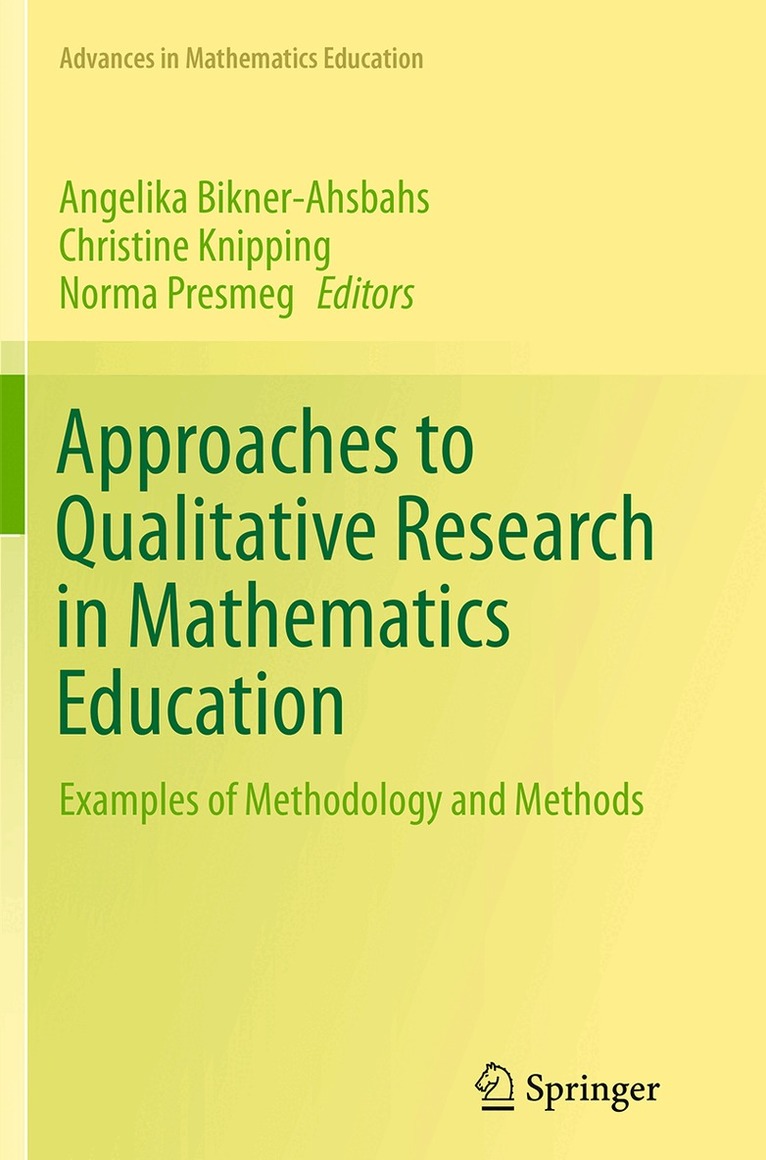
    Approaches to Qualitative Research in Mathematics Education

    Examples of Methodology and Methods

    AvAngelika Bikner-Ahsbahs,Christine Knipping

    Häftad, Engelska, 2016

    Del i serien Advances in Mathematics Education

    1 790 kr

    Beställningsvara. Skickas inom 10-15 vardagar. Fri frakt över 249 kr.

    Beskrivning

    This volume documents a range of qualitative research approaches emerged within mathematics education over the last three decades, whilst at the same time revealing their underlying methodologies. Continuing the discussion as begun in the two 2003 ZDM issues dedicated to qualitative empirical methods, this book presents astate of the art overview on qualitative research in mathematics education and beyond. The structure of the book allows the reader to use it as an actual guide for the selection of an appropriate methodology, on a basis of both theoretical depth and practical implications. The methods and examples illustrate how different methodologies come to life when applied to a specific question in a specific context. Many of the methodologies described are also applicable outside mathematics education, but the examples provided are chosen so as to situate the approach in a mathematical context.

    Produktinformation

    • Utgivningsdatum:2016-09-11
    • Mått:155 x 235 x 33 mm
    • Vikt:908 g
    • Format:Häftad
    • Språk:Engelska
    • Serie:Advances in Mathematics Education
    • Antal sidor:592
    • Förlag:Springer
    • ISBN:9789402406887

    Utforska kategorier

    • Undervisning i specifika ämnen inom Psykologi och pedagogik

    Recensioner i media

    "Approaches to Qualitative Research in Mathematics Education: Examples of Methodology and Methods is a clever gift for the skeptics who believe that pursuing truth is only possible through traditional empirical research. ... The work of the contributors inspires researchers in the field of mathematics education to replicate the studies and, more importantly, creates opportunities to further reflect on the ways theories inform qualitative research designs and methods." (Woong Lim, MAA Reviews, July, 2015)

    Innehållsförteckning

    • Part 1: Grounded theory methodology. Chapter 1: Anne R. Teppo. Grounded Theory Methods. Chapter 2: Maike Vollstedt. To see the wood for the trees: The development of theory from empirical interview data using grounded theory.- Part 2: Approaches to reconstructing argumentation. Chapter 3: Götz Krummheuer. Methods for reconstructing processes of argumentation and Chaptericipation in primary mathematics classroom interaction. Chapter 4: Christine Knipping and David Reid. Reconstructing argumentation structures: A perspective on proving processes in secondary mathematics classroom interactions.- Part 3: Ideal type construction. Chapter 5: Angelika Bikner-Ahsbahs. Empirically grounded building of ideal types. A methodical principle of constructing theory in the interpretive research in mathematics education. Chapter 6: Angelika Bikner-Ahsbahs. How ideal type construction can be achieved: An example.- Part 4: Semiotic research. Chapter 7: Luis Radford and Cristina Sabena. The question of method in a Vygotskian semiotic approach.- Part 5: A theory on abstraction and its methodology. Chapter 8: Tommy Dreyfus, Rina Hershkowitz and Baruch Schwarz. The nested epistemic actions model for Abstraction in Context: Theory as methodological tool and methodological tool as theory.- Part 6: Networking of theories. Chapter 9: Ivy Kidron and Angelika Bikner-Ahsbahs. Advancing research by means of the networking of theories. Chapter 10: Angelika Bikner-Ahsbahs and Ivy Kidron. A cross-methodology for the networking of theories: The general epistemic need (GEN) as a new concept at the boundary of two theories.- Part 7: Multi-level-analysis. Chapter 11: Geoffrey B. Saxe, Kenton de Kirby, Marie Le, Yasmin Sitabkhan, Bona Kang. Understanding learning across lessons in classroom communities: A multi-leveled analytic approach.- Part 8: Mixed Methods. Chapter 12: Udo Kelle and Nils Buchholtz. The combination of qualitative and quantitative research methods in mathematics education—A “Mixed Methods” study on the development of the professional knowledge of teachers.- Part 9: Qualitative Content Analysis. Chapter 13: Philipp Mayring. Qualitative Content Analysis: Theoretical background and procedures. Chapter 14: Björn Schwarz. A study on professional competence of future teacher students as an example of a study using Qualitative Content Analysis.- Part 10: Triangulation and cultural studies. Chapter 15:  Ida Ah Chee Mok and David J. Clarke. The contemporary importance of triangulation in a post-positivist world: Examples from the Learner’s Perspective Study.- Part 11: Design research as aresearch methodology. Chapter 16: Arthur Bakker and Dolly van Eerde. An introduction to design-based research with an example from statistics education. Chapter 17: Michèle Artigue. Perspectives on design research: The case of didactical engineering. Chapter 18: Erin Henrick, Paul Cobb and Kara Jackson. Educational design research to support system-wide instructional improvement. Part 12: Looking back. Chapter 19: Angelika Bikner-Ahsbahs, Christine Knipping and Norma Presmeg. Appendix.- References.- Index of keywords.