• Fri frakt över 249 kr
  • •
  • Snabba leveranser
  • •
  • Billiga böcker
Kundservice

Du är på sajten för privatpersoner.

Företag, bibliotek eller offentlig verksamhet?

Du handlar på classic.bokus.com, där alla dina funktioner finns intakta.
Till classic.bokus.com
Bokus logotyp. Gå till startsidan.
  • Erbjudanden
  • Nyheter
  • Student
  • Topplistor
  • Barn & ungdom
  • Bokus Play
  • E-böcker
  • Pocketböcker
  • Spel & pussel

10% rabatt på allt med kod: NYSTART10 →

Sidfot

Mina sidor

    Hjälp

    • Kundservice
    • Vanliga frågor och svar
    • Frakt och leverans
    • Retur vid ångerrätt
    • Reklamera vara
    • Betalning
    • Köpvillkor
    • Allmänna villkor
    • Information om webbplatsens tillgänglighet

    Om Bokus

    • Om oss
    • Pressrum
    • För studenter
    • För företag
    • För bibliotek och offentlig verksamhet
    • För leverantörer
    • Hållbarhet

    Populärt

    • Aktuella erbjudanden
    • Presentkort
    • Studentlitteratur
    • Nya böcker
    • Topplistor
    • Signerade böcker
    • Engelska böcker

    Inspiration

    • Boktips
    • BookTok
    • Populära bokserier
    • Barnbokskaraktärer
    • Populära författare
    Logotyp för Bokus
    Följ oss på Facebook (extern länk)Följ oss på Instagram (extern länk)Följ oss på YouTube (extern länk)Följ oss på TikTok (extern länk)
    bokus @ CookiesAnpassa cookiesIntegritetspolicyKöpvillkor
    Till Citymail hemsida (extern länk)Till Budbee hemsida (extern länk)Till Postnord hemsida (extern länk)Till Schenker hemsida (extern länk)Till Early Bird hemsida (extern länk)Till Walleys hemsida (extern länk)
    1. Kultur
    2. Arkitektur

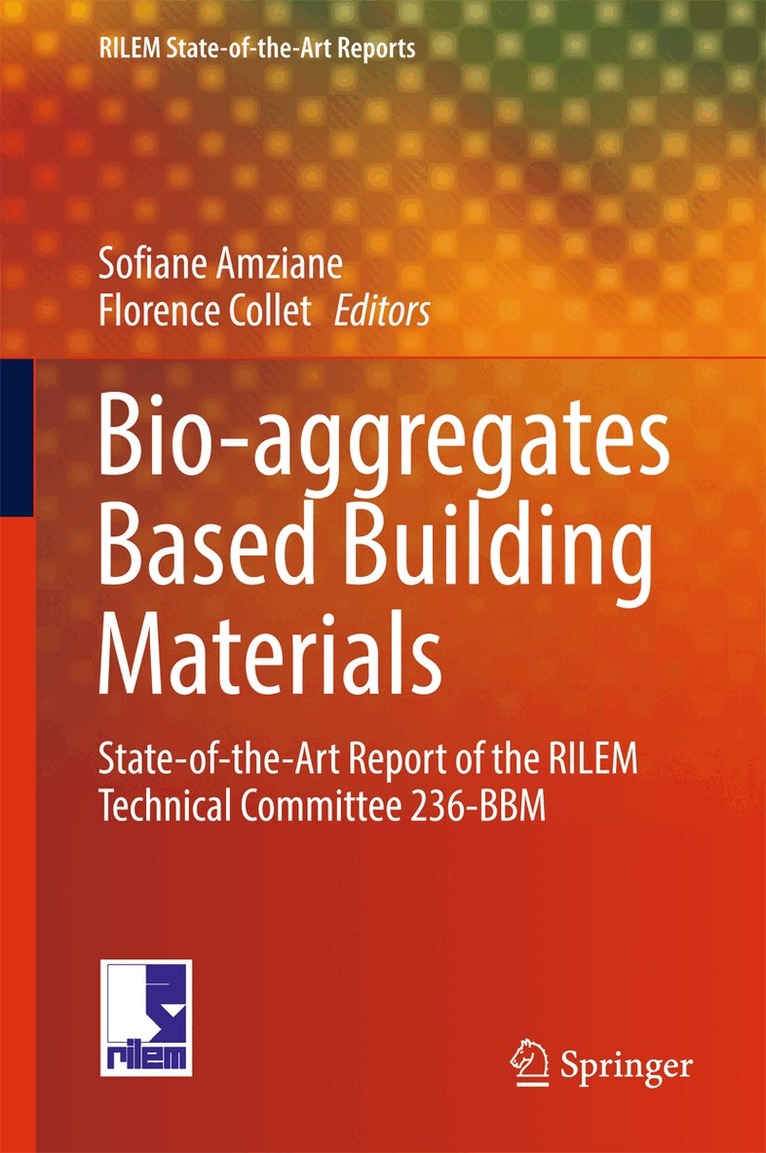
    Bio-aggregates Based Building Materials

    State-of-the-Art Report of the RILEM Technical Committee 236-BBM

    AvSofiane Amziane,Florence Collet

    Inbunden, Engelska, 2017

    Del i serien RILEM State-of-the-Art Reports

    1 896 kr

    Beställningsvara. Skickas inom 10-15 vardagar. Fri frakt över 249 kr.

    Beskrivning

    The work of the RILEM Technical Committee (TC -236 BBM) was dedicated to the study of construction materials made from plant particles. It considered the question whether building materials containing as main raw material recyclable and easily available plant particles are renewable. This book includes a state-of-the-art report and an appendix. The state-of-the-art report relates to the description of vegetal aggregates. Then, hygrothermal properties, fire resistance, durability and finally the impact of the variability of the method of production of bio-based concrete are assessed. The appendix is a TC report which presents the experience of a working group. The goal was to define testing methods for the measurement of water absorption, bulk density, particle size distribution, and thermal conductivity of bio aggregates. The work is based on a first round robin test of the TC-BBM where the protocols in use by the different laboratories (labs) are compared.  p>

    Produktinformation

    • Utgivningsdatum:2017-02-10
    • Mått:155 x 235 x 22 mm
    • Vikt:617 g
    • Format:Inbunden
    • Språk:Engelska
    • Serie:RILEM State-of-the-Art Reports
    • Antal sidor:263
    • Upplaga:17001
    • Förlag:Springer
    • ISBN:9789402410303

    Utforska kategorier

    • Arkitektur inom Kultur
    • Byggnadsteknik inom Naturvetenskap och teknik
    • Maskinteknik och material inom Naturvetenskap och teknik

    Innehållsförteckning

    • Chapter 1. Chemical composition of bioaggregates and their interactions with mineral binders.- 1.0 Introduction.- 1.1 Composition of hemp stem.- 1.2 Processing of hemp stem and microstructure of hemp shiv.- 1.3 Cell wall components.- 1.4 Chemical composition of bioaggregates.- 1.5 Surface characterization of bioaggregates – adhesion between lignocellulosic aggregates and a mineral binder.- 1.6 Chemical interactions between bioaggregates and mineral binders.- 1.7 Conclusion.- References.- Chapter 2. Porosity, pore size distribution, micro-structure.- 2.0 Introduction.- 2.1 Techniques used to measure porosity.- 2.2 Conclusion.- References.- Chapter 3. Water absorption of plant aggregate.- 3.0 Introduction.- 3.1 Wetting of porous, heterogeneous surfaces.- 3.2 Transfer phenomena in a porous medium.- 3.3 Analogy with adhesion of mortars to a porous support.- 3.4 Overview of the processes of binder/wood adhesion.- 3.5 Conclusion.- References.- Chapter 4. Particle Size Distribution.- 4.0 Introduction.- 4.1 General characteristics of shiv particles.- 4.2 Sieving methods .- 4.3 Image-processing methods.-  4.4 Image-analysis.-  4.5 Characterization of the PSD.- 4.6 Conclusions.- References.- Chapter 5. Bulk density and compressibility.- 5.0 Introduction.- 5.1 Density and porosity, case of hemp shiv.- 5.2 Bulk compressibility.- 5.3 Conclusions and perspectives.- References.- Chapter 6. Hygric and thermal properties of bio-aggregate based building materials.-  6.0 Introduction.- 6.1 Hygric properties.- 6.2 Thermal properties.- 6.3 Concluding remarks on hygrothermal behavior of bio-aggregate based building materials.- References.- Chapter 7. Bio-aggregate based building materials exposed to fire7.1 Introduction.- 7.2 Fire reaction.- 7.3 Fire resistance.- 7.4 Real scale fire tests.- 7.5 Other quaint matter fire test.- References.- Chapter 8. Durability of bio-based concretes.- 8.0 Introduction.- 8.1 Accelerated aging protocols for bio-based construction materials.-8.2 Aging of bio-based concretes.-  8.3 Aging of natural fibres-cement composites.- 8.4 Concluding remarks.- References.- Chapter 9. Effect of testing variables (method of production).- 9.0 Introduction.- 9.1 Materials and methods.- 9.2 Results.- 9.3 Conclusion.- Acknowledgments.- References.- APPENDIX : Technical Commitee Report - Rilem TC 236 BBM - Bio based Building Materials - Round Robin test for hemp shiv Characterisation.- Round Robin Test For Hemp shiv Characterisation.- Part 1 : Evaluation Of Initial Water Content And Water Absorption.-  1 Introduction.- 2 Material.- 52%.- 18%.- 2.1 Microscopical description.- 3 Initial Water Content.- 3.1 Methods.- 3.2 Results.- 3.3 Concluding remarks on initial water content.- 4 Water Absorption.- 4.1 Description of the experimental methods.- 4.2 Results.- 4.3 Concluding remarks.- Summary of Findings.- Round Robin Test For Hemp shiv Characterisation.- Part 2: Bulk Density And Particle Size Distribution.- 5 Introduction.- 6 Material.- 52%.- 18%.- 7 Bulk Density.- 7.1 Methods.- 7.2 Results.- 7.3 Concluding remarks on bulk density.- 8 Particle Size Distribution.- 8.1 Sieving method.- 8.2 Image processing.- 8.3 Comparison between sieving and image analysis results.- 8.4 Concluding remarks on Particle Size Distribution.- Summary Of Findings.- Acknowledgements.- Round Robin Test For Hemp shiv Characterisation.- Part 3 : Thermal Conductivity.- 9 Introduction.- 10 Material.- 52%.- 18%.- 11 Thermal Conductivity.- 11.1 Experimental methods.- 11.2 Results.- 11.3 Concluding remarks.- Summary Of Findings.- Acknowledgements.