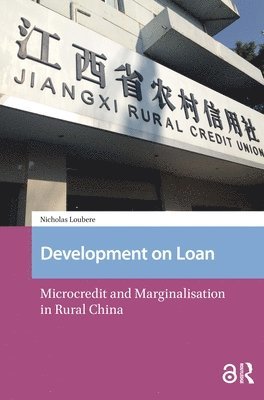
Drawing on in-depth fieldwork in rural China, this book examines the formulation, implementation and outcomes of government-run microcredit programmes in China-illuminating the diverse roles that microcredit plays in local processes of socioeconomic development and the livelihoods of local actors.
Nicholas Loubere is an Associate Senior Lecturer in the Study of Modern China at the Centre for East and South-East Asian Studies, Lund University. His research examines socioeconomic development in rural China, with a particular focus on microcredit and migration.
Recensioner i media
"This is a detailed and thoroughly compelling study that anyone with an interest in the workings of the Chinese economy and society, as well as the impact of microcredit, will simply have to acquire." - Milford Bateman, author of *Why Doesn't Microfinance Work? The Destructive Rise of Local Neoliberalism*
Innehållsförteckning
Front Material 1. Introduction 1.1 Contested and Paradoxical Rural Development in China 1.2 The Rise of the Global Microfinance Movement and the Adoption of Microcredit in Rural China 1.3 Research Questions and Objectives 1.4 Research Methodology and Fieldwork Sites 1.5 Book Outline 2. Rural Financial Services in China: Historical and Literature Review 2.1 The Trajectories and Contours of the Rural Financial Landscape since 1949 2.2 Research on Rural Financial Services in China 2.3 Conclusion 3. Making Microcredit: Policy Formulation and Implementation 3.1 The Formulation of Microcredit Policy 3.2 A Tale of Three Townships: Microcredit Implementation at the Local Level 3.3 Conclusion 4. Variation in Microcredit Implementation: Understanding Heterogeneity from a Relational Perspective 4.1 Differentiated Financial Landscapes and Segmented Financial Markets 4.2 Strategising and Rationalising Pressures and Incentives 4.3 Interpersonal Relationships and Negotiations at the Interface 4.4 Emergence and Complexity in Implementation Outcomes 4.5 Conclusion 5. Microcredit as Modernisation and De-marginalisation 5.1 The Linear Progression Development Paradigm 5.2 Local Interpretations of Microcredit as a Means of De-marginalisation 5.3 Microcredit as De-marginalisation Through Capital, Knowledge, and Technology Transfers 5.4 Microcredit as De-marginalisation Through the Formation of New Socio-political and Socioeconomic Linkages 5.5 Microcredit as De-marginalisation Through Employment, Local Cooperation, and Financial Inclusion 5.6 Microcredit and Local Livelihood Improvement 5.7 Conclusion 6. Microcredit, Precarious Livelihoods and Undercurrents of Marginalisation 6.1 The Unequal Foundations of Development and Relational Marginality 6.2 The Rural-Urban Dichotomy and Relational Marginality in the Chinese Context 6.3 Microcredit as Resource Diversion and Extraction 6.4 Microcredit as Elite Capture and Exclusion 6.5 Microcredit as Precarity, Risk, and Exploitation 6.6 Conclusion 7. Conclusion 7.1 In Summary 7.2 Key Findings 7.3 Directions for Future Research End Material - Bibliography - Interview Lists - Index