• Fri frakt över 249 kr
  • •
  • Snabba leveranser
  • •
  • Billiga böcker
Kundservice

Du är på sajten för privatpersoner.

Företag, bibliotek eller offentlig verksamhet?

Du handlar på classic.bokus.com, där alla dina funktioner finns intakta.
Till classic.bokus.com
Bokus logotyp. Gå till startsidan.
  • Erbjudanden
  • Nyheter
  • Student
  • Topplistor
  • Barn & ungdom
  • Bokus Play
  • E-böcker
  • Pocketböcker
  • Spel & pussel

10% rabatt på allt med kod: NYSTART10 →

Sidfot

Mina sidor

    Hjälp

    • Kundservice
    • Vanliga frågor och svar
    • Frakt och leverans
    • Retur vid ångerrätt
    • Reklamera vara
    • Betalning
    • Köpvillkor
    • Allmänna villkor
    • Information om webbplatsens tillgänglighet

    Om Bokus

    • Om oss
    • Pressrum
    • För studenter
    • För företag
    • För bibliotek och offentlig verksamhet
    • För leverantörer
    • Hållbarhet

    Populärt

    • Aktuella erbjudanden
    • Presentkort
    • Studentlitteratur
    • Nya böcker
    • Topplistor
    • Signerade böcker
    • Engelska böcker

    Inspiration

    • Boktips
    • BookTok
    • Populära bokserier
    • Barnbokskaraktärer
    • Populära författare
    Logotyp för Bokus
    Följ oss på Facebook (extern länk)Följ oss på Instagram (extern länk)Följ oss på YouTube (extern länk)Följ oss på TikTok (extern länk)
    bokus @ CookiesAnpassa cookiesIntegritetspolicyKöpvillkor
    Till Citymail hemsida (extern länk)Till Budbee hemsida (extern länk)Till Postnord hemsida (extern länk)Till Schenker hemsida (extern länk)Till Early Bird hemsida (extern länk)Till Walleys hemsida (extern länk)
    1. Samhälle och politik
    2. Samhälle och kultur
    3. Kultur och medier
    4. Referensverk och tvärvetenskap

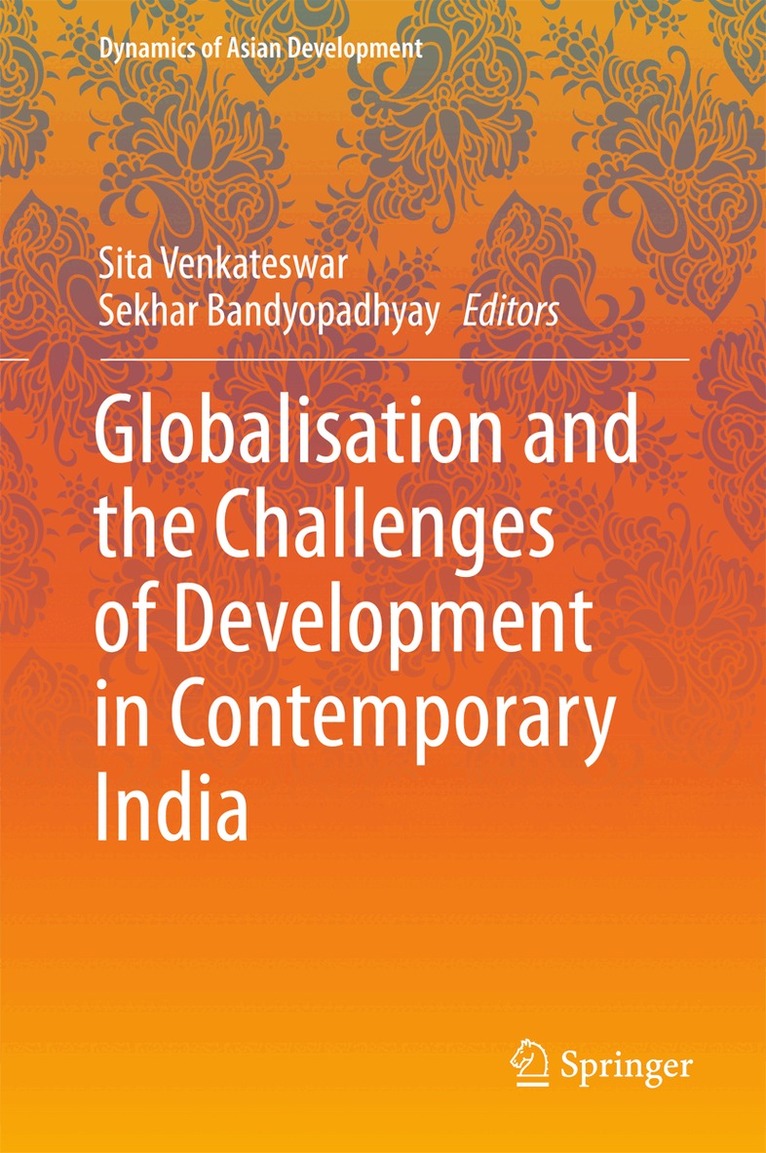
    Globalisation and the Challenges of Development in Contemporary India

    AvSita Venkateswar,Sekhar Bandyopadhyay

    Inbunden, Engelska, 2016

    Del i serien Dynamics of Asian Development

    1 518 kr

    Beställningsvara. Skickas inom 10-15 vardagar. Fri frakt över 249 kr.

    Beskrivning

    This volume brings together multidisciplinary, situated and nuanced analyses of contingent issues framing a rapidly changing India in the 21st century. It moves beyond the ready dichotomies that are often extended to understand India as a series of contrasts and offers new insights into the complex realities of India today, thereby enabling us to anticipate the decades to come.The editors focus on three major themes, each discussed in a section: The first section, Framing the Macro-Economic Environment, defines the framework for interrogatingglobalisation and socio-economic changes in India over the last few decades ofthe 20th century spiraling into India in the 21st century. The next section,Food Security and Natural Resources, highlights critical considerationsinvolved in feeding a burgeoning population. The discussions pose importantquestions in relation to the resilience of both people and planet confrontingincreasingly unpredictable climate-induced scenarios. The final section,Development, Activism and Changing Technologies, discusses some of the socialchallenges of contemporary India through the lens of inequalities and emergentactivisms. The section concludes with an elaboration of the potential and promise of changing technologies and new social media to build an informed and active citizenry across existing social divides.

    Produktinformation

    • Utgivningsdatum:2016-03-30
    • Mått:155 x 235 x 20 mm
    • Vikt:646 g
    • Format:Inbunden
    • Språk:Engelska
    • Serie:Dynamics of Asian Development
    • Antal sidor:270
    • Upplaga:16001
    • Förlag:Springer Verlag, Singapore
    • ISBN:9789811004537

    Utforska kategorier

    • Referensverk och tvärvetenskap inom Samhälle och politik
    • Internationell ekonomi inom Ekonomi och Ledarskap

    Mer om författaren

    Sita Venkateswar is a socio-cultural anthropologist in the School of People, Environment and Planning, Massey University and Associate Director, Massey chapter, New Zealand India Research Institute, New Zealand. Her research documents the ways academic practices can be responsive to social inequities and she incorporates critical feminist scholar-activist research methodologies, designated as Public Anthropology, informed by feminist and postcolonial theories. She uses a comparative and reflexive anthropological lens to address issues of internal colonialism, gender, poverty, social oppression and structural violence within the postcolonial and neoliberal contexts of South Asia. Her ethnography Development and Ethnocide: Colonial Practices in the Andaman Islands (2004) is based on her PhD fieldwork in the Andaman Islands from 1989 to 1992 funded by the National Science Foundation Dissertation Improvement Grant. Her co-edited book, The Politics of Indigeneity: Dialogues and Reflections on Indigenous Activism (2011) published by Zed Books. Her current research explores multi-species approaches to food resilience that focuses on millet cultivation in India.SekharBandyopadhyay is Director, New Zealand India Research Institute, Schoolof History, Philosophy, Political Science & International Relation, NewZealand. Sekhar Bandyopadhyay is Director of the New Zealand India Research Institute and Professor of Asian History at Victoria University of Wellington. His academic specialisation is in social and political history of colonial and postcolonial India. He has also written on the Indian diaspora and India-New Zealand relations in historical times. He has published seven books, eight edited or co-edited books, and more than fifty book chapters and journal articles. In 2009 he was elected a Fellow of the Royal Society of New Zealand. In 2014, for his book Decolonization in South Asia: Meanings of Freedom in Post-independence West Bengal, 1947-52, he was awarded the Rabindra Smriti Puraskar by the Bangla Academy, Government ofWest Bengal.

    Innehållsförteckning

    • Chapter 1. Globalisation and the Challenges of Development: An Introduction- Sekhar Bandyopadhyay and Sita Venkateswar.- Section 1: Framing the Macro environment.- Chapter 2. Compressed Capitalism, Globalization, and the Fate of Indian Development.- Chapter 3. India’s Economic Performance in the Post Reforms Period: A Tale of Mixed Messages.- Chapter 4. Post-Industrial Development and the New Leisure Economy.- Section 2: Food Security.- Chapter 5. India’s Evolving Food and Nutrition Scenario: An Overview.- Chapter 6. Millet in Our Own Voices: A Culturally-Centered Articulation of Alternative Development by DDS Women Farmers’ Sanghams.- Chapter 7. Beyond Basmati: Two Approaches to the Challenge of Agricultural Development in the ‘New India'.- Section 3: Activism, Development and Changing Technologies.- Chapter 8. Investment-Induced Displacement and the Ecological Basis of India’s Economy.- Chapter 9. Urban Neoliberalism and the Right to Water and Sanitation for Bangalore’s Poor.- Chapter 10. Bastis as “Forgotten Places” in Howrah, West Bengal.- Chapter 11. ICT4D and Empowerment: Uneven Development in Rural South India.- Chapter 12 Paradigms of Digital Activism: India and its Mobile Internet Users.- Section 4: Conclusion.- Chapter 13. Approaching Contemporary India: the Politics of Scale, Space and Aspiration in the Time of Modi.